


For an orthopedic device manufacturer, FDA 510(k) approval — or its heavyweight sibling, PMA — is the moment the American market actually opens. The FDA’s two main premarket pathways, the 510(k) premarket notification and Premarket Approval, exist to make one thing certain: no device reaches a patient without meeting stringent safety and effectiveness standards.
Choosing between them isn’t academic. The 510(k) route runs on substantial equivalence to a predicate device and takes months; the PMA route demands clinical trials and takes years. Pick the wrong pathway at the start and you’ll discover it around month ten, with a submission you can’t salvage. Pick the right one, and the whole regulatory program follows logically.
This guide walks through FDA device classification, both approval pathways in full, the strategic moves that shorten reviews, and the pitfalls that sink submissions. For the bigger picture across all jurisdictions, start with our complete orthopedic device regulatory compliance guide.
🗂️ Understanding FDA Device Classification
The Three-Class System Behind FDA 510(k) Approval
Everything starts with classification, because the device’s risk class dictates the pathway.
Class I (low risk): general controls only — crutches, bed rails, manual surgical instruments. Fully 95% are exempt from premarket notification, though registration, listing, and quality system compliance still apply.
Class II (moderate risk): where most orthopedic products live — powered surgical instruments, orthopedic implants, bone screws. These require general and special controls, and most need 510(k) clearance, with performance standards and post-market surveillance attached.
Class III (high risk): novel orthopedic implants and bone graft materials that sustain or support life. PMA territory, with clinical trials typically required.
How Classification Is Determined
Classification hinges on intended use and indications, technological characteristics, risk to patient and user, comparison to predicate devices, and technological novelty. The tools to figure it out are public: the FDA Product Classification Database, 21 CFR Part 888 (the regulation dedicated to orthopedic devices), FDA guidance documents, and — most underused of all — pre-submission meetings, where FDA staff will tell you the answer before you spend a year guessing.
📋 The 510(k) Premarket Notification Process
510(k) Overview: The Substantial Equivalence Principle
Roughly 90% of FDA device clearances each year run through the 510(k) pathway — and it’s built on a single concept: substantial equivalence. You must demonstrate that your device matches a legally marketed predicate device in intended use and technological characteristics, or that any differences don’t raise new questions of safety and effectiveness.
That word “predicate” is doing heavy lifting. A good predicate is the difference between a six-month clearance and a two-year odyssey — more on choosing one in the strategy section below.
The Three Types of 510(k) Submissions
Not all 510(k)s are the same animal:
- Traditional 510(k) — the standard submission with full predicate comparison and a 90-day review clock
- Special 510(k) — for device modifications by the same manufacturer, leaning on design control documentation; review runs about 30 days
- Abbreviated 510(k) — relies on FDA-recognized consensus standards and summary reports for reduced documentation and a streamlined review
What FDA 510(k) Approval Requires: The Submission Package
A complete 510(k) is a structured story told in five chapters:
- Administrative information: device name, classification, applicant details, indications for use
- Device description: specifications, engineering drawings, materials, manufacturing processes, software documentation
- Substantial equivalence comparison: predicate identification, a side-by-side comparison table, and an honest analysis of similarities and differences
- Performance data: bench testing, biocompatibility per ISO 10993, sterilization validation, shelf-life testing, plus electrical safety and software validation where applicable
- Labeling: proposed labels, instructions for use, package labeling, and promotional materials
Incomplete submissions die young — the next section explains exactly how.
The FDA 510(k) Approval Review: From Acceptance to Clearance
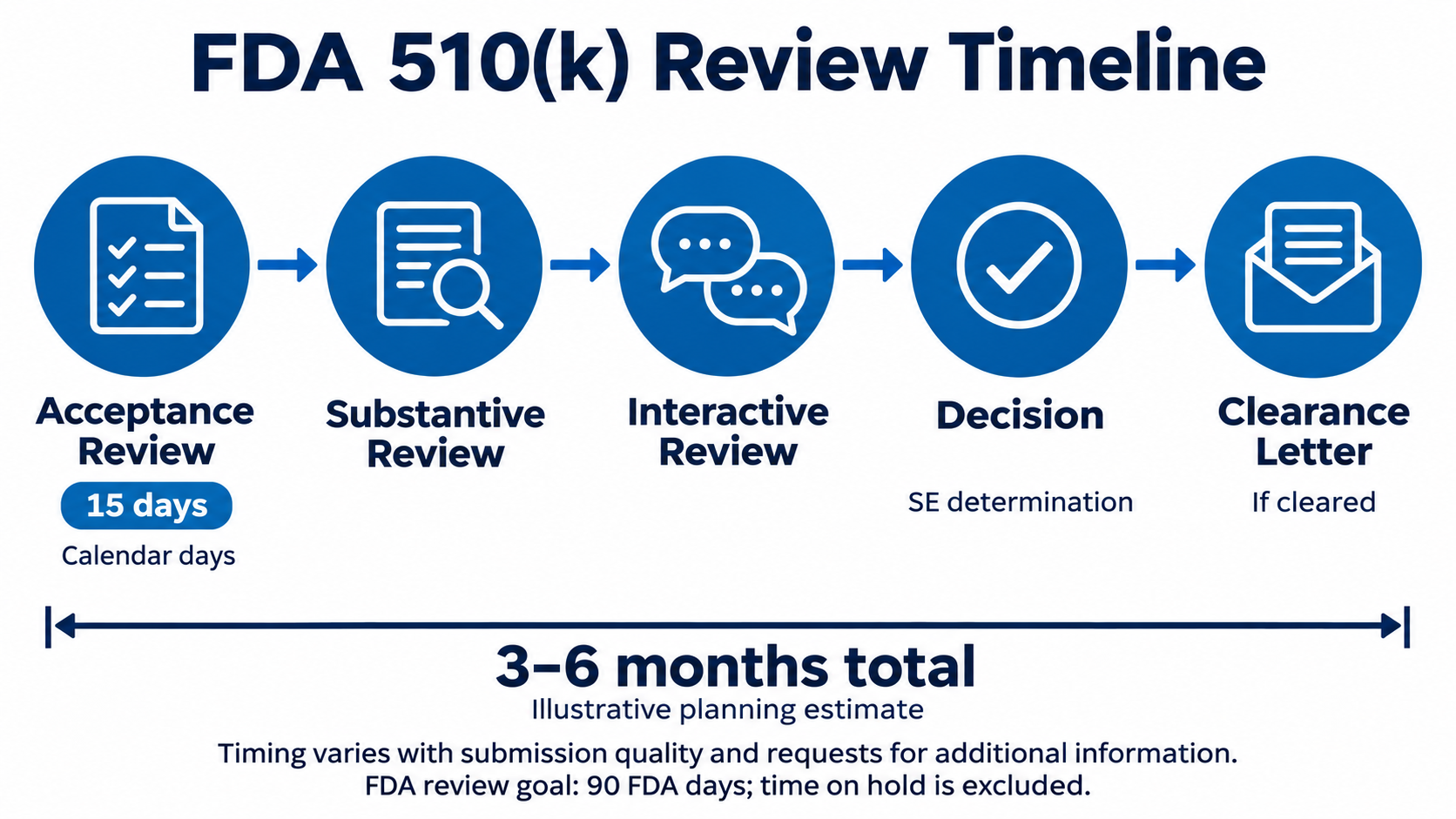
Review proceeds in stages. Acceptance review (15 days): an administrative completeness check — fail it and you get a Refuse to Accept (RTA) letter before the science is even looked at. Substantive review: scientific and regulatory scrutiny, with interactive review, additional information requests, and deficiency letters along the way. Decision: a clearance letter declaring the device substantially equivalent, a Not Substantially Equivalent (NSE) letter, or your withdrawal option.
Timeline expectations: simple devices clear in 2–3 months, the average runs 3–6 months, and complex devices can stretch to 6–12. You can verify any predicate or competitor’s history yourself in the FDA 510(k) database — free and public.
🧪 The PMA Approval Process
PMA Overview: The Highest Bar
The PMA pathway is reserved for Class III devices that can’t demonstrate substantial equivalence — or that simply warrant the highest level of scrutiny. The FDA demands valid scientific evidence and a reasonable assurance of safety and effectiveness, which in practice means clinical trials, a manufacturing facility inspection, and usually an advisory panel review.
PMA Application Components
A PMA is a dossier of everything: administrative sections (device description, indications, clinical study summaries), technical sections (manufacturing information, quality system documentation, non-clinical laboratory studies, biocompatibility, sterilization, software), clinical investigations (IDE studies, protocols, statistical analysis, adverse event reporting), and draft labeling with patient information.
Clinical Trial Requirements Under the PMA Approval Process
The clinical machinery starts before any patient is enrolled. An IDE (Investigational Device Exemption) requires FDA approval for the trial itself, plus IRB approval, informed consent procedures, Good Clinical Practice compliance, and ongoing monitoring and reporting.
Study design follows clinical science best practice: prospective controlled studies preferred, randomization and blinding where appropriate, well-chosen endpoints, and honest statistical power calculations. The phases run from feasibility studies (early safety), through pivotal studies (safety and effectiveness), to continued access and post-approval studies. You can browse real approved PMAs — with their trial designs — in the FDA PMA database.
PMA Review: Timeline and Decision Points
Filing review (45 days) checks administrative completeness — refuse-to-file letters go out early. Then interactive review begins: in-depth scientific review, an advisory panel meeting if required, facility inspection, deficiency letters, and amendments. The decision comes as an approval order, an approvable letter (minor deficiencies remain), a not-approvable letter, or a denial.
Timeline expectations: the initial review is 180 FDA days, but the total process runs 1–3 years — panel reviews and inspections add real time.
🎯 Strategic Considerations
Predicate Device Selection: The Highest-Leverage Decision
The single most consequential choice in a 510(k) is the predicate. A good one shares your intended use and technological characteristics, is legally marketed in the U.S., has no unaddressed safety issues, and was cleared recently. Multiple predicates are acceptable — one primary for substantial equivalence, additional ones for specific features — but each adds complexity to the comparison story.
No predicate available? The exits are the de novo classification pathway, a down-classification petition, or PMA if the device is genuinely high-risk.
Pre-Submission (Q-Sub) Meetings: Cheap Insurance
A Q-Sub buys early FDA feedback for a fraction of the cost of a failed submission. The menu includes pre-submission meetings, informational meetings, study risk determinations, and formal early collaboration meetings. Benefits: regulatory strategy alignment, shorter reviews, fewer deficiency letters. Preparation matters — bring specific questions, supporting documentation, proposed indications, and preliminary data. Manufacturers who skip Q-Subs aren’t brave; they’re just paying full price for information that was available for free.
Common Pitfalls That Delay FDA 510(k) Approval
Four failure patterns account for most delays:
- Inadequate predicate comparison — the fix is a detailed side-by-side analysis that addresses all differences and explains why each one doesn’t affect safety or efficacy
- Insufficient performance data — build a comprehensive testing plan following recognized standards, including worst-case testing
- Poorly defined indications — write clear, specific indications that match predicate language; avoid overly broad claims
- Inadequate risk analysis — comply with ISO 14971 with a comprehensive hazard analysis and documented risk controls
📮 Post-Market Requirements
Medical Device Reporting (MDR)
Clearance isn’t the finish line — it’s the starting whistle. Medical Device Reporting requires 5-day reports for serious events, 30-day reports for malfunctions, annual reports for certain devices, and user facility reporting. Reportable events include deaths, serious injuries, malfunctions likely to cause harm, and removals or corrections. Every cleared device carries this obligation for its entire commercial life.
Quality System Regulation and Inspection Readiness
Under 21 CFR Part 820, manufacturers maintain design controls, manufacturing controls, CAPA procedures, document controls, and management responsibility — and the FDA will come check. Routine inspections use the QSIT (Quality System Inspection Technique) approach, for-cause inspections follow any signal of trouble, and the potential endpoint of a poor inspection is a warning letter. Inspection readiness is a permanent state, not a project.
⚖️ Comparison: 510(k) vs. PMA
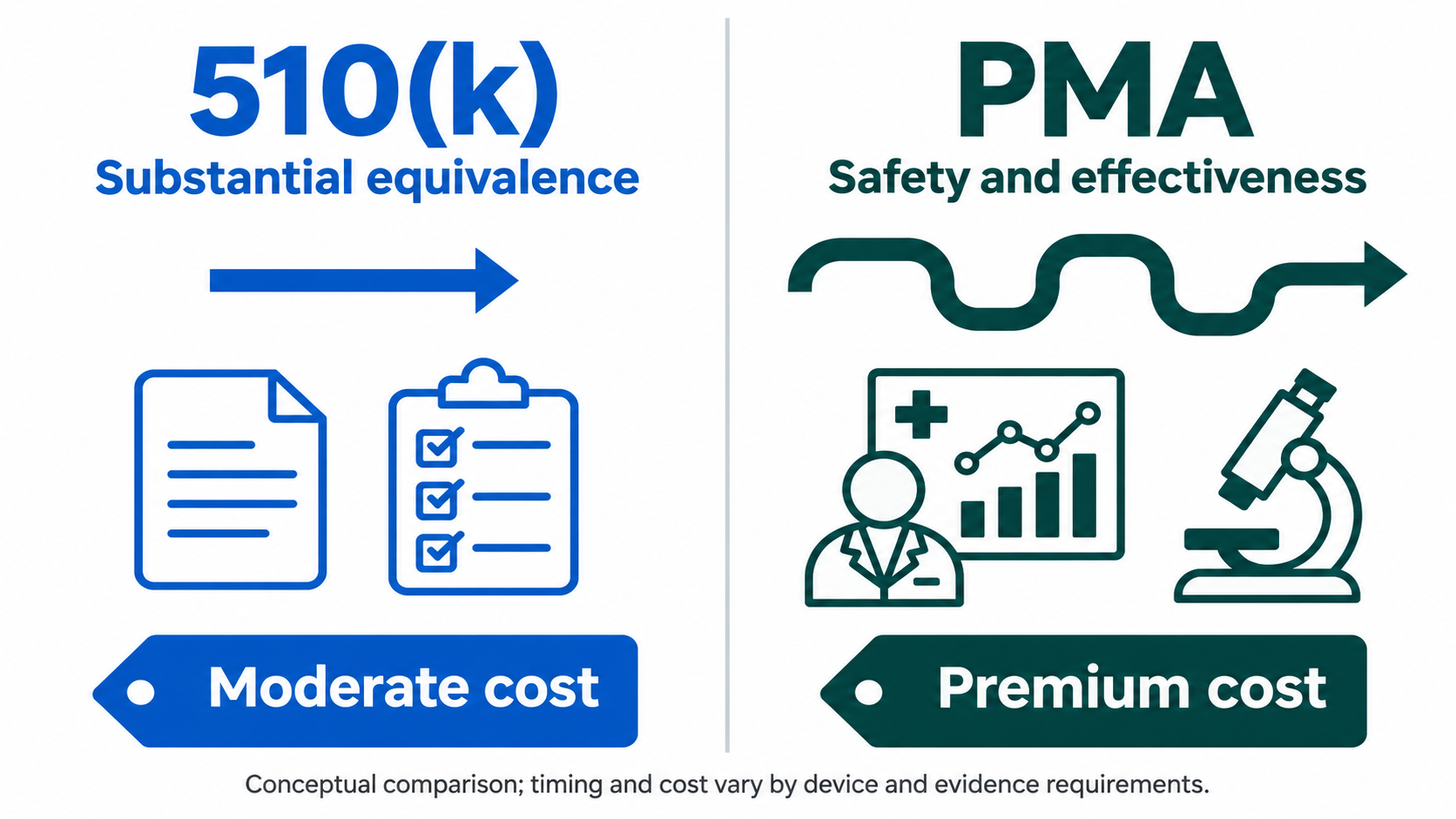
| Aspect | 510(k) | PMA |
|---|---|---|
| Device Class | Class I & II | Class III |
| Clinical Data | Usually not required | Typically required |
| Timeline | 3–6 months average | 1–3 years |
| Cost | 50,000–50,000–200,000+ | 500,000–500,000–5,000,000+ |
| Review Standard | Substantial equivalence | Reasonable assurance |
| Facility Inspection | Not routine | Required |
| Panel Review | Rare | Often required |
| Post-Market Studies | Sometimes | Often required |
The takeaway from the table: a 510(k) and a PMA aren’t two speeds of the same process — they’re different sports entirely, with different costs, timelines, and evidentiary philosophies. Pathway strategy is product strategy. For the parallel European system, see our EU MDR CE marking guide, and for the quality system underneath both, the ISO standards and quality management guide.
❓ Frequently Asked Questions
Q1: How much does it cost to get FDA clearance for an orthopedic device?
A: 510(k) submissions typically run 50,000–50,000–200,000 including testing, consulting, and FDA fees; PMAs cost 500,000–500,000–5,000,000+ due to clinical trials. FY2026 FDA user fees are roughly 22,000fora510(k)and22,000fora510(k)and365,000 for a PMA, plus biocompatibility testing (20,000–20,000–100,000) and sterilization validation (10,000–10,000–50,000).
Q2: Can I use clinical data from outside the United States for FDA approval?
A: Yes — FDA accepts foreign data if it’s applicable to the U.S. population, conducted under GCP, and ethically performed with proper informed consent. FDA may still require U.S. studies for certain devices, particularly PMAs. The FDA guidance on acceptance of foreign clinical studies details the requirements.
Q3: What happens if my 510(k) submission is rejected?
A: An NSE determination opens several doors: a new 510(k) with better data or a different predicate, the de novo pathway if no predicate exists, a PMA if the device is high-risk, or modifying the device to match a predicate more closely. You can also request a meeting with FDA to discuss paths forward.
Q4: How do I know if my device needs a 510(k) or PMA?
A: Classification decides. Check the FDA Product Classification Database using intended use and technology: Class I is usually exempt, Class II typically needs 510(k), Class III needs PMA. Novel devices without predicates may qualify for de novo. Pre-submission meetings confirm the pathway before you commit.
Q5: What is the de novo classification pathway?
A: It’s for novel low-to-moderate risk devices without a predicate that don’t warrant full PMA. After an initial NSE determination, request de novo classification; if granted, FDA creates a new classification regulation and your device becomes the predicate for future 510(k)s. The pathway takes 120–150 days after NSE and is increasingly used for innovative orthopedic technologies.
Q6: Can I market my device while FDA review is pending?
A: Generally, no — marketing without clearance violates the Federal Food, Drug, and Cosmetic Act. Exceptions include investigational devices under an approved IDE, export-only devices, custom device exemptions, and humanitarian use devices. Marketing early risks warning letters, seizures, and prosecution.
🏁 The Bottom Line
The FDA 510(k) approval process rewards preparation and punishes improvisation. Get the classification right, choose the predicate with care, run a Q-Sub before committing, and the 510(k) becomes a manageable 3–6 month project. Take the substantial equivalence shortcut on a genuinely novel device, and you’ll meet the PMA approval process the hard way — a year in, with data you can’t reuse.
The comparison table says it plainly: different pathways, different sports. Know which game you’re playing before the clock starts. For the full regulatory map across jurisdictions, return to the orthopedic device regulatory compliance hub.
Medical Disclaimer
The information provided is for educational purposes only and does not constitute legal or regulatory advice. FDA regulations change frequently, and consultation with regulatory affairs professionals is essential for specific submission strategies.



 English
 Arabic
 French
 German
 Italian
 Japanese
 Korean
 Portuguese
 Turkish
 Russian
 Spanish