


Orthopedic device regulatory compliance is the gate between a great product and a sellable one. Every implant, power tool, and external fixator has to clear stringent safety, efficacy, and quality standards before it reaches a patient — and those standards keep getting more demanding.
The landscape is genuinely multi-jurisdictional. The U.S. FDA, the European Union’s Medical Device Regulation (MDR), and a network of international standards organizations each set their own benchmarks, and a manufacturer selling globally has to satisfy all of them without losing its mind — or its margin. Understanding these frameworks is essential for manufacturers, distributors, and healthcare providers anywhere in the orthopedic device supply chain.
This guide walks through the six major frameworks, the quality systems underneath them, clinical evaluation requirements, and the harmonization trends reshaping global market access. If you’re still mapping the market itself, start with our global orthopedic devices market overview.
🇺🇸 United States FDA Regulations
FDA Classification: Where Orthopedic Device Regulatory Compliance Begins
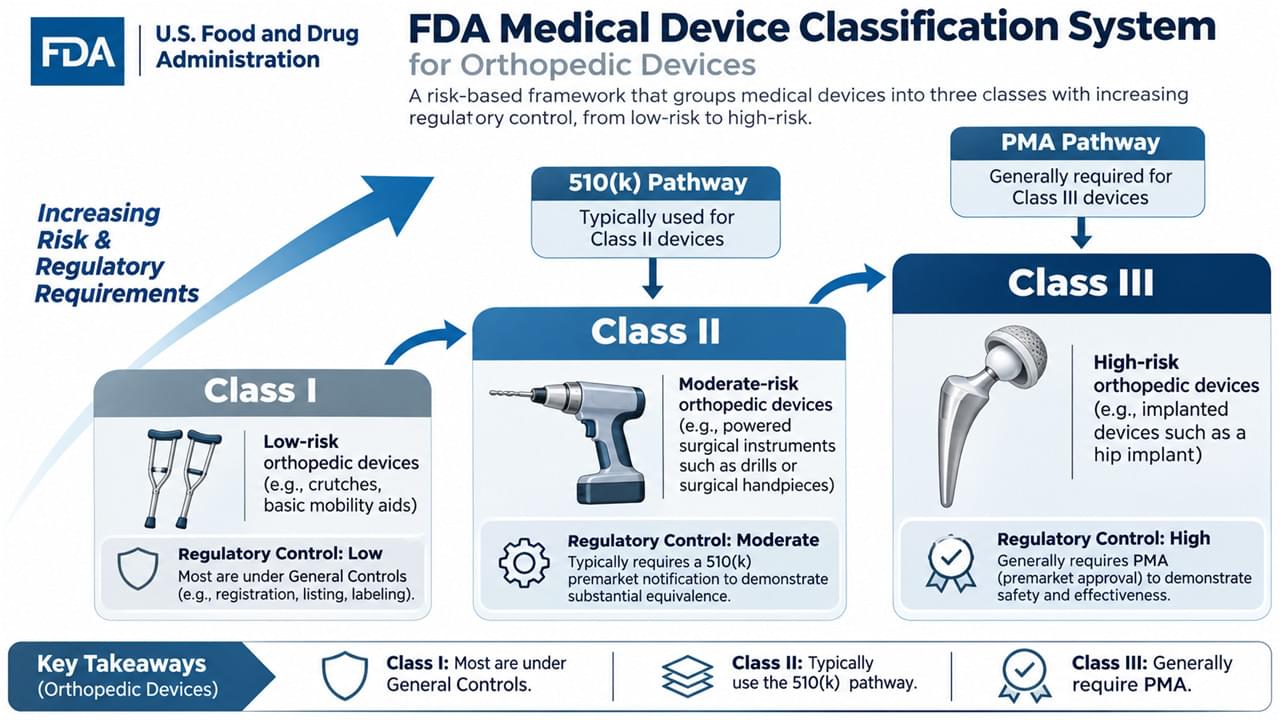
The FDA sorts medical devices into three risk-based classes, and the class determines everything downstream.
Class I (low risk): general controls only — think crutches, bed rails, and manual surgical instruments. Most are exempt from premarket notification, though registration and listing are still required.
Class II (moderate risk): special controls apply, and this is where most orthopedic products live — powered surgical instruments, orthopedic implants, diagnostic equipment. A 510(k) premarket notification is typically required, along with performance standards and post-market surveillance.
Class III (high risk): the most stringent pathway. Novel orthopedic implants and life-sustaining devices need Premarket Approval (PMA) with clinical trial data.
The 510(k) Pathway for Orthopedic Device Regulatory Compliance
The 510(k) is the most common route to the U.S. market, and it hinges on one idea: substantial equivalence to a legally marketed predicate device — same intended use, same technological characteristics, or different characteristics that don’t raise new safety or efficacy questions.
A complete submission includes device description and specifications, indications for use, the predicate comparison, performance testing data, biocompatibility information, sterilization and shelf-life data, and software documentation where applicable. Standard review runs 90 FDA days, with interactive review and additional-information requests being the norm rather than the exception. Earning FDA 510(k) clearance is a milestone — but only the first one.
Premarket Approval (PMA) for High-Risk Devices
When a device is genuinely novel and high-risk, PMA is the price of admission. The FDA demands valid scientific evidence — clinical trials are typically required — plus manufacturing facility inspection, panel review for novel devices, and post-approval studies that often run for years.
The clinical trial machinery itself is regulated: an IDE (Investigational Device Exemption) for the trial, Good Clinical Practice compliance, IRB oversight, informed consent procedures, and adverse event reporting throughout. Budget accordingly — this pathway is measured in years and millions of dollars.
Quality System Regulation: 21 CFR Part 820
FDA’s quality system requirements ensure manufacturing stays consistent long after the clearance letter arrives. 21 CFR Part 820 covers design controls, document controls, purchasing controls, identification and traceability, production and process controls, acceptance activities, nonconforming product procedures, CAPA, labeling and packaging, handling and distribution, records, servicing, and statistical techniques.
In plain terms: the FDA isn’t just reviewing what you make — it’s auditing how you make it, forever.
🇪🇺 European Union Medical Device Regulation (MDR)
MDR Overview: A Hard Reset for EU Market Access
Regulation (EU) 2017/745 replaced the old MDD in May 2021, and the industry still talks about it like a weather event. The changes were structural: expanded device scope, stricter clinical evidence requirements, a mandatory Unique Device Identification (UDI) system, enhanced post-market surveillance, much tighter Notified Body oversight, and the EUDAMED database rollout.
Device Classification Under EU MDR Conformity Assessment
The MDR uses four risk classes:
- Class I (low risk): non-invasive devices like crutches, wheelchairs, and reusable surgical instruments — self-certified, though sterile (Is), measuring (Im), and reusable (Ir) variants pull in a Notified Body
- Class IIa (medium risk): short-term invasive devices, including external fixators — Notified Body conformity assessment required
- Class IIb (higher medium risk): long-term invasive devices like joint prostheses and spinal implants — clinical evaluation included
- Class III (high risk): absorbable implants and active implantable devices — full quality assurance system and typically clinical trial data
Conformity Assessment Procedures
The EU MDR conformity assessment runs on two rails. First, technical documentation: device description, manufacturing information, a risk management file per ISO 14971, the clinical evaluation report, a post-market surveillance plan, and labeling with instructions for use. Second, Notified Body involvement: selection, quality system audit, technical documentation review, clinical evaluation assessment, CE certificate issuance, and annual surveillance audits after that.
The official requirements live on the European Commission’s medical devices portal — worth bookmarking, because guidance updates land there first.
Clinical Evaluation Requirements
The MDR’s sharpest teeth are in clinical evidence. The Clinical Evaluation Report (CER) demands a systematic literature review, analysis of clinical data, a state-of-the-art assessment, risk-benefit analysis, and post-market clinical follow-up planning. Clinical investigations become necessary for novel devices, high-risk implantables, significant design changes, and new intended uses.
Translation from anyone who lived through the transition: the era of paper-thin clinical justification is over.
🌐 International Standards
ISO 13485: The Backbone of Orthopedic Device Regulatory Compliance
ISO 13485 is the internationally recognized standard for medical device quality management — and while no law on earth universally mandates it, market access practically does. The certification journey runs through gap analysis, implementation planning, documentation development, internal audits, the certification body audit, and annual surveillance audits thereafter.
Its requirements span quality management system documentation, management responsibility, resource management, product realization, measurement and improvement, risk management integration, and regulatory compliance. For most markets, ISO 13485 certification is the ticket that gets checked first.
ISO 14971: Risk Management as a Discipline
Risk management is the connective tissue of device safety, and ISO 14971 defines the process: risk analysis (hazard identification), risk evaluation, risk control, residual risk assessment, the risk management report, and post-production information feeding back into the loop.
Applied to orthopedic devices, the hazard catalog is familiar: biocompatibility risks, mechanical failure risks, surgical procedure risks, long-term implant risks — all weighed in a formal risk-benefit determination.
Product-Specific Standards
Beyond the systems standards, orthopedic products answer to a family of technical standards:
- ISO 5832 — metallic materials: stainless steel, cobalt-chromium, and titanium alloys with mechanical property requirements
- ISO 5833 — acrylic bone cement: composition, mechanical properties, testing, and labeling
- ISO 6018 — orthopedic implants: general requirements, marking, packaging, and sterilization
These documents rarely make headlines, but they’re what implant materials are actually tested against.
🤝 Global Regulatory Harmonization
IMDRF: The World’s Regulators Talking to Each Other
The International Medical Device Regulators Forum (IMDRF) is where convergence happens — its members include the FDA, the European Commission, Health Canada, Australia’s TGA, Japan’s PMDA, China’s NMPA, and Brazil’s ANVISA. The forum’s harmonization work covers Unique Device Identification, device nomenclature, clinical evaluation guidelines, post-market surveillance, and quality management systems. Its output shapes national regulations years before they’re formally adopted.
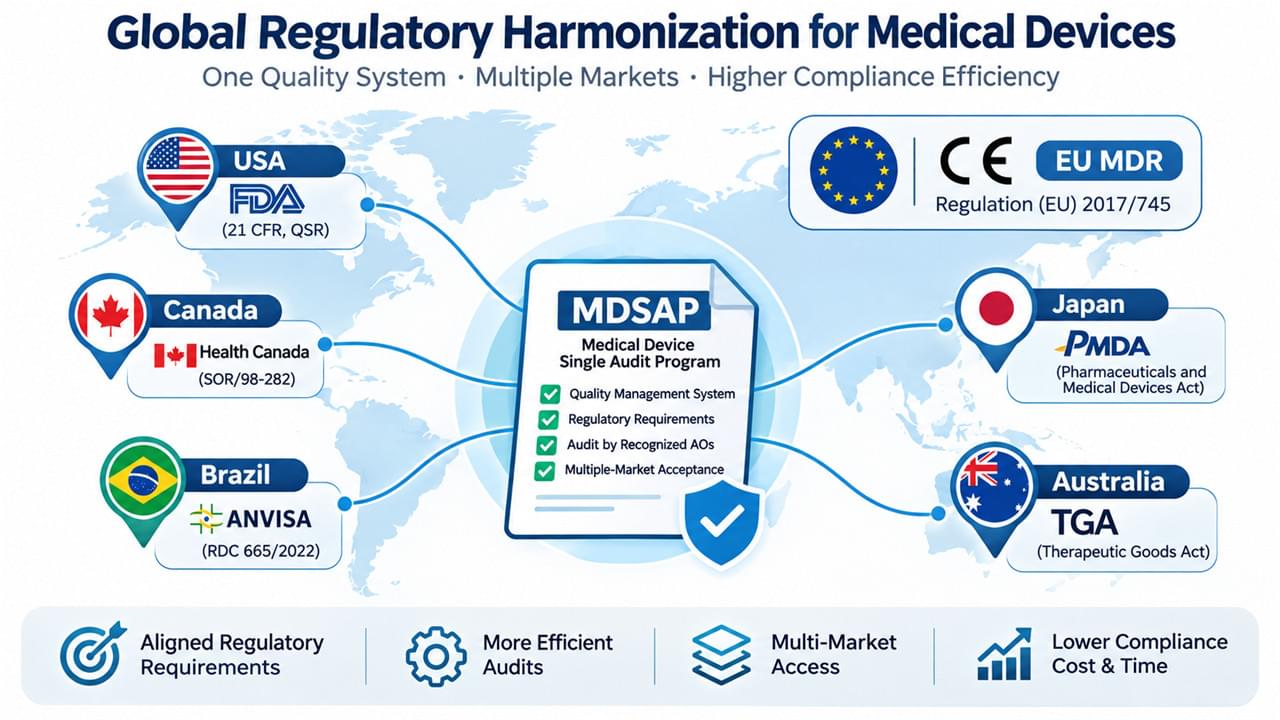
MDSAP: One Audit, Five Regulators
The Medical Device Single Audit Program is harmonization you can bill for. A single third-party audit satisfies the quality system requirements of the FDA, Health Canada, TGA, ANVISA, and PMDA simultaneously — comprehensive quality system assessment, regulatory requirement verification, and audit reports shared among authorities. For manufacturers selling into multiple MDSAP markets, one audit replaces five. The math is not close.
Regional Frameworks Beyond the US and EU
China NMPA: Class I–III classification, separate domestic and imported device pathways, clinical trial requirements, and quality system requirements.
Japan PMDA: pre-market approval, foreign manufacturer registration, quality management, and post-market surveillance.
Health Canada: Medical Device License (MDL) plus a quality system certificate, with its own classification system and post-market requirements.
Same planet, different rulebooks — which is exactly why regulatory intelligence matters.
📡 Post-Market Surveillance
Vigilance Reporting in Orthopedic Device Regulatory Compliance
Getting to market is half the job; staying there is the other half. FDA requirements include Medical Device Reporting with 30-day reports for malfunctions, 5-day reports for serious events, and annual reports for certain devices. The EU vigilance system adds serious incident reporting, field safety corrective actions, periodic safety update reports, and trend reporting. Underneath both, IMDRF adverse event guidelines push the world toward common reporting formats and shared signal detection.
Post-Market Clinical Follow-up (PMCF)
Under EU MDR, a PMCF plan isn’t optional — it’s mandatory. Manufacturers must actively collect clinical data, monitor device performance, and reassess the risk-benefit balance on an ongoing basis. The methods include registry participation, clinical studies, published literature review, and complaint analysis. Think of it as the clinical evaluation report that never stops being written.
CAPA: Corrective and Preventive Action
The CAPA system is where quality problems get hunted down: nonconformance identification, root cause analysis, corrective action implementation, preventive action planning, effectiveness verification, and documentation and review. A regulator’s first question after any incident is always “show me the CAPA file” — make sure there’s one to show.
🔮 Emerging Regulatory Trends
Digital Health and Software as Medical Device
Software is rewriting the rulebook. Software as a Medical Device (SaMD) carries its own standalone regulations, risk-based classification, clinical evaluation requirements, and — increasingly urgent — cybersecurity considerations. Artificial intelligence goes further: machine learning algorithms and continuous learning systems challenge regulators’ assumptions about fixed products, and validation, verification, and dedicated regulatory pathways are still being invented in real time.
3D Printing and Custom Devices
Patient-specific implants are moving from novelty to norm, dragging custom device regulations, manufacturing quality control, design validation requirements, and clinical evidence needs behind them. Point-of-care manufacturing — hospital-based 3D printing — raises the thorny question of who carries regulatory responsibility when the “manufacturer” is a hospital. The detailed rules are still settling; see our orthopedic implants guide for how manufacturing technology is reshaping the products themselves.
Real-World Evidence
Regulators are learning to love data from outside the trial. Real-world evidence — registry data, claims analysis, electronic health records, post-market study designs — is gaining formal acceptance through FDA guidance development and EMA qualification opinions, with methodological standards and data quality requirements maturing alongside. Expect RWE to carry more weight in both approval and post-market decisions each year.
✅ Compliance Strategy and Best Practices
Regulatory Strategy Development
Winning companies treat orthopedic device regulatory compliance as strategy, not paperwork. Market entry planning starts with target market identification, regulatory pathway selection, timeline and resource planning, and honest risk assessment. Quality system implementation follows with management commitment, resource allocation, process documentation, training programs, and internal audit schedules. The companies that skip the strategy phase don’t skip the cost — they just pay it later, with interest.
Regulatory Intelligence
Requirements change monthly, and yesterday’s guidance can quietly invalidate today’s submission. Effective monitoring covers regulatory change tracking, guidance document updates, standards revisions, and competitive intelligence. On the human side: regulatory affairs certification, industry conferences, professional association membership, and continuing education keep the team sharp. Manufacturers considering outsourcing production should also read our OEM and ODM manufacturing guide — the regulatory responsibilities don’t transfer with the contract.
❓ Frequently Asked Questions
Q1: How long does it take to get FDA clearance for an orthopedic device?
A: It depends on the pathway. 510(k) clearances typically take 3–6 months, though complex submissions run longer. PMA approvals require 1–3 years due to clinical trials, and de novo classifications fall in between. Early FDA engagement through pre-submission meetings helps optimize the process.
Q2: What’s the difference between CE marking under MDD and MDR?
A: The MDR replaced the MDD in May 2021 with far stricter requirements: expanded scope, tougher clinical evidence, mandatory UDI, enhanced post-market surveillance, rigorous Notified Body oversight, and the EUDAMED database. Legacy MDD-certified devices can stay on the market until certificate expiration but must transition to MDR.
Q3: Do I need separate regulatory approvals for each country?
A: Generally, yes — though harmonization helps. The EU MDR covers all member states plus EFTA through a single CE marking, MDSAP consolidates audits across five authorities, and some countries offer abbreviated pathways for FDA/CE-approved devices. Verify each target market’s specific requirements.
Q4: What is ISO 13485 certification, and is it required?
A: ISO 13485 is the international standard for medical device quality management systems. Not universally mandated by law, but practically mandatory: the EU MDR requires Notified Body quality system certification, the FDA’s QSR aligns closely with it, and most other major markets require or recognize it.
Q5: What clinical data is required for orthopedic device approval?
A: It varies by classification, novelty, and pathway. Class II devices with solid predicates may rely on literature-based evaluations; novel or high-risk devices typically need clinical investigations. The EU MDR demands more robust evidence than previous directives, and the FDA may require trials for PMA or certain 510(k) submissions. Engage regulatory professionals early.
Q6: How do I maintain regulatory compliance after market approval?
A: Through ongoing vigilance: adverse event reporting, post-market surveillance, quality system maintenance, regulatory change monitoring, periodic audits, complaint handling, CAPA implementation, and label updates. The EU MDR specifically requires PMCF and Periodic Safety Update Reports. Robust quality systems and regulatory intelligence processes keep you compliant for the long haul.
🏁 The Bottom Line
Orthopedic device regulatory compliance is not one framework — it’s six, layered: FDA classification and its 510(k)/PMA pathways, the EU MDR’s conformity assessment machine, the ISO standards underneath (13485 for quality, 14971 for risk), global harmonization through IMDRF and MDSAP, post-market surveillance obligations that never sleep, and an emerging layer of rules for software, 3D printing, and real-world evidence.
The manufacturers who thrive treat compliance as a competitive moat rather than a tax. Build the quality system first, wire clinical evidence into the product lifecycle from day one, automate the regulatory intelligence, and the approvals stop being battles — they become process. For the products at the center of it all, explore the complete global orthopedic devices market guide.
Medical Disclaimer
The information provided is for educational purposes only and does not constitute legal or regulatory advice. Regulatory requirements change frequently, and professional consultation with regulatory affairs specialists is essential for specific compliance decisions.


 English
 Arabic
 French
 German
 Italian
 Japanese
 Korean
 Portuguese
 Turkish
 Russian
 Spanish