


Orthopedic implant materials form the silent foundation of orthopedic device performance. Selecting the right material is the defining factor between an implant that performs flawlessly for decades and one that fails catastrophically within years. For device manufacturers, materials engineers, and hospital procurement teams, mastering the mechanical properties, biological compatibility, and cost dynamics of these materials is crucial for ensuring clinical success.
This guide is part of our extensive master class: Orthopedic Implants: Types, Materials & Manufacturing Technologies.
🛠️ Critical Criteria for Sourcing Implant Materials
Surgical implants must withstand a brutal biological environment while enduring millions of high-stress loading cycles without cracking. The criteria for picking these components include:
- Biocompatibility & Safety: Zero toxic, inflammatory, or adverse immune reactions in human tissues per the rigorous ISO 10993 series standards.
- Mechanical Integrity & Fatigue Resistance: Excellent structural resilience to bear weight over long life cycles.
- Corrosion Resistance: The ability to withstand continuous exposure to highly corrosive bodily fluids.
- Osseointegration Capacity: Promoting natural bone growth onto the surface for permanent structural fixation.
- Advanced Diagnostics Compatibility: Minimizing distortion or risks during post-operative MRI and CT scans.
🔬 Deep-Dive: 5 Vital Orthopedic Implant Materials
1. Titanium Alloys: The Structural Powerhouse
Titanium alloys remain the unquestioned industry gold standard for load-bearing skeletal applications. Among them, Ti-6Al-4V (Grade 5) and its premium counterpart Ti-6Al-4V ELI (Extra-Low Interstitial) dominate production lines.
🌟 Key Benefits of Titanium Orthopedic Implants
- Biocompatibility: Features a natural titanium dioxide passive layer that resists corrosion and naturally encourages rapid osseointegration.
- Optimized Elasticity: Offers a modulus of elasticity (~110 GPa) that sits closer to human bone than stainless steel, significantly decreasing stress shielding.
- Diagnostic Ease: Provides excellent MRI-conditional safety profiles with minimal image artifacts.
Common Clinical Applications: Femoral stems, tibial trays, hip acetabular shells, trauma bone plates, and high-strength pedicle screws.
2. Cobalt-Chrome Alloys: The Ultimate Bearing Surface
When joint replacements require extreme hardness and fluid, frictionless movement, cobalt chrome orthopedic solutions are the premium choice. Comprising cobalt, chromium, and molybdenum (per ASTM F75 and F1537), these alloys are built for articulating surfaces.
🌟 High-Performance Wear Resistance
- Extreme Hardness: Reaches roughly 35 HRC, protecting critical joint surfaces against abrasive scratches.
- High Modulus: Its stiff structure (~230 GPa) provides massive structural strength but requires careful engineering to manage stress shielding risks.
Common Clinical Applications: Total knee replacement femoral components, sliding hip joints, and specialized high-stiffness spinal rods.
3. PEEK: The Flexible Polymer Revolution
Polyether ether ketone (PEEK) has radically changed the landscape of modern spinal surgeries. This high-performance polymer stands toe-to-toe with metal alternatives by matching unique anatomical properties.
🌟 Clinical Advantages of PEEK Spinal Implants
- Radiolucency: Completely transparent under X-ray and CT scans, enabling surgeons to easily track bone fusion progress without visual obstruction.
- Bone-Mimicking Modulus: Boasting a flexural modulus of ~3.6 GPa, it matches human cortical bone closely, preventing bone degradation around the implant site.
💡 Pro-Tip: Because PEEK is inherently hydrophobic, premium variations feature titanium plasma-sprayed or hydroxyapatite (HA) coatings to boost bone bonding.
Common Clinical Applications: Spinal interbody fusion cages (including TLIF, PLIF, and ALIF designs) and specialized vertebral body replacements.
4. Stainless Steel 316L: The Rugged Trauma Workhorse
While it faces tough competition from titanium, 316L medical-grade austenitic stainless steel remains a staple for temporary structural fixes. Governed globally by the strict ISO 5832-1 standard, it delivers excellent mechanical toughness.
🌟 Cost-Effective Mechanical Power
- Highly Economical: Significantly more affordable to source and machine than titanium or cobalt-chrome.
- High Yield Strength: Ranging from 170 to 690 MPa, it offers great temporary stabilization. However, its high nickel content requires screening for patient allergies.
Common Clinical Applications: Internal trauma fixation plates, temporary bone screws, K-wires, and structural Steinmann pins.
5. Ultra-High Molecular Weight Polyethylene & Bio-ceramics
These specialized materials complete modern joint reconstruction assemblies. Highly Cross-Linked Polyethylene (XLPE) and Vitamin E-stabilized variations serve as ultra-low-friction liners in joint components, cutting down wear particles by over 90%.
Meanwhile, Zirconia-Toughened Alumina (ZTA) ceramics are highly favored for premium ceramic femoral heads due to their extreme hardness and inert biological profile. Additionally, plasma-sprayed Hydroxyapatite (HA) coatings act as direct bioactive bonding agents on structural metal surfaces.
📊 Comprehensive Comparison Matrix
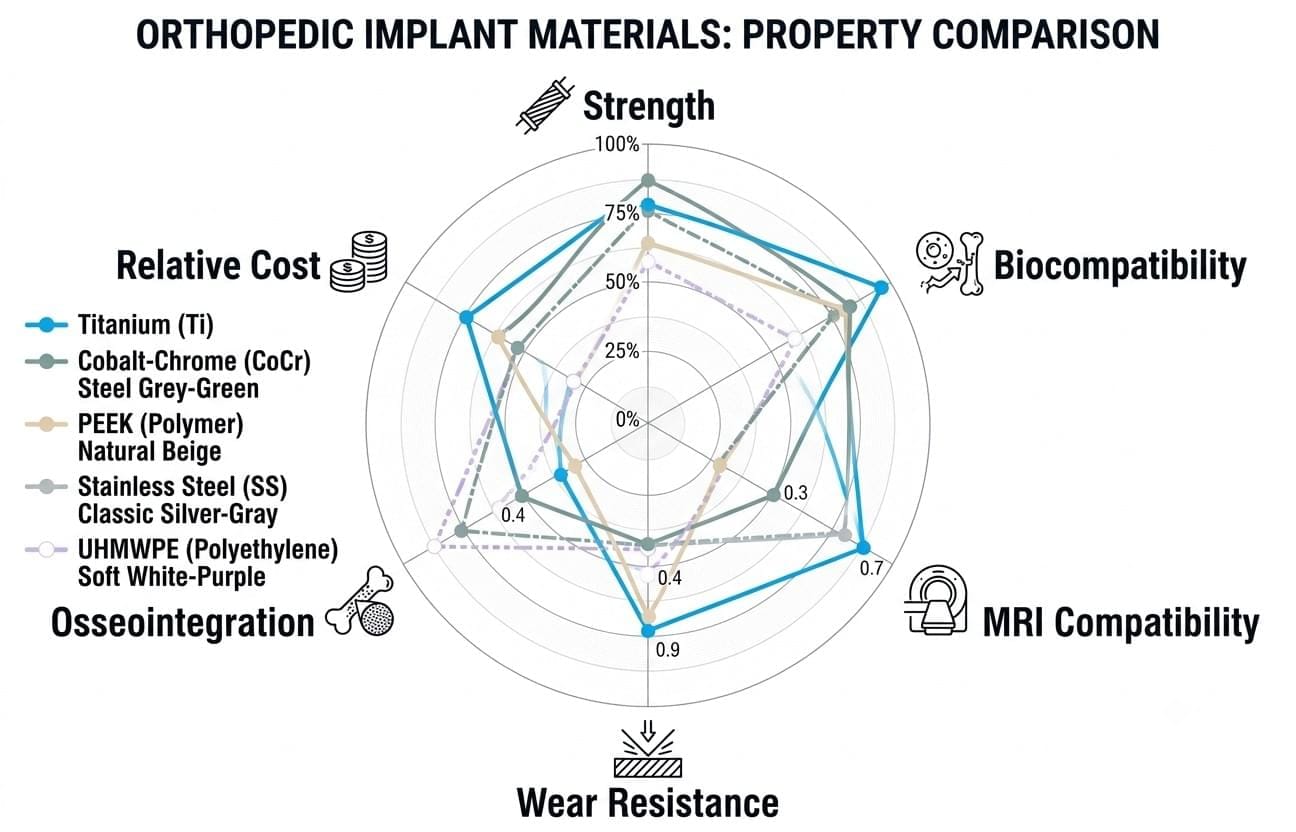
| Material Category | Yield Strength | Modulus of Elasticity | Biocompatibility Profile | Diagnostic (MRI) Compatibility | Relative Production Cost |
|---|---|---|---|---|---|
| Ti-6Al-4V Alloy | 880–1100 MPa | 110 GPa | ⭐ Excellent | Conditional (Low Distortion) | 💰 High |
| CoCrMo Alloy | 500–1000 MPa | 230 GPa | 👍 Good | Conditional (High Artifact) | 💰 High |
| PEEK Polymer | 100 MPa | 3.6 GPa | ⭐ Excellent | ✅ Highly Compatible | 💎 Moderate |
| 316L Stainless Steel | 170–690 MPa | 200 GPa | 👍 Good | Conditional (High Artifact) | 📉 Low |
| UHMWPE Liner | ~20 MPa | 0.7–1 GPa | ⭐ Excellent | ✅ Highly Compatible | 📉 Low-Moderate |
| Alumina Ceramic | 500+ MPa | 380 GPa | ⭐ Excellent | ✅ Highly Compatible | 💎 Moderate |
💬 Frequently Asked Questions
Q: Why is titanium favored over stainless steel for permanent implants?
Titanium provides far better biocompatibility, superior corrosion resistance, and less stress shielding due to its lower elastic modulus. Stainless steel is preferred for temporary trauma hardware due to its low cost.
Q: How does PEEK solve imaging issues after a spinal procedure?
Unlike metals that block radiation, PEEK is radiolucent. This allows medical teams to monitor internal healing and bone growth directly through the device using standard X-rays.
Q: Are there biodegradable implant material options?
Yes. Magnesium alloys and bio-absorbable polymers (such as PLA and PGA) are increasingly utilized for pediatric trauma and soft-tissue fixation, gradually dissolving as the body heals.
🎯 Conclusion
Choosing from available orthopedic implant materials is one of the most critical engineering decisions in modern healthcare manufacturing. Balancing structural strength, wear resistance, imaging compatibility, and cost ensures that devices deliver elite, life-changing performance.
To see how these raw materials are shaped by advanced manufacturing methods, read our comprehensive guide to Orthopedic Implants: Types, Materials & Manufacturing Technologies.
Need certified engineering support, mechanical validation, or compliant material sourcing? Contact our engineering team today for a professional consultation.
Disclaimer: This technical resource is tailored for medical device manufacturing and procurement professionals. Material performance varies based on exact design, surface treating, and clinical implementation.
 English
 Arabic
 French
 German
 Italian
 Japanese
 Korean
 Portuguese
 Turkish
 Russian
 Spanish