


🦴 3D Printed Orthopedic Implants are reshaping the future of orthopedic device manufacturing. Once viewed as an emerging technology, additive manufacturing has become a practical solution for producing highly complex implants with exceptional precision, enhanced biological performance, and patient-specific customization.
Unlike conventional subtractive machining, which removes material from a solid metal block, additive manufacturing builds implants layer by layer directly from digital CAD models. This approach gives engineers far greater design freedom while reducing material waste and enabling structures that simply cannot be produced through traditional manufacturing.
📌 In this guide, you’ll discover how 3D Printed Orthopedic Implants are manufactured, where they provide the greatest clinical value, their current limitations, and what manufacturers should consider before investing in additive manufacturing technologies.
This article is part of our complete guide on Orthopedic Implants: Types, Materials & Manufacturing Technologies.
The Additive Manufacturing Process for Orthopedic Implants
Every successful implant begins with selecting the right manufacturing process. Different additive manufacturing technologies offer unique advantages depending on the implant design, material, and clinical application.
⚙️ Electron Beam Melting (EBM)
Best suited for: Highly porous titanium implants designed for superior osseointegration.
Instead of machining titanium blocks, EBM spreads thin layers of titanium alloy powder—typically Ti-6Al-4V ELI—and selectively melts each layer using an electron beam inside a vacuum chamber. The implant gradually takes shape layer by layer until the complete geometry is produced.
✅ Why EBM is valuable for 3D Printed Orthopedic Implants
- Produces dense titanium with mechanical properties comparable to forged materials.
- Creates interconnected porous structures that closely resemble natural cancellous bone.
- Vacuum processing minimizes oxidation and improves material purity.
- Offers faster production for many large orthopedic components compared with laser-based systems.
Its ability to generate highly porous lattice structures makes EBM particularly attractive for cementless implants where rapid bone ingrowth is essential.
⚙️ Selective Laser Melting (SLM/DMLS)
Best suited for: Precision titanium and cobalt-chromium implant components.
SLM and DMLS use a high-powered laser to selectively melt metal powder in an inert gas environment. Compared with EBM, these technologies generally produce finer surface resolution and greater dimensional accuracy.
✅ Key advantages
- Higher geometric precision
- Excellent detail for intricate implant designs
- Suitable for patient-specific orthopedic implants
- Ideal for custom surgical guides and complex lattice structures
Because of its precision, SLM has become one of the preferred technologies for manufacturing custom 3D printed orthopedic implants that require complex anatomical geometries.
⚙️ Selective Laser Sintering (SLS) for PEEK
Although titanium dominates orthopedic additive manufacturing, polymer-based implants continue to evolve.
SLS uses lasers to fuse medical-grade PEEK powder into lightweight components with controlled porosity and complex internal structures. Researchers are actively exploring porous PEEK cages that combine excellent imaging compatibility with improved biological fixation.
While still developing, this technology may significantly expand future applications of additive manufacturing for orthopedic implants.
Why 3D Printed Orthopedic Implants Matter
Modern orthopedic surgeons increasingly expect implants to deliver more than mechanical strength alone. They also demand faster bone integration, improved anatomical fit, and long-term durability.
These expectations explain why 3D Printed Orthopedic Implants continue gaining market share across multiple orthopedic specialties.
🦴 Benefit 1: Advanced Porous Architecture Improves Osseointegration
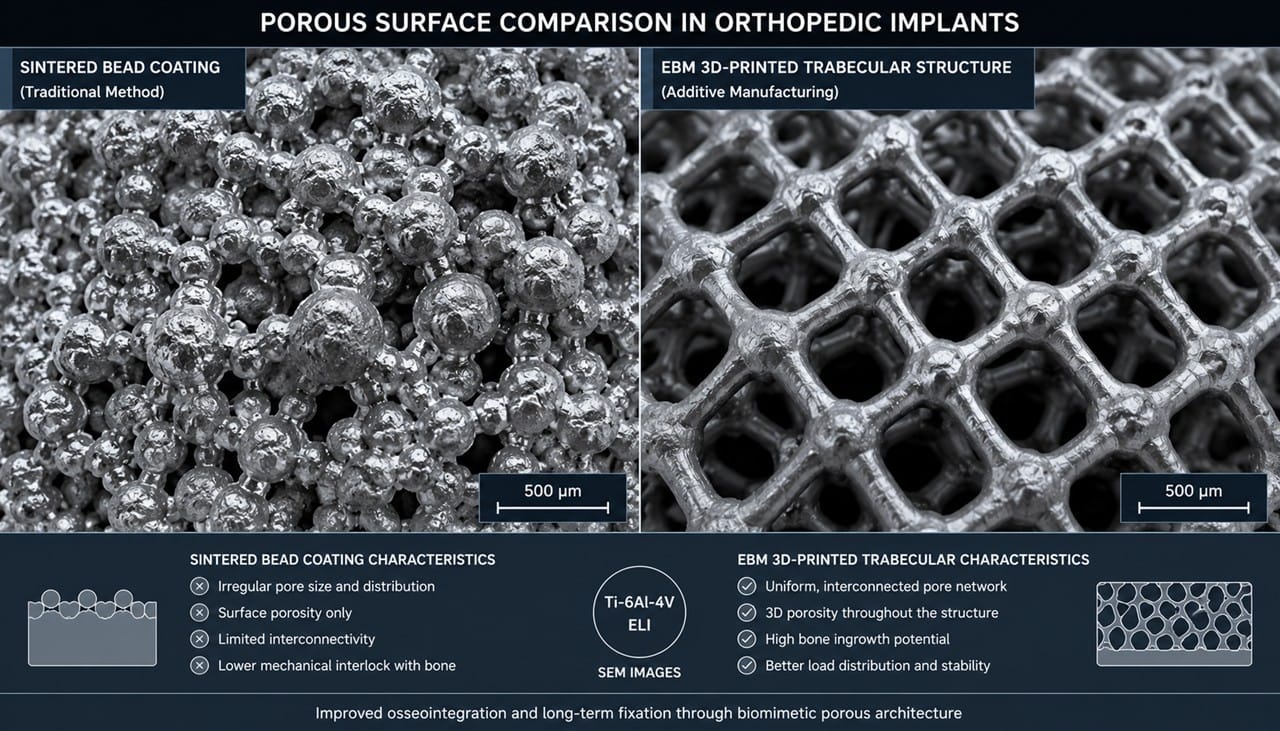
One of the greatest strengths of 3D Printed Orthopedic Implants is the ability to create fully interconnected porous structures throughout the implant instead of applying porous coatings only to the surface.
Traditional manufacturing techniques typically rely on plasma spray coatings or sintered beads to encourage bone attachment. While effective, these coatings cannot reproduce the three-dimensional architecture found in natural cancellous bone.
Additive manufacturing changes this entirely.
💡 Modern lattice structures can be engineered with precisely controlled pore size, porosity, and mechanical stiffness, allowing implants to better mimic human bone while promoting stronger biological fixation.
Clinical advantages include:
- ✅ Faster bone ingrowth
- ✅ Increased bone-to-implant contact
- ✅ Improved long-term implant stability
- ✅ Potential reduction in revision procedures
Today, porous titanium produced through additive manufacturing has become a premium feature in many cementless hip and knee replacement systems.
🦴 Benefit 2: Patient-Specific Customization
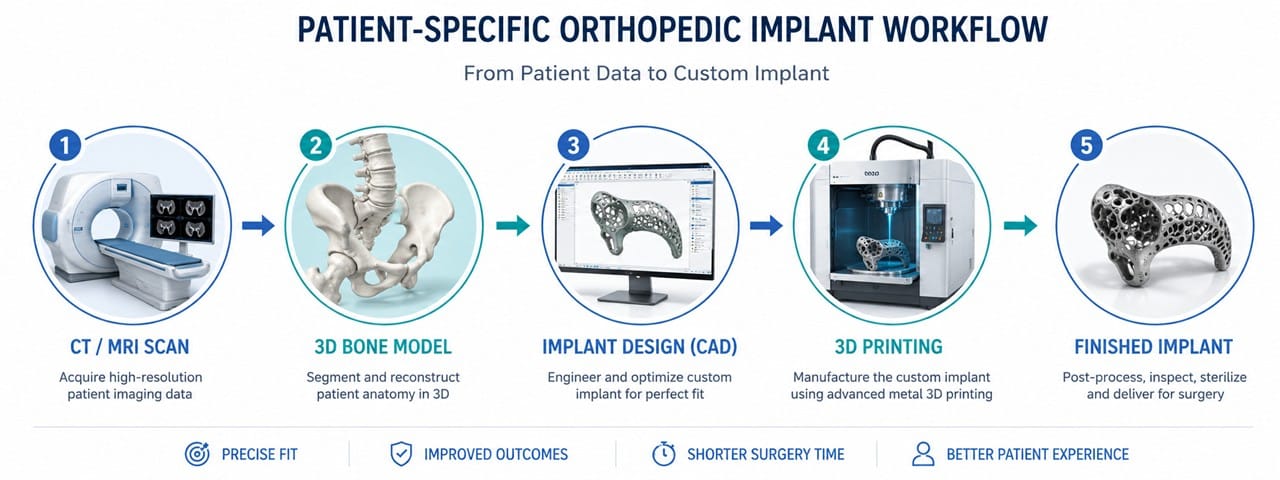
Not every patient fits a standard implant.
For complex anatomical defects, trauma reconstruction, or oncology cases, patient-specific orthopedic implants provide solutions that conventional manufacturing often cannot achieve.
Using CT or MRI imaging, engineers convert patient anatomy into highly accurate digital models before designing customized implants that precisely match each defect.
Typical applications include:
- Pelvic tumor reconstruction
- Complex revision joint replacement
- Severe bone deformities
- Pediatric orthopedic procedures
- Craniofacial reconstruction
A typical digital workflow includes:
- CT or MRI imaging
- Anatomical segmentation
- CAD implant design
- Virtual surgical planning
- Additive manufacturing
- Surface finishing
- Sterilization and implantation
📌 This digital workflow allows surgeons to improve implant fit while potentially reducing operating time and simplifying complex procedures.
🦴 Benefit 3: Complex Designs Impossible with Traditional Machining
One of the biggest engineering advantages of additive manufacturing is design freedom.
Traditional CNC machining struggles with enclosed cavities, internal channels, lattice structures, and undercuts. Producing these features often requires assembling multiple components, increasing manufacturing complexity and potential failure points.
By contrast, 3D Printed Orthopedic Implants can integrate these features into a single component.
Examples include:
- Lattice structures with optimized stiffness
- Internal drug-delivery channels
- Sensor-ready implant cavities
- Integrated fixation features
- Complex internal geometries impossible to machine conventionally
This flexibility enables engineers to optimize implants for both biological performance and mechanical strength simultaneously.
🦴 Benefit 4: Higher Material Efficiency
Titanium is an expensive raw material, making efficient production increasingly important.
Traditional machining may remove up to 90% of the original billet during manufacturing, particularly for highly complex implants.
Additive manufacturing significantly improves material utilization by building components only where material is required.
📈 Benefits include:
- Less raw material waste
- Lower environmental impact
- Reduced machining operations
- Improved production efficiency for complex parts
Although powder handling introduces additional process costs, improved material utilization often offsets part of the investment for advanced implant designs.
Real-World Clinical Applications
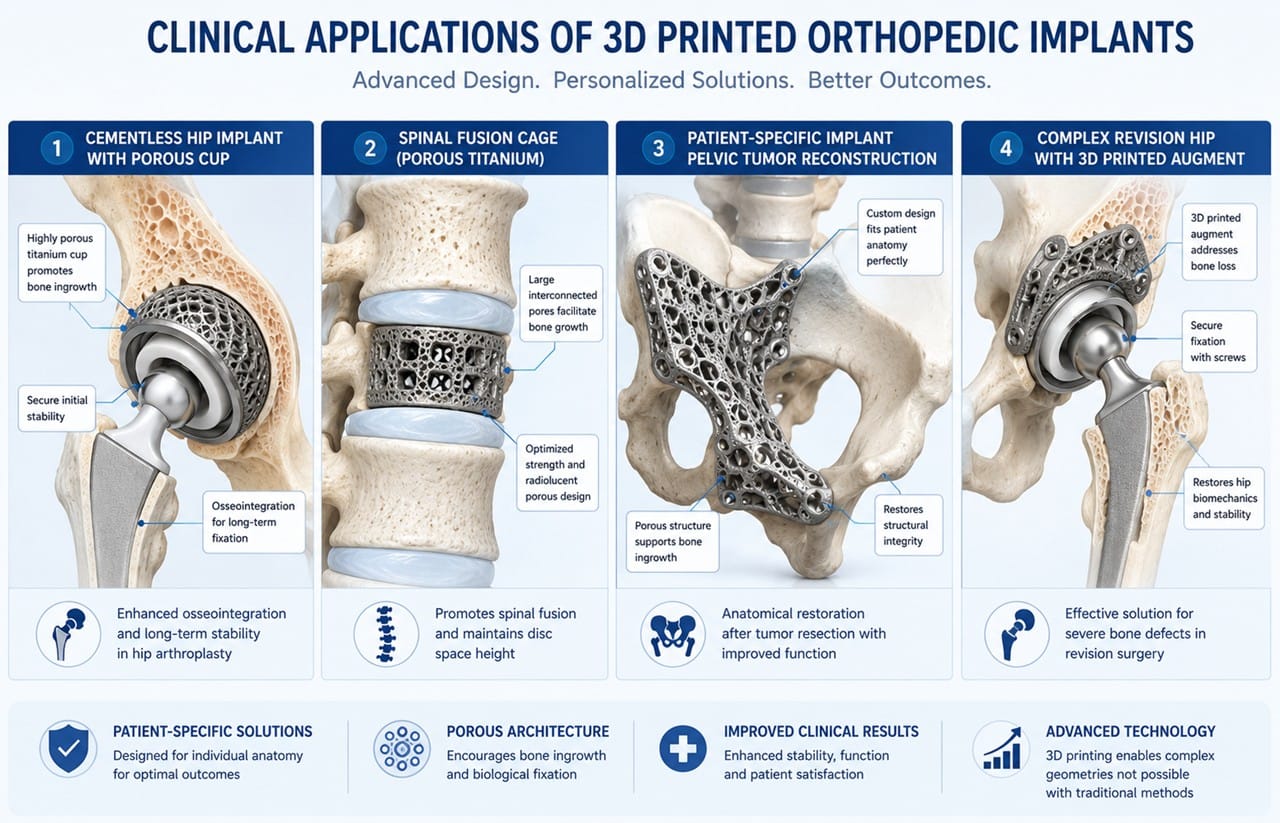
The value of 3D Printed Orthopedic Implants is no longer theoretical. Around the world, hospitals and orthopedic manufacturers are adopting additive manufacturing across multiple clinical specialties.
🏥 Cementless Joint Replacement
Porous titanium acetabular cups and tibial components have become some of the most successful commercial examples of additive manufacturing.
Major manufacturers have introduced implants featuring highly porous lattice structures that promote rapid bone ingrowth and long-term biological fixation.
Independent clinical studies have reported:
- Faster early osseointegration
- Greater bone-to-implant contact
- Excellent short- and medium-term survivorship
- Stable fixation in demanding clinical cases
As manufacturing technologies mature, these implants continue setting new standards for cementless joint replacement.
🏥 Spinal Fusion Cages with Porous Titanium
One of the fastest-growing applications of 3D Printed Orthopedic Implants is spinal fusion surgery. Traditional PEEK cages have long been used because of their radiolucency, but porous titanium cages produced through additive manufacturing are becoming increasingly popular thanks to their superior biological performance.
The ability to engineer interconnected lattice structures encourages stronger bone attachment while maintaining excellent mechanical strength.
✅ Why surgeons are choosing porous titanium cages
- Faster and more reliable osseointegration
- No additional porous coating required
- Improved primary implant stability
- Optimized elastic modulus that better matches natural bone
- Continuous improvements in imaging technology help reduce concerns about metal artifacts
Well-known examples include Stryker Tritanium®, DePuy Synthes CONDUIT™, and NuVasive Modulus®, all of which demonstrate how additive manufacturing is advancing spinal implant design.
📖 For a deeper look at spinal devices, see our guide: Spinal Implants: Design Principles and Clinical Applications.
🏥 Patient-Specific Tumor Reconstruction
Few clinical scenarios benefit more from patient-specific orthopedic implants than musculoskeletal oncology.
Large pelvic, spinal, or shoulder tumors often leave irregular bone defects after resection. Standard implants rarely provide an ideal fit, making reconstruction extremely challenging.
Using CT imaging and digital surgical planning, engineers can create customized implants that accurately restore anatomy while preserving critical attachment points for muscles and ligaments.
Clinical experience has shown several important advantages:
- ✅ Better anatomical reconstruction
- ✅ Improved implant fit
- ✅ Reduced intraoperative adjustments
- ✅ Shorter surgical time through preoperative planning
- ✅ Enhanced postoperative functional recovery in selected patients
As software, imaging, and manufacturing technologies continue to improve, customized oncology implants are becoming increasingly accessible for complex reconstruction cases.
🏥 Complex Revision Joint Arthroplasty
Revision joint replacement often involves extensive bone loss that standard implants cannot adequately address.
In these situations, custom 3D printed orthopedic implants provide surgeons with greater flexibility for restoring structural stability.
One rapidly expanding application is the use of 3D-printed acetabular augments during complex hip revision procedures. Their porous architecture promotes biological fixation while allowing surgeons to reconstruct severe bone defects with greater precision.
These solutions have become particularly valuable for patients with:
- Severe acetabular bone loss
- Multiple previous revisions
- Large structural defects
- Failed primary arthroplasty requiring individualized reconstruction
⚠️ Current Limitations and Challenges
Although 3D Printed Orthopedic Implants offer remarkable advantages, additive manufacturing is not the ideal solution for every orthopedic product. Manufacturers should carefully evaluate both the technical benefits and practical challenges before investing.
💰 Higher Manufacturing Costs
For straightforward implants such as trauma plates and standard screws, conventional CNC machining remains the more economical option.
Several factors contribute to the higher cost of additive manufacturing:
- Industrial EBM and DMLS systems typically require investments ranging from hundreds of thousands to several million dollars.
- Medical-grade titanium powder is more expensive than traditional titanium billets.
- Additional inspection, support removal, and surface finishing increase overall production costs.
As production volumes rise and equipment becomes more efficient, these costs are expected to decline. However, for many standard implant designs, traditional manufacturing continues to provide the best value.
⚙️ Extensive Post-Processing
Printing an implant is only one stage of the manufacturing process.
Every metal implant produced through additive manufacturing requires careful post-processing to achieve the required mechanical properties, dimensional accuracy, and surface quality.
Typical post-processing steps include:
- Support structure removal
- Precision machining of functional surfaces
- Surface polishing where necessary
- Hot Isostatic Pressing (HIP) to reduce residual porosity
- Thorough cleaning to eliminate trapped metal powder
- Final dimensional and quality inspection
These additional operations are essential for ensuring consistent product performance and regulatory compliance.
📋 Regulatory Requirements
Manufacturing 3D Printed Orthopedic Implants involves more than advanced engineering—it also requires rigorous quality management and regulatory oversight.
The FDA has published detailed guidance covering additive manufacturing for medical devices, including design controls, process validation, material traceability, and documentation requirements.
Key expectations include:
- Complete traceability from digital design to finished implant
- Validation of each printer, material, and manufacturing parameter
- Comprehensive mechanical and biological performance testing
- Powder characterization and batch control
- Robust documentation for customized implant workflows
📖 For official guidance, see the FDA document:
Technical Considerations for Additive Manufactured Medical Devices
You may also find our compliance guide helpful:
Orthopedic Device Regulatory Compliance.
🏭 What This Means for OEM & ODM Manufacturers
For manufacturers entering the additive manufacturing market, success depends on careful planning rather than simply purchasing new equipment.
Consider the following best practices:
✅ Begin with Standard Porous Designs
Instead of immediately developing fully customized implants, many manufacturers successfully introduce porous versions of existing implant systems. This approach reduces regulatory complexity while building production experience.
✅ Validate Every Manufacturing Process
Mechanical testing, fatigue analysis, and dimensional verification should be completed before introducing any new implant into commercial production.
✅ Partner Before Investing
Working with experienced additive manufacturing service providers allows companies to evaluate market demand before committing to expensive production equipment.
✅ Establish Strict Powder Management
Titanium powder requires specialized handling because of its fire and explosion risks. Comprehensive storage, recycling, and safety procedures are essential.
✅ Invest in Advanced Quality Control
Modern quality systems increasingly include:
- CT scanning for internal defect detection
- Coordinate Measuring Machines (CMM)
- Mechanical property verification
- Surface roughness analysis
- Digital production traceability
Strong quality assurance remains one of the most important competitive advantages for OEM and ODM manufacturers.
❓ Frequently Asked Questions
💬 Are 3D Printed Orthopedic Implants FDA approved?
Many 3D Printed Orthopedic Implants have received FDA 510(k) clearance. Manufacturers must validate their complete digital manufacturing workflow and demonstrate that printed implants consistently meet safety and performance requirements.
💬 Which materials are commonly used?
Titanium alloys such as Ti-6Al-4V and Ti-6Al-4V ELI remain the most widely used materials. Cobalt-chromium alloys are also suitable for additive manufacturing, while PEEK components can be produced using Selective Laser Sintering (SLS).
💬 Are customized implants available for every patient?
Not routinely. Patient-specific implants are generally reserved for complex situations, including tumor reconstruction, severe deformities, major bone defects, and challenging revision surgeries where standard implants cannot achieve satisfactory outcomes.
💬 Do porous printed implants perform better than conventional porous coatings?
Current clinical evidence suggests that additively manufactured porous structures provide more consistent interconnected porosity and may improve bone ingrowth compared with traditional sintered-bead or plasma-sprayed coatings. Long-term outcomes continue to be evaluated as more clinical data become available.
💬 What does the future look like?
The future of additive manufacturing for orthopedic implants is highly promising.
As printing technologies become faster, more accurate, and more cost-effective, additive manufacturing is expected to expand beyond premium implant categories into broader orthopedic applications. Advances in automation, artificial intelligence, and digital surgical planning will further accelerate the adoption of patient-specific solutions.
3D Printed Orthopedic Implants have moved well beyond the experimental stage. Today, they play an important role in cementless joint replacement, spinal fusion, complex revision surgery, and customized tumor reconstruction.
Their ability to create porous structures, manufacture highly complex geometries, and support personalized treatment is transforming how orthopedic implants are designed and produced.
Although challenges remain—including higher production costs, extensive post-processing, and strict regulatory requirements—the long-term outlook for additive manufacturing is exceptionally strong. As technologies continue to mature, manufacturers that invest in robust design capabilities, quality systems, and regulatory expertise will be well positioned to compete in the next generation of orthopedic innovation.
📖 Return to our comprehensive guide:
Orthopedic Implants: Types, Materials & Manufacturing Technologies.
🤝 Ready to explore advanced additive manufacturing solutions for orthopedic implants? Contact our team to discuss your technical requirements, OEM/ODM manufacturing needs, and long-term partnership opportunities.
⚕️ Medical Disclaimer
This article is intended for educational and informational purposes only and is written primarily for professionals in the medical device industry. Clinical examples and manufacturing information are based on publicly available literature and current industry practices. All clinical decisions, regulatory activities, and manufacturing processes should be performed by qualified healthcare professionals and certified medical device manufacturers.
 English
 Arabic
 French
 German
 Italian
 Japanese
 Korean
 Portuguese
 Turkish
 Russian
 Spanish