


Pick up any external fixator and hold it for a minute. The frame, the clamps, the pins — every gram of it is a compromise between strength, weight, cost, and biology. That’s the real story of external fixator materials: nothing gets chosen by accident.
The choice affects everything downstream — how stable the construct feels in the OR, how comfortable the patient is weeks later, and what the system costs to manufacture. Get the material wrong and no amount of clever design saves you.
This article is part of the guide: External Fixators: Design, Types and Clinical Applications.
💡 Why Material Selection Matters in External Fixation
Here’s the twist that makes this product category so interesting: an external fixator is only semi-implantable. The pins pass through skin into bone, while the frame stays outside the body. That hybrid nature creates a demanding, often contradictory set of material requirements:
- Frame components: high stiffness, light weight, corrosion resistance, and radiolucency so imaging stays unobstructed
- Pins and wires: biocompatible, high fatigue strength, with surface finishes that actively discourage pin site infection
- Clamps and connectors: high clamping force, corrosion resistance, and the ability to survive repeated sterilization
Balancing all three is where external fixator materials stop being theory and become product differentiation.
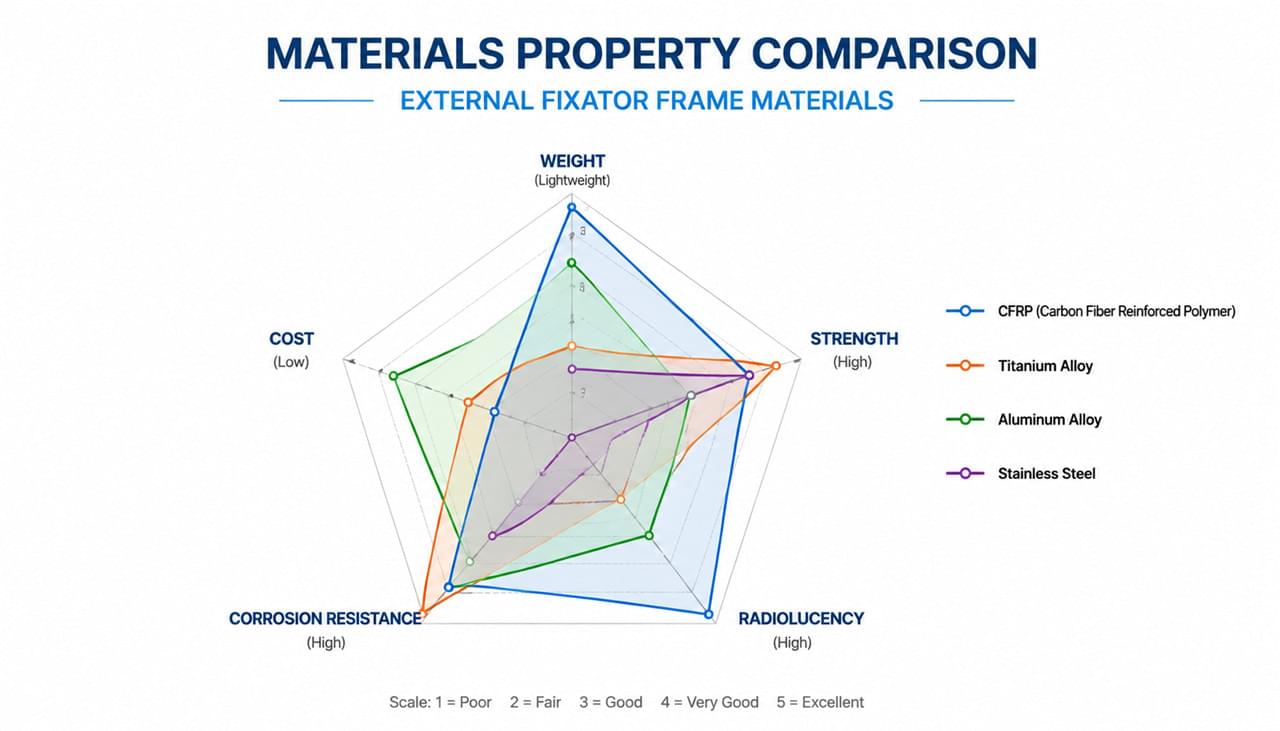
🧱 Frame Materials: Aluminum, Carbon Fiber, and Stainless Steel
Frame materials do the heavy lifting — literally. Here’s how the main external fixation frame materials stack up, from the incumbent to the newcomer.
Aluminum Alloy: The Workhorse of External Fixator Materials
Aluminum remains the dominant frame material for standard clinical-grade systems — and it earned that position:
- Weight: 2.7 g/cm³ — roughly one-third of steel
- Strength: 7075 alloy hits a yield strength around 500 MPa, adequate for most external fixation loads
- Corrosion resistance: anodized aluminum offers excellent protection and is MRI-compatible
- Manufacturing: easily machined and anodized; cost-effective at scale
- Applications: standard monolateral bars, ring components, and clamp bodies
Carbon Fiber: The Premium Choice in External Fixator Materials
For high-performance systems, carbon fiber reinforced polymer (CFRP) is the material everyone’s watching:
- Weight: 1.5–1.6 g/cm³ — even lighter than aluminum
- Stiffness: exceptional, with a modulus of 70–150 GPa depending on fiber direction
- Radiolucency: nearly X-ray transparent — surgeons can image the fracture through the frame without taking it off
- Strength: excellent in uniaxial loading; needs care in torsion and off-axis situations
- Cost: higher than aluminum, with specialized manufacturing requirements
- Applications: premium monolateral rods, circular rings where imaging access matters
That radiolucency is a genuine clinical win. A carbon fiber external fixator lets surgeons watch fracture alignment progress on X-ray without component interference — a luxury steel never offered. Carbon fiber bars are also roughly 15% stiffer than stainless steel rods, per the external fixation principles overview on NCBI’s StatPearls.
Stainless Steel: The Budget Option in External Fixator Materials
Steel is the traditionalist’s choice, still holding ground in Ilizarov ring systems and clamps:
- Weight: 7.9 g/cm³ — the heaviest of the common frame materials
- Strength: very high, 170–690 MPa depending on alloy and heat treatment
- Cost: the lowest of all frame materials
- MRI: conditional — some artifact, but generally scannable
- Applications: Ilizarov rings, threaded rods, traditional clamps
The weight penalty is real, though. A steel Ilizarov frame is noticeably harder on patients than an aluminum or titanium alternative — a quality-of-life factor that matters over months of wear.
🔩 Pin and Wire Materials
Frames get the spotlight, but pins do the dirty work — which makes them the most demanding external fixator materials to engineer. Biocompatibility, fatigue strength, and surface finish all have to be right at once.
Stainless Steel Pins and Wires
The standard for most Schanz screws and K-wires:
- Type 316L SS: high fatigue strength with a smooth, machineable surface
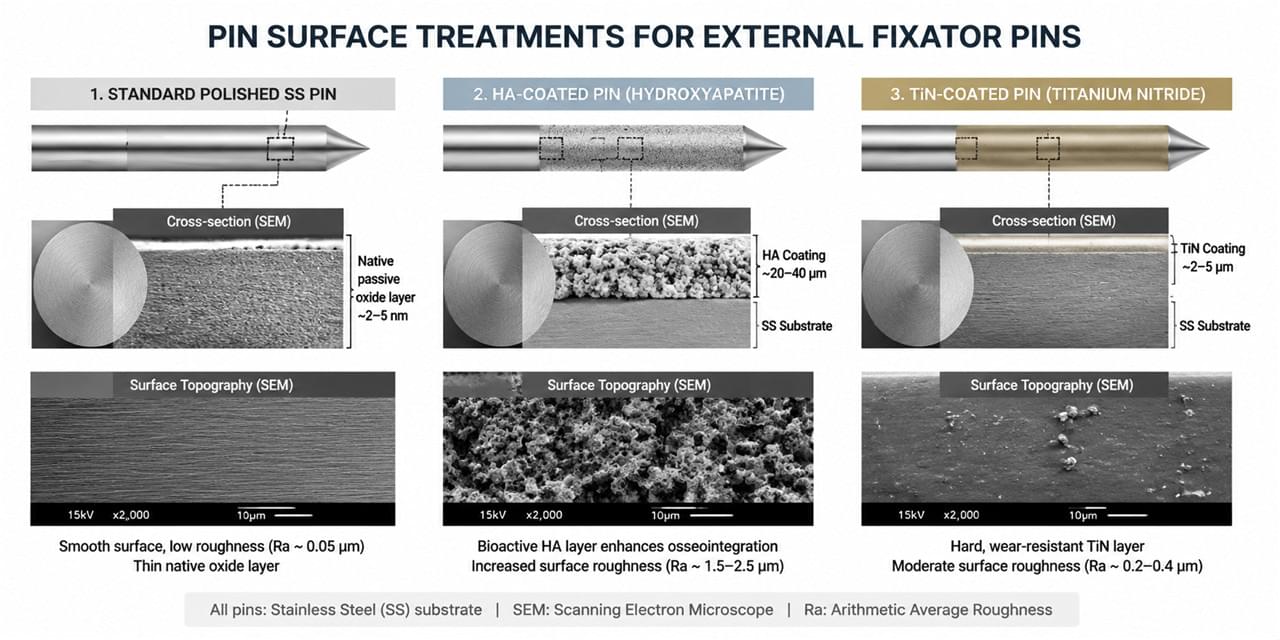
- Surface finish: critical for pin site management — a polished shaft reduces trauma at the skin-pin interface
- Hydroxyapatite coating: an emerging option, with some studies showing reduced infection rates
Titanium Alloy Pins (Ti-6Al-4V)
Titanium is steadily climbing into premium systems:
- Biocompatibility: better tissue tolerance than stainless steel
- Lower stiffness: reduces stress concentration at cortical contact points
- MRI compatibility: significantly less artifact than steel pins
- Cost: 3–5x higher than stainless steel
- Applications: premium trauma systems and patients with nickel sensitivity
If your follow-up protocol leans on MRI, titanium external fixator pins become the obvious upgrade.
Surface Treatments: Protecting External Fixator Materials
Pin site infection is the most common complication of external fixation — incidence runs 20–30% in long-term fixation. Surface engineering is where the next generation of external fixator materials earns its keep:
- Electrolytic polishing: ultra-smooth surfaces reduce bacterial adhesion
- Silver coating: antimicrobial Ag ions, though regulatory complexity varies by market
- Titanium nitride (TiN) coating: hard, smooth, with emerging infection-reduction evidence
- HA coating: promotes bone-pin integration and may reduce loosening
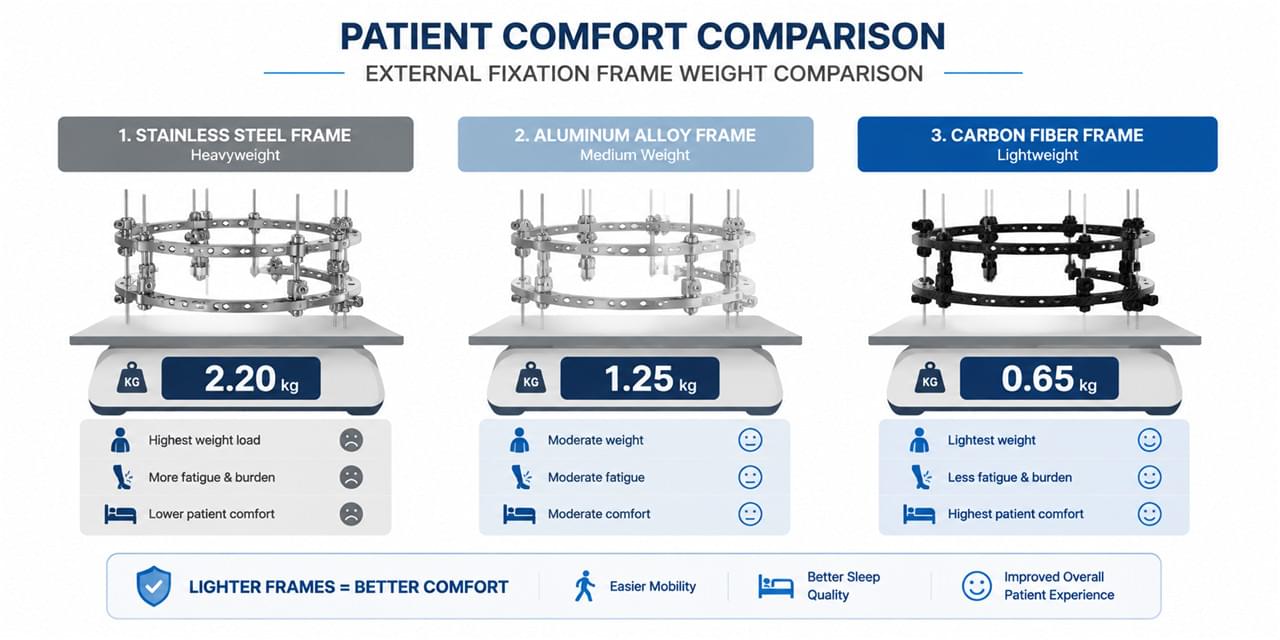
⚖️ Weight vs. Strength: The Eternal Trade-off
Here’s the balance sheet at the heart of external fixator materials:
| Material | Density (g/cm³) | Yield Strength (MPa) | Strength/Weight Ratio | Relative Cost |
|---|---|---|---|---|
| Carbon Fiber (CFRP) | 1.5–1.6 | 300–600+ | Excellent | High |
| Titanium Ti-6Al-4V | 4.4 | 880–1100 | Very Good | Very High |
| Aluminum 7075 | 2.7 | 500 | Good | Moderate |
| Stainless Steel 316L | 7.9 | 170–690 | Fair | Low |
For patients wearing a frame for months — limb lengthening is the classic case — weight stops being an engineering footnote and becomes a quality-of-life issue. Carbon fiber and aluminum/titanium hybrid systems win that argument every time. A recent engineering review of external fixators published in Medical Engineering & Physics confirms the trend: lightweight composite materials are steadily replacing traditional metallic alloys in modern designs.
🛡️ Corrosion Resistance Requirements
External fixator materials face a genuinely hostile environment:
- Saline wound secretions pooling around pin sites
- Repeated sterilization cycles — autoclave, EtO, chemical
- Mechanical fretting at clamp-rod interfaces
Best performers: CFRP (immune to corrosion), titanium alloy (passive oxide layer), anodized aluminum (protective layer).
Adequate performers: stainless steel 316L — it has a passive film, but is susceptible to crevice corrosion at clamp interfaces.
The critical design trap: galvanic corrosion when dissimilar metals touch. A stainless steel clamp on an aluminum rod is a corrosion cell waiting to happen. Manufacturers must handle this through material compatibility choices or protective coatings — it’s not optional.
📋 Regulatory and Biocompatibility Requirements
All external fixator materials must clear a well-defined regulatory bar:
- ISO 10993: biocompatibility evaluation for every tissue-contacting component
- ISO 5832-1: wrought stainless steel for surgical implants
- ISO 5832-3: wrought Ti-6Al-4V for surgical implants
- ASTM F136: Ti-6Al-4V ELI for surgical implants
- FDA device guidance: external fixation systems are typically Class II devices requiring 510(k) clearance
See our regulatory guide: Orthopedic Device Regulatory Compliance.
❓ FAQ: External Fixator Materials
Q1: Why is carbon fiber used in some external fixator bars?
Because it nails two problems at once. Carbon fiber delivers an excellent stiffness-to-weight ratio and, critically, is radiolucent — surgeons can X-ray through the frame without removing it, keeping tabs on fracture healing throughout treatment.
Q2: Are titanium external fixator pins better than stainless steel?
Titanium pins win on biocompatibility and MRI compatibility, but cost 3–5x more. For most standard cases, stainless steel pins with a good surface finish are clinically adequate. Titanium earns its premium in MRI-dependent follow-up or for nickel-sensitive patients.
Q3: How often are external fixator frames reused?
Frame components are designed for multiple-use after sterilization — but must be inspected for damage before every application. Pins and K-wires are single-use sterile items. Most manufacturers specify a maximum number of sterilization cycles for frame components.
Q4: What causes pin loosening in external fixation?
Three culprits: bone resorption at the pin-cortex interface (often from thermal necrosis caused by excessive insertion speed, or from infection), cyclic fatigue loading at the pin-bone interface, and initially inadequate bicortical purchase. Prevention starts with insertion technique.
Q5: Can external fixator components go in an MRI?
Most aluminum and CFRP components are MRI-compatible. Stainless steel may cause local artifact, and titanium pins are the preferred choice for MRI-compatible systems. Always check each manufacturer’s MRI conditions of use — component by component.
🏁 Conclusion
External fixator materials selection is a balancing act across mechanical performance, patient comfort, imaging compatibility, infection prevention, and cost. Carbon fiber rods, aluminum alloy rings, titanium pins, and advanced surface treatments collectively define the current state of the art — and the manufacturers who master this balance are the ones winning premium segments.
Return to: External Fixators: Design, Types and Clinical Applications.
Interested in material testing or OEM manufacturing for external fixation systems? Contact our team for technical consultation.
⚠️ Medical Disclaimer
For informational purposes only. All device material selection and testing must comply with applicable ISO and FDA standards.
 English
 Arabic
 French
 German
 Italian
 Japanese
 Korean
 Portuguese
 Turkish
 Russian
 Spanish