


An orthopedic trauma instrument set is the workhorse of any fracture service — but it’s only one of three core trays a well-run orthopedic OR depends on. Alongside joint replacement and spine sets, these trays decide whether a case flows smoothly or stalls mid-incision.
This guide catalogues the standard sets across all three categories, with tray counts, weights, and configuration notes for procurement teams and OR managers.
This article is part of: Orthopedic Instrument Sets: Composition, Configuration & Best Practices.
🦴 Trauma Instrument Sets
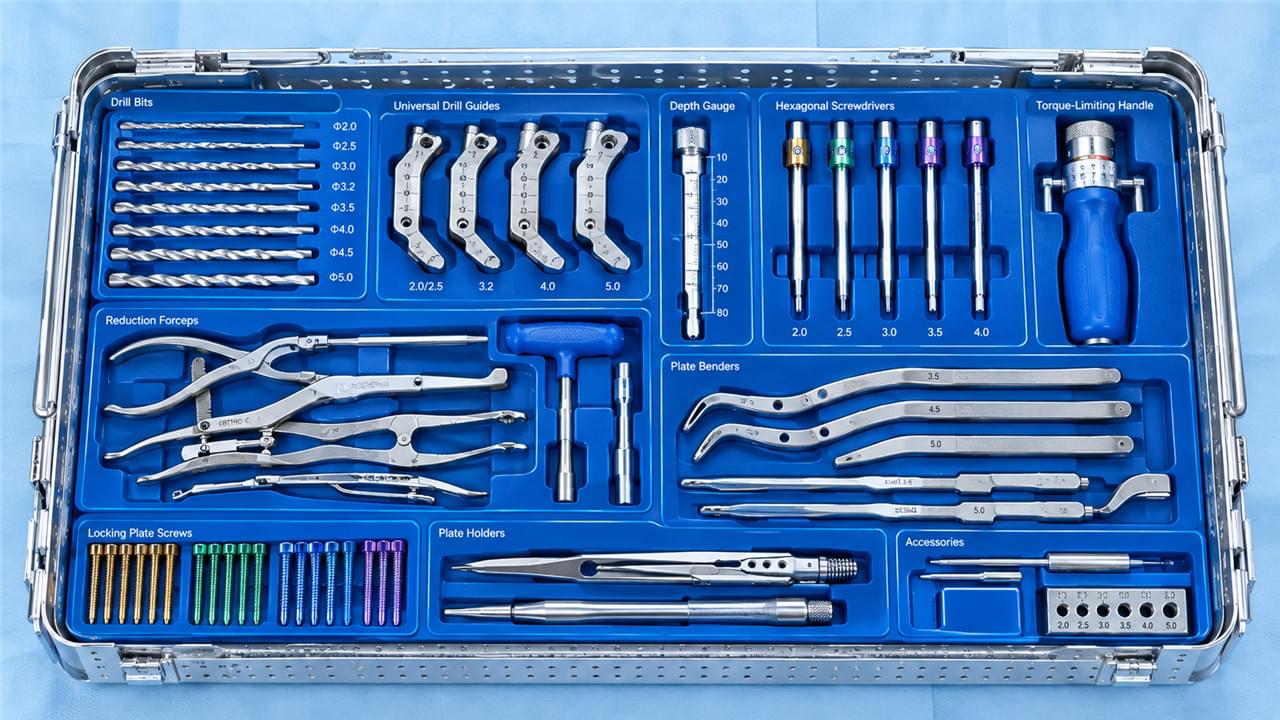
The Orthopedic Trauma Instrument Set for Locking Plating
An orthopedic trauma instrument set built for locking plate osteosynthesis covers four modules:
Drilling module:
- 2.0/2.5/3.2/4.3mm drill bits (paired with plate screw diameters)
- Universal drill guide/screw guide sleeve
- Calibrated depth gauge with retaining ring
- Tissue protection sleeve
Screw insertion module:
- Hexagonal (stardrive) screwdrivers — various shaft lengths
- Torque-limiting screwdriver handle
- Self-holding screw holder
- Locking screw driver for variable-angle holes
Reduction and plate holding:
- Reduction forceps (large and small)
- Plate-holding forceps
- Plate-to-bone pushing device
- Bone hook
Plate contouring:
- Plate bender (in-situ and pre-operative)
- Plate-cutting pliers (for plate length adjustment)
Standard components: ~40–60 instruments per set. Typically organized in one large orthopedic instrument tray.
The Orthopedic Trauma Instrument Set for Intramedullary Nailing
Nailing trays trade the plate modules for targeting hardware:
Entry and preparation module:
- Entry awl/trephine
- Bone awl for canal opening
- Guide wire (ball-tipped and olive-tipped variants)
- Flexible reamers (compatible with power tool — see Orthopedic Surgical Power Tools)
Nail insertion module:
- Nail insertion handle (proximal targeting arm attachment)
- Proximal targeting guide (for proximal interlocking screws)
- Distal targeting device (freehand guide or targeting bow)
- Interlocking drill guide sleeve
- Calibrated drill bit for interlocking holes
- Screw driver for locking bolts
End cap and closure:
- End cap inserter
- Torque wrench for final tightening
Want to see these instruments in context? The AO Surgery Reference’s tibial nailing technique walkthrough shows exactly how each targeting and reaming component is used step by step.
🦵 Joint Replacement Instrument Sets
Total Hip Arthroplasty (THA) Set Summary
A complete joint replacement instrument set for THA was described in detail in the Pillar 5 article. Key configuration considerations:
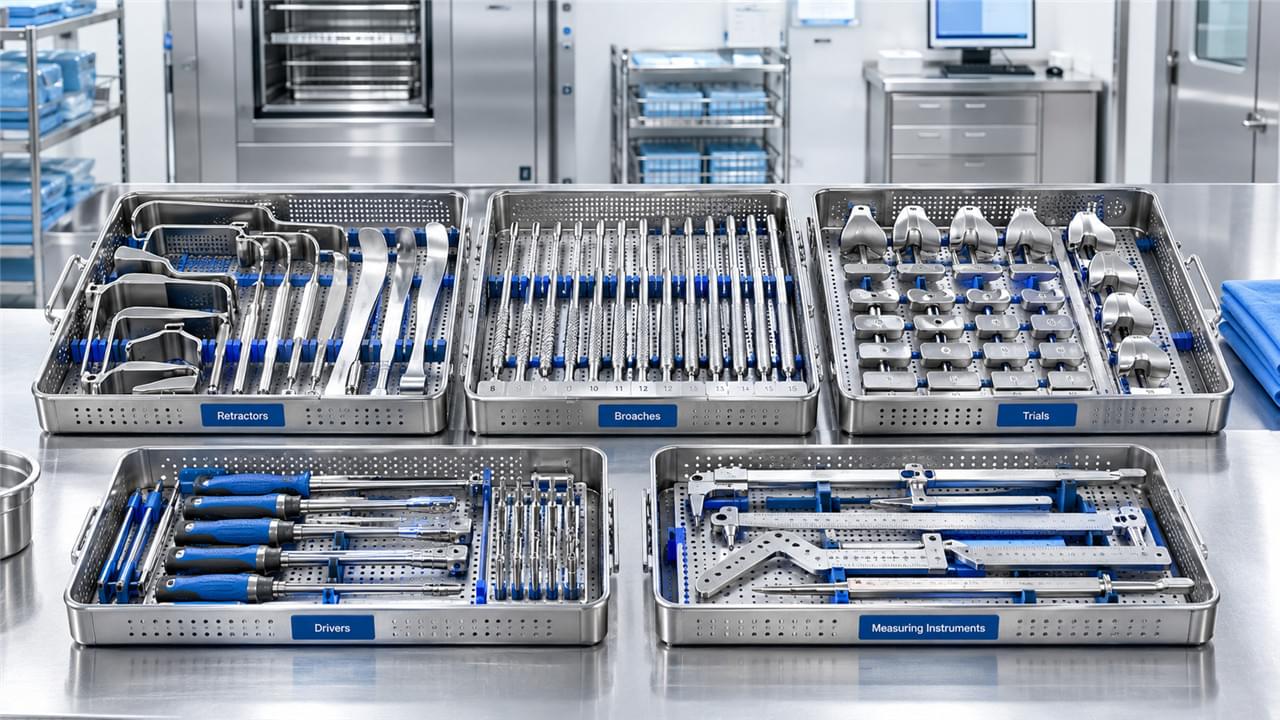
- Acetabular module: Reamer system (sequence of 2mm increments, 42–76mm range), cup impactor, trial components
- Femoral module: Broach set (10–15 sizes per system), handle, trials, caliper, stem impactor
- Universal module: Retractors, mallet, extractor, cleaning instruments
Total Knee Arthroplasty (TKA) Set Summary
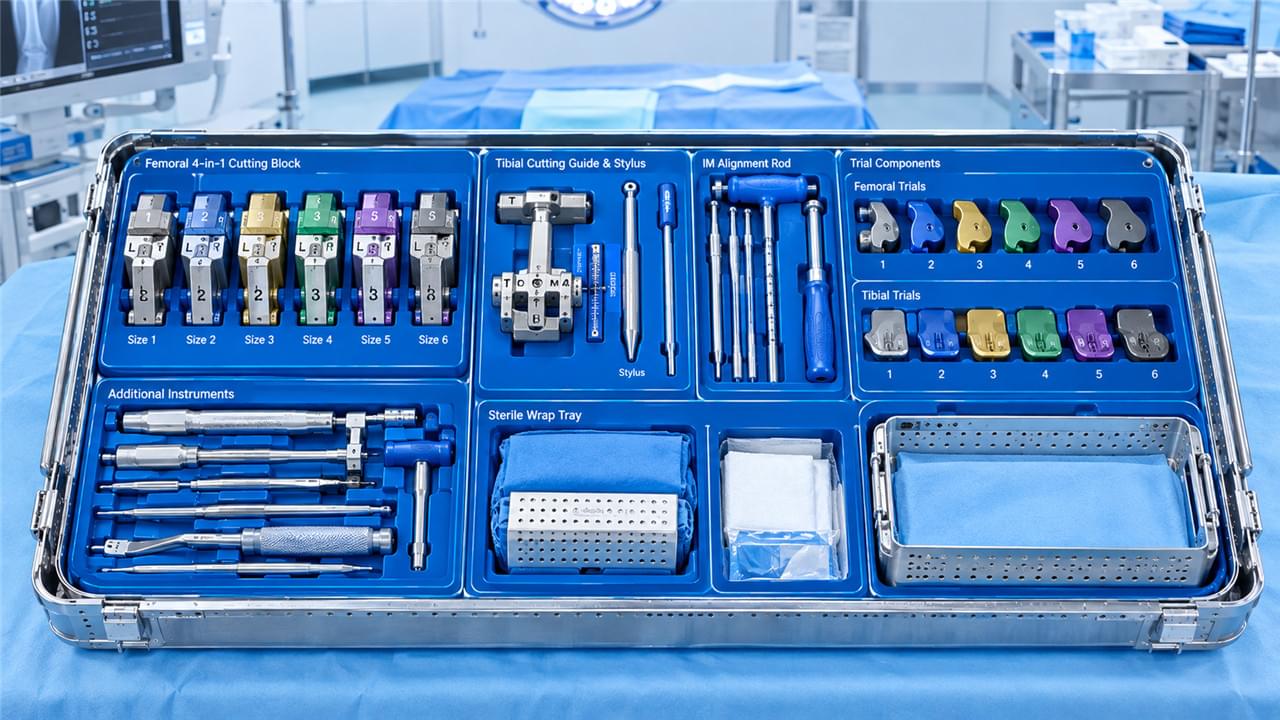
TKA sets are the most complex in orthopedics. Key modules:
- Alignment module: IM rod, extramedullary guide, ankle clamp
- Femoral resection module: Distal cutting guide, 4-in-1 cutting block, sizing guides
- Tibial resection module: Tibial cutting guide, stylus, slope adjustment
- Trialing module: All size femoral and tibial trials, insert trials
- Implantation module: Implant impactors, cement pressurizers, sizing handles
For a clinical grounding in how these instruments shape the procedure, the StatPearls guide to total knee replacement techniques covers the bone cuts each module supports.
🧍 Spine Instrument Sets
Posterior Lumbar Fusion Set
Spine surgery instrument sets are highly technique-specific:
Access and exposure:
- Tubular retractor system (MIS approach) or open retractors (Caspar, McCulloch)
- Curettes (straight and angled)
- Rongeurs (pituitary, Kerrison, Leksell)
Pedicle screw placement:
- Pedicle probe (starter awl)
- Pedicle tap (appropriate diameter for screw size)
- Pedicle screw driver with shaft and handle
- Ball probe for pedicle breach detection
- Fluoroscopy-compatible K-wire for pedicle targeting
Rod placement:
- Rod cutter and bender
- Rod persuader/reducer
- In-situ bender
- Torque wrench for final set screw tightening
Interbody module (TLIF/PLIF):
- Disc space preparation rasps and shavers
- Trial cage inserter (multiple cage sizes)
- Cage inserter and impactor
📊 Procedure-Specific Configuration Comparison
How Each Orthopedic Instrument Tray Compares
| Procedure | Approx. Instrument Count | Set Weight | Complexity | Key Specialized Instruments |
|---|---|---|---|---|
| Long bone plating | 40–60 | 5–8 kg | Moderate | Reduction forceps, plate bender |
| IM nailing | 30–50 | 4–7 kg | Moderate | Targeting guide, reamer system |
| Total Hip Arthroplasty | 60–100 | 8–15 kg | High | Broach set, reamer, caliper |
| Total Knee Arthroplasty | 80–120 | 10–18 kg | Very High | Cutting guide system, trials |
| Posterior spinal fusion | 50–80 | 7–12 kg | High | Rongeurs, rod system, pedicle tools |
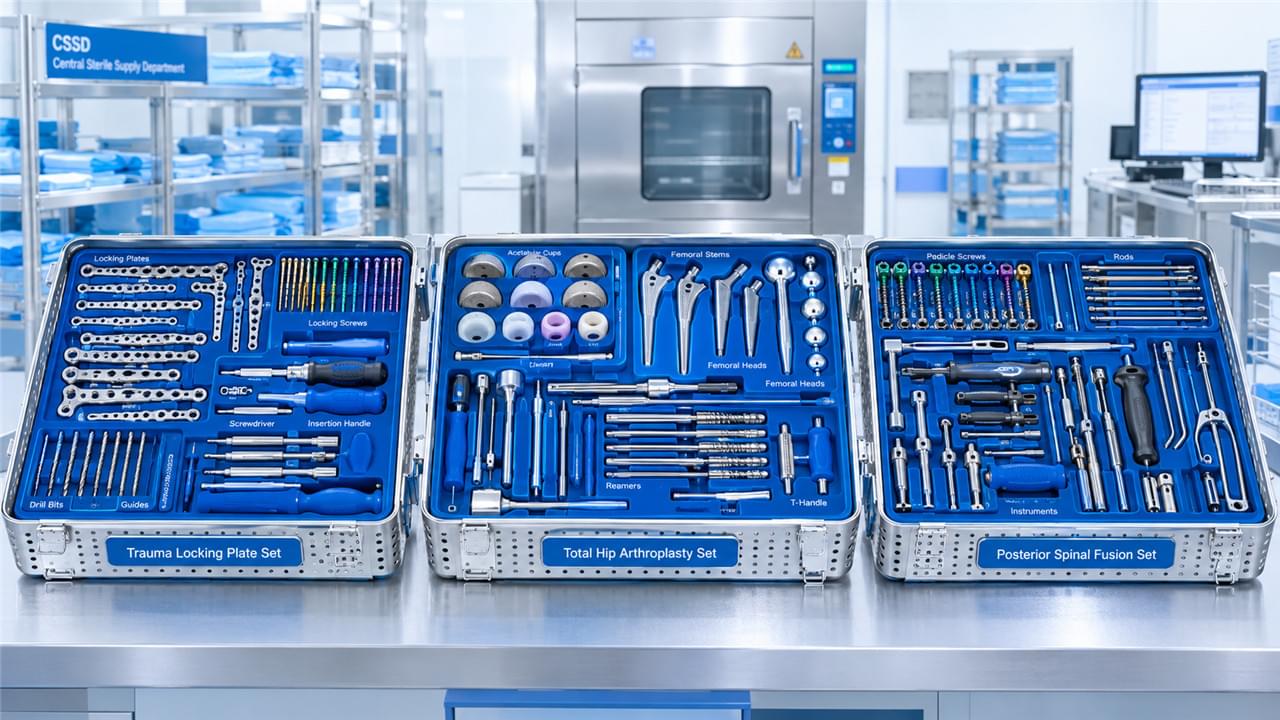
Notice the pattern? Trauma trays are lean and versatile; arthroplasty trays are heavy and implant-specific. Your storage footprint and CSSD workload follow the same curve.
❓ FAQ: Choosing an Orthopedic Trauma Instrument Set and Beyond
Q1: What is included in a basic orthopedic trauma instrument set?
A basic locking plate trauma set includes: drill bits, drill guides, depth gauge, screwdrivers, torque limiter, reduction forceps, plate holders, and plate bender. Approximately 40–60 instruments.
Q2: Are THA and TKA instrument sets interchangeable?
No. THA and TKA instrument sets are system-specific — they are designed and validated specifically for each implant manufacturer’s implant dimensions and surgical technique. Cross-use between brands is not appropriate.
Q3: Can one IM nail instrument set work for multiple nail systems?
Generally no — targeting arms and interlocking guides are specific to nail dimensions and locking hole positions. However, some general instruments (reduction tools, general awls) may be shared between compatible systems at the surgeon’s discretion.
Q4: How are instrument sets organized in the OR?
Instruments are arranged in sterilization trays with custom foam or silicone inserts holding each instrument in a specific position. This “organized tray” system enables rapid instrument identification, count verification, and detection of missing instruments.
Q5: What is the difference between implant trials and final implants?
Trials are non-sterile, non-implantable replica components of the same dimensions as final implants. They are used intraoperatively to verify correct sizing before the sterile final implant is opened. Trials go through the instrument set sterilization cycle; final implants are supplied sterile in sealed packaging.
🏁 Conclusion
Standard orthopedic trauma instrument sets, joint replacement sets, and spine surgery sets each have specific compositions matched to their clinical requirements. Understanding these configurations enables better procurement planning, supplier evaluation, and OR management.
Return to: Orthopedic Instrument Sets: Composition, Configuration & Best Practices.
Medical Disclaimer
Informational purposes only. Instrument set composition must be confirmed with implant manufacturer documentation.

 English
 Arabic
 French
 German
 Italian
 Japanese
 Korean
 Portuguese
 Turkish
 Russian
 Spanish