


The orthopedic instrument set is the organized collection of specialized surgical instruments required to perform a specific orthopedic procedure. Without a complete, properly maintained set, even the best implant can’t be correctly placed — it’s that simple. For hospitals, OR efficiency lives or dies on well-configured instrument sets. For manufacturers and distributors, they’re a critical commercial product line that drives implant sales and builds lasting hospital relationships.
This guide covers composition, procedure-based surgical instrument configuration, sterilization management, cost optimization, and innovation trends. For deeper dives, explore our cluster articles: Standard Orthopedic Instrument Sets by Procedure, How to Configure Cost-Effective Kits, Reusable vs Disposable Instruments, Sterilization Standards, and Innovation Trends.
🦴 What Is an Orthopedic Instrument Set?
An orthopedic instrument set (also called a surgical instrument tray, kit, or implant instrument set) is a curated collection of specialized orthopedic surgical instruments packaged together to enable a specific procedure. A complete set includes:
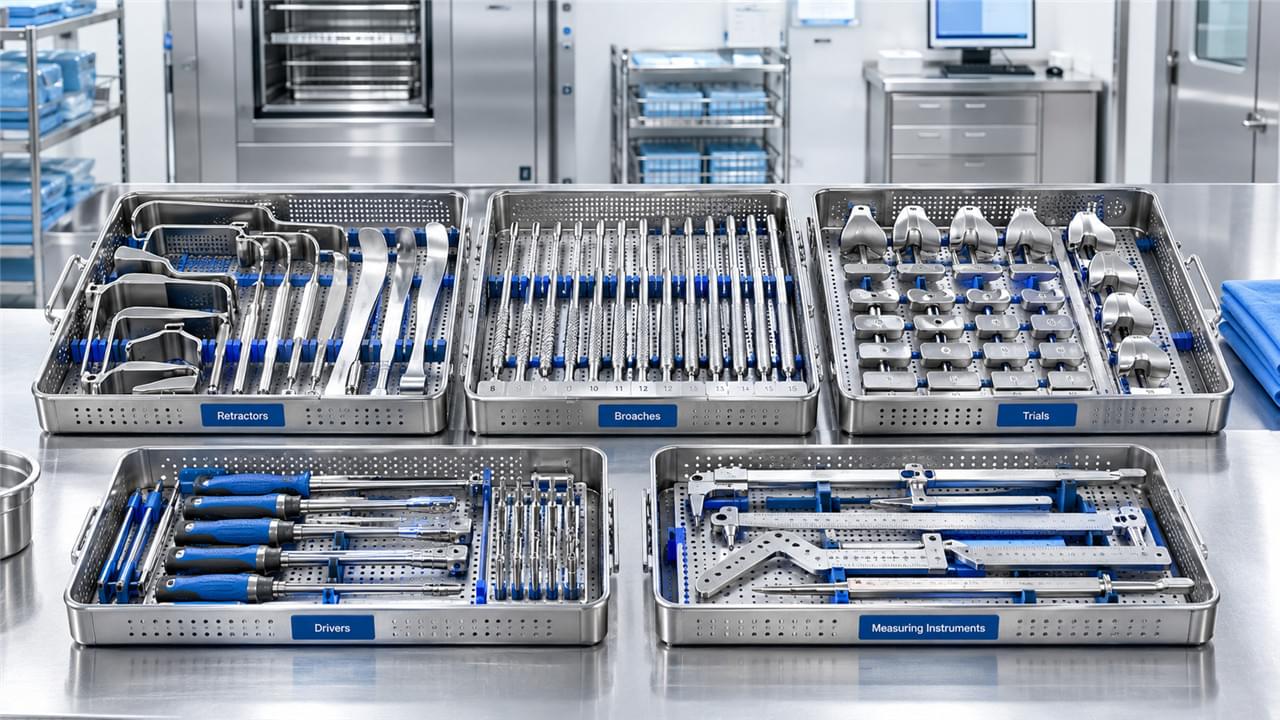
Inside an Orthopedic Instrument Set: The Six Instrument Families
- Exposure instruments: Retractors, elevators, hooks — providing surgical access to the bone
- Bone preparation instruments: Gouges, rasps, chisels, osteotomes — shaping bone to receive implants
- Implant-specific instruments: Sizing trials, broaches, impactors, extractors — matched to each implant system
- Measuring instruments: Depth gauges, calipers, offset guides — ensuring correct implant sizing
- Fixation instruments: Screw drivers, drivers, torque wrenches — for screw and component insertion
- Sterilization tray/container: A custom-fitted tray holding every instrument in its designated position
🧰 Classification by Surgical Procedure
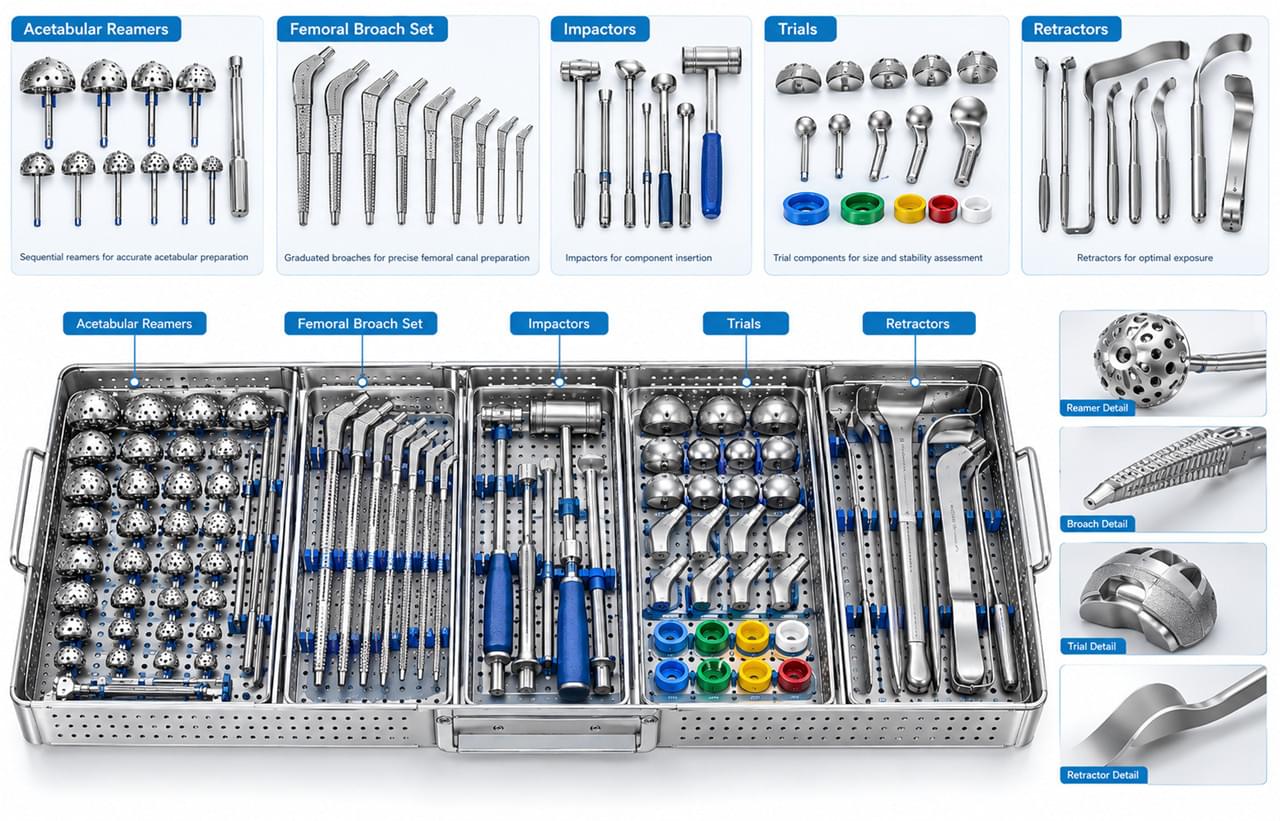
The THA Orthopedic Instrument Set
A complete THA orthopedic instrument set includes:
Acetabular side:
- Acetabular reamers (hemispherical, graduated sizes)
- Acetabular cup impactor and extraction handle
- Acetabular trial components (multiple sizes)
- Liner impactor
Femoral side:
- Femoral broach set (progressive sizes matching the implant stem)
- Broach handle
- Femoral head trials (multiple diameters)
- Neck resection guide
- Femoral stem impactor
- Leg length caliper
General:
- Retractor set (Hohmann, bent-tip, Aufranc)
- Mallet (standard and light)
- Ruler and depth gauge
- Component extractor
A standard THA set contains 60–100+ individual instruments in a dedicated sterilization tray. Total set weight: 8–15 kg.
The TKA Orthopedic Instrument Set
TKA sets are among the most complex, with multiple alignment guides, cutting guides, and trialing components:
Distal femoral cutting system:
- Intramedullary alignment rod
- Distal femoral cutting guide with variable valgus angle settings
- Distal femoral resection guide
- Femoral rotation guide (4-in-1 cutting block)
Tibial cutting system:
- Extramedullary alignment guide
- Tibial cutting guide
- Tibial resection guide
Trialing system:
- Femoral trial components (multiple sizes)
- Tibial tray trials (multiple sizes)
- Polyethylene insert trials (multiple thicknesses)
Final implantation:
- Femoral and tibial cement pressurizers (cemented technique)
- Tibial keel punch (cementless)
- Femoral component impactor
- Tibial tray impactor
TKA sets typically contain 80–120+ instruments; many systems now offer modular “reduced set” configurations for ambulatory surgery centers.
How a Trauma Orthopedic Instrument Set Is Organized
Trauma sets are organized around implant systems rather than a single procedure:
LCP/Plate Set:
- Drill bits (matching plate screw diameters)
- Drill guide (combination drill/depth gauge)
- Depth gauge
- Tap (for cortical screws)
- Plate bender
- Screw drivers (hexagonal, star, slotted)
- Plate-holding forceps
- Reduction forceps
IM Nail Set:
- Entry awl/opening chisel
- Ball-tipped guidewire
- Flexible reamer set (see: Surgical Power Tools)
- Nail insertion handle
- Targeting arm (for interlocking screw placement)
- Interlocking drill guide
- Depth gauge
⚖️ Standard vs. Customized Instrument Sets
Standard Sets
Most manufacturers offer standardized orthopedic instrument kits supplied with each implant system:
- Designed for the broadest patient population
- Validated for the complete procedure sequence
- Regulatory submission covers the standard set composition
- Supports field representative-driven surgical training
Customized/Reduced Sets
Increasingly popular in ambulatory surgery center (ASC) environments:
- Reduced instrument count — only what common cases actually need
- Lower set weight — less logistical burden on CSSD
- Faster processing — fewer instruments to clean and inspect
- Cost savings — less capital tied up in rarely-used instruments
Choosing the Right Orthopedic Instrument Set Configuration
Customization demands careful analysis of case mix and surgeon technique preferences — cut the wrong instruments and you’ll get “missing instrument” disruptions mid-case, which nobody enjoys.
For procurement guidance, see: How to Configure Cost-Effective Orthopedic Instrument Kits.
🧪 Material and Manufacturing Considerations
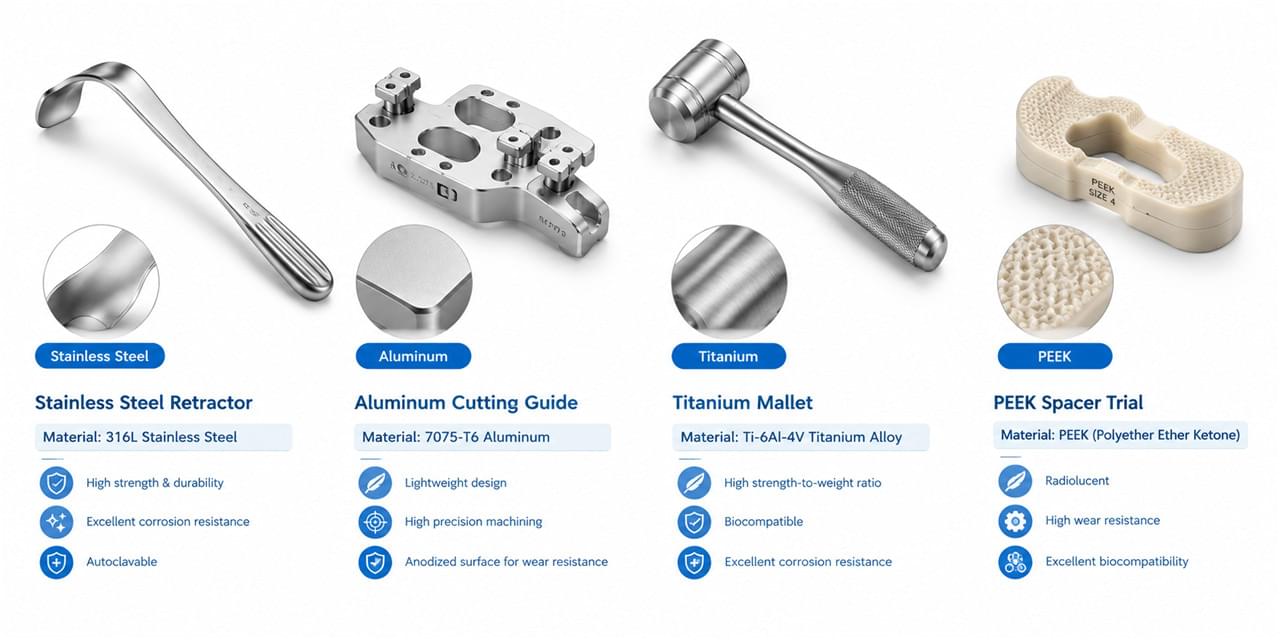
Stainless steel (17-4 PH, 304, 316L):
- The workhorse material for reusable orthopedic instruments
- Excellent corrosion resistance after passivation treatment (per ASTM A967)
- Autoclave compatible
- Requires precise machining for cutting edges and fitting surfaces
Aluminum alloy:
- Used for retractor handles, frames, and cutting guide bodies
- Lighter than steel — reduces overall set weight
- Color anodization used for size coding
Titanium alloy:
- Premium tier — lighter than steel with excellent corrosion resistance
- Found in mallet heads and cutting guides in premium sets
- Significantly higher cost
PEEK:
- Used for spacer trials and alignment guides
- Radiolucent — allows intraoperative imaging without removing the instrument
Manufacturing quality for orthopedic instrument sets requires:
- Investment casting or precision CNC machining for complex cutting geometry
- Passivation of all stainless steel components (per ASTM A967)
- Electropolishing of contact surfaces
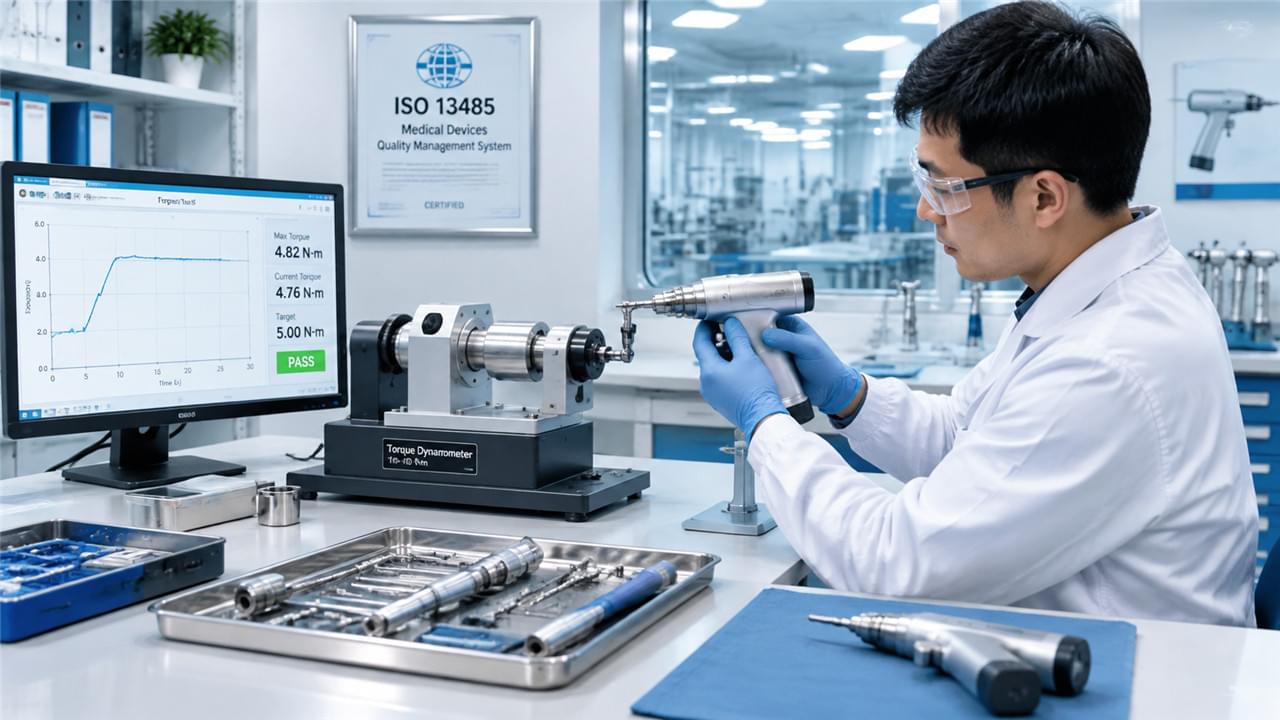
- Dimensional verification per engineering drawings
- Functional testing (fit verification with matching implants)
🔥 Sterilization and Lifecycle Management
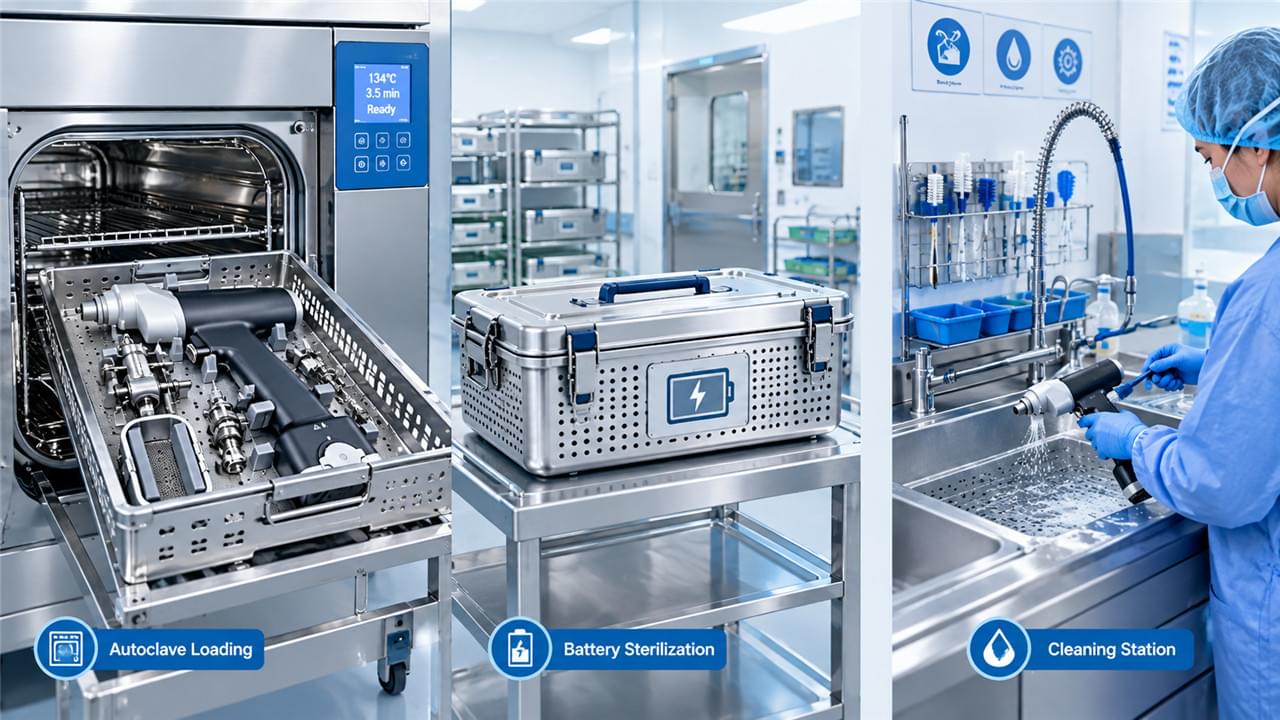
All orthopedic instrument sets must run through validated sterilization cycles between procedures — the CDC’s sterilization recommendations provide the framework most facilities build on:
Sterilization and Lifecycle Management of the Orthopedic Instrument Set
Standard protocol:
- Point-of-use pre-cleaning
- Transport to CSSD
- Manual/automated washing (washer-disinfector)
- Visual inspection
- Assembly in sterilization tray
- Steam autoclave (134°C pre-vacuum)
- Sterility verification
- Storage and distribution
Lifecycle management:
- Instruments inspected for wear, damage, and functional degradation at every processing cycle
- Worn cutting edges, bent retractors, and damaged screw drivers replaced on condition
- Each instrument tracked through sterilization cycles via RFID or barcode
- Manufacturers specify maximum service life for precision instruments
For detailed sterilization standards, see: Sterilization Standards for Orthopedic Surgical Instruments.
💰 Cost Efficiency for Hospitals and Distributors
Orthopedic instrument sets represent serious capital investment:
- Standard THA instrument set: USD 10,000–35,000+
- Standard TKA instrument set: USD 15,000–50,000+
- Complete trauma plate system: USD 5,000–20,000+
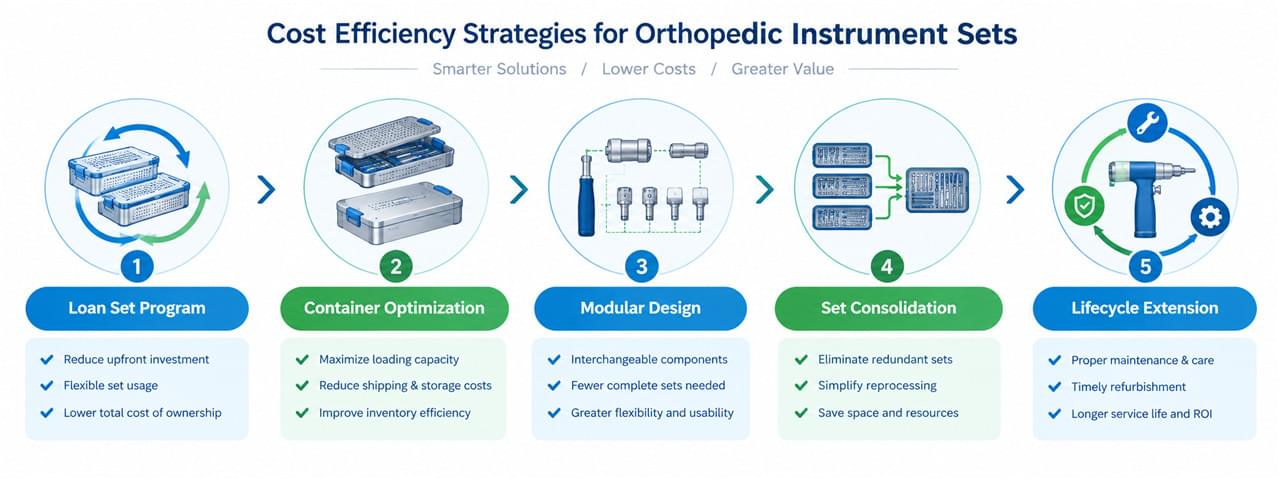
Cost efficiency strategies:
- Loan set programs: Manufacturers loan sets to hospitals, recovering cost through implant sales
- Container optimization: Reduce per-procedure set weight to cut CSSD processing cost
- Modular set design: Core set + procedure-specific add-on modules
- Set consolidation: Fewer total sets required through careful case scheduling
- Instrument lifecycle extension: Preventive maintenance programs stretch service life
❓ FAQ: Orthopedic Instrument Sets
Q1: How many instruments are typically in a TKA instrument set?
A complete TKA instrument set typically contains 80–120+ individual instruments. Reduced/modular sets for ambulatory surgery centers may carry 40–60 instruments covering common case configurations.
Q2: What material is used for orthopedic surgical instruments?
Primarily 17-4 PH stainless steel (precipitation hardened) for high-stress instruments, 304/316L stainless steel for general instruments, and aluminum alloy for frames and guides. Premium sets may incorporate titanium and PEEK components.
Q3: What is a “loaner” instrument set in orthopedics?
A loaner set is provided by the implant manufacturer or distributor on a per-case loan basis. The hospital uses it for surgery and returns it for processing. Most major orthopedic manufacturers rely on loaner sets commercially, particularly in new accounts.
Q4: How often should orthopedic instrument sets be replaced?
Individual instruments are replaced on condition (when worn, damaged, or functionally degraded). Complete sets are typically redesigned every 5–10 years alongside major implant system revisions. Lifecycle tracking enables data-driven replacement decisions.
Q5: Can hospitals customize their instrument sets?
Yes, in collaboration with the manufacturer or distributor. Customization must ensure the modified set still supports the complete surgical sequence safely. Some manufacturers offer formal customization programs with regulatory documentation support.
🏁 Conclusion
The orthopedic instrument set is far more than a collection of tools — it’s a precisely engineered enabler of safe, efficient orthopedic surgery. For manufacturers, instrument set quality reflects directly on the implant system’s reputation. For hospitals, well-configured, well-maintained sets translate into surgical efficiency, fewer complications, and lower total procedure costs.
Ready to discuss orthopedic instrument set development, OEM manufacturing, or hospital optimization? Contact our team for technical consultation and product capabilities.
Medical Disclaimer
This article is for informational purposes only, directed at medical device industry professionals. Surgical instrument selection and configuration decisions should involve qualified OR management and surgical teams.
 English
 Arabic
 French
 German
 Italian
 Japanese
 Korean
 Portuguese
 Turkish
 Russian
 Spanish