


Orthopedic power tool sterilization is a non-negotiable patient safety requirement. Every power tool that enters the sterile field must be effectively cleaned, decontaminated, and sterilized between procedures — no exceptions, no shortcuts. Failures here create infection risk, device malfunction, and regulatory liability in one fell swoop.
The good news? The process is entirely learnable. This article is part of: Orthopedic Surgical Power Tools: Technology, Selection & Maintenance.
📋 Sterilization Compatibility: Understanding IFU Requirements
Every orthopedic power tool ships with manufacturer Instructions for Use (IFU) specifying exact cleaning and sterilization parameters. Following the IFU isn’t optional — it’s required for:
- Maintaining regulatory compliance (FDA, EU MDR)
- Preserving the manufacturer warranty
- Ensuring sterilization validation claims actually hold
The FDA guidance on reprocessing of medical devices and WHO infection prevention guidelines provide the overarching regulatory framework.
🧼 Pre-Cleaning: The Most Critical Step
Here’s a hard truth from sterile processing: the sterilization cycle can’t rescue a poorly cleaned instrument.
Why Orthopedic Power Tool Sterilization Starts Before the Autoclave
The CDC’s sterilizing practices guidance is blunt about this: items must be cleaned with detergents or enzymatic cleaners before sterilization, because organic residue shields microorganisms from the sterilant. Effective orthopedic power tool sterilization therefore begins the moment the tool leaves the surgical field.
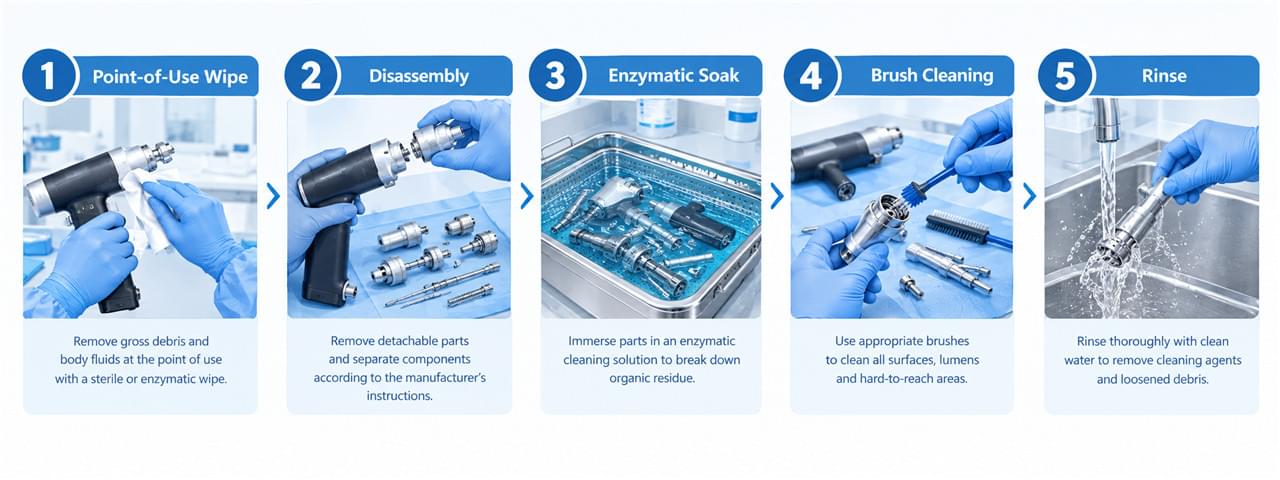
Immediate post-use handling:
- Remove gross bone debris and tissue at point of use (damp gauze wipe)
- Place in a transport container — never let organic material dry on surfaces
- Transport to the decontamination area within 60 minutes
Manual cleaning protocol — the standard power tool cleaning protocol:
- Disassemble per IFU (chuck, attachments, battery if applicable)
- Submerge in enzymatic detergent solution (per IFU dilution and soak time)
- Manual brush cleaning of all surfaces, grooves, and chuck interior
- High-pressure water rinse
- Ultrasonic bath (where manufacturer-permitted) for internal channels
- Final rinse with purified/RO water
- Lubrication per IFU before sterilization
Critical points:
- Enzymatic soak time must be respected — shortcuts leave organic residue behind
- The chuck interior needs dedicated brush cleaning — it’s the most commonly neglected spot on any surgical drill
- Drying before sterilization is essential — moisture interferes with steam penetration
🔥 Autoclave Compatibility
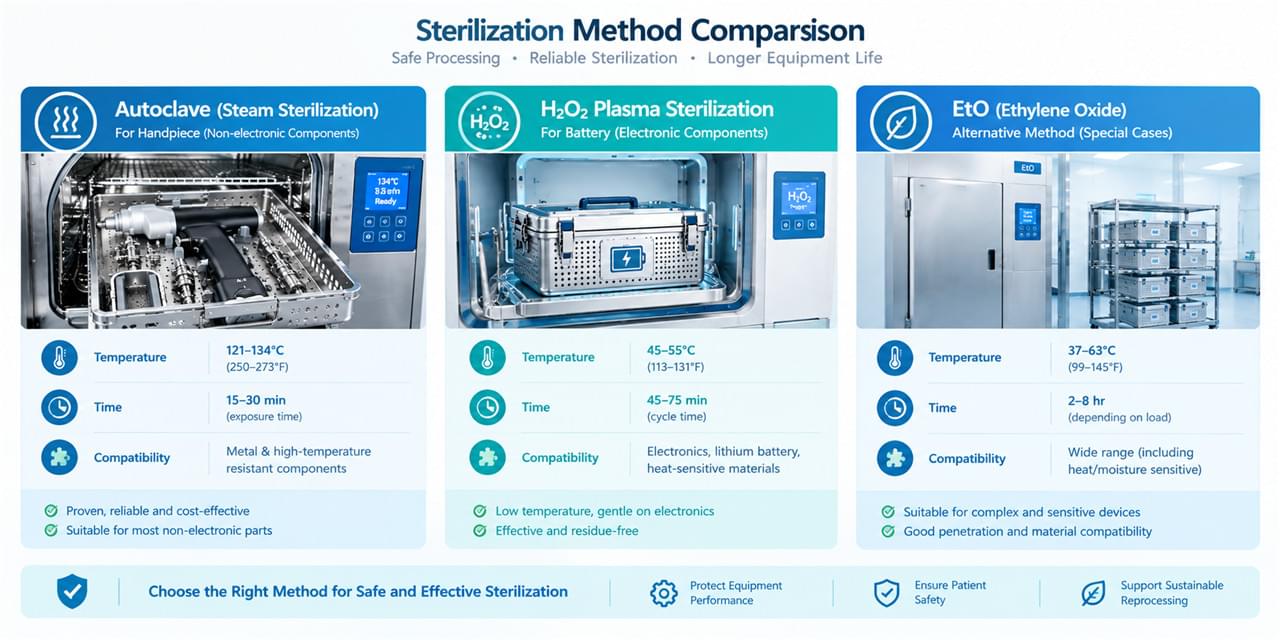
When teams autoclave orthopedic tools, the steam cycle (134°C pre-vacuum) is the standard method for handpieces:
Autoclave Parameters for Orthopedic Power Tool Sterilization
Standard orthopedic power tool sterilization parameters:
- Temperature: 134°C (273°F)
- Pressure: 2.2 bar / 32 psi
- Holding time: 3–4 minutes at temperature
- Cycle type: Pre-vacuum (fractional vacuum) or gravity displacement, depending on instrument design
IFU compliance points:
- Maximum sterilization temperature per device (some tools specify 134°C max, others 137°C)
- Maximum number of cycles before recommended inspection/replacement
- Wrapped vs. unwrapped sterilization
- Sterilization container compatibility
Post-sterilization:
- Allow full cooling and drying before storage
- Inspect for moisture before transferring to the sterile field
- Check packaging integrity before use
❄️ Battery Packs: The Exception
Low-Temperature Orthopedic Power Tool Sterilization for Battery Packs
Battery packs can’t survive 134°C — autoclave them and you’ll fry the electronics and void the warranty. The FDA’s overview of medical device sterilization methods details the validated low-temperature alternatives used across the industry:
Ethylene Oxide (EtO):
- 37°C or 55°C cycle
- Long aeration period required (12–24 hours)
- Effective but slow — high-volume centers need multiple battery sets to stay in rotation
Hydrogen Peroxide Plasma (STERRAD-type):
- 45–55°C cycle, 30–55 minute cycle time
- Faster turnaround than EtO
- Many newer battery systems are validated for H₂O₂ plasma
- The preferred method for modern battery tool sterilization
Manufacturer-proprietary sterilization containers:
- Some manufacturers supply rigid containers designed to protect battery packs through modified steam cycles
- These demand strict IFU adherence — they’re not interchangeable across brands
🔧 Maintenance Cycles
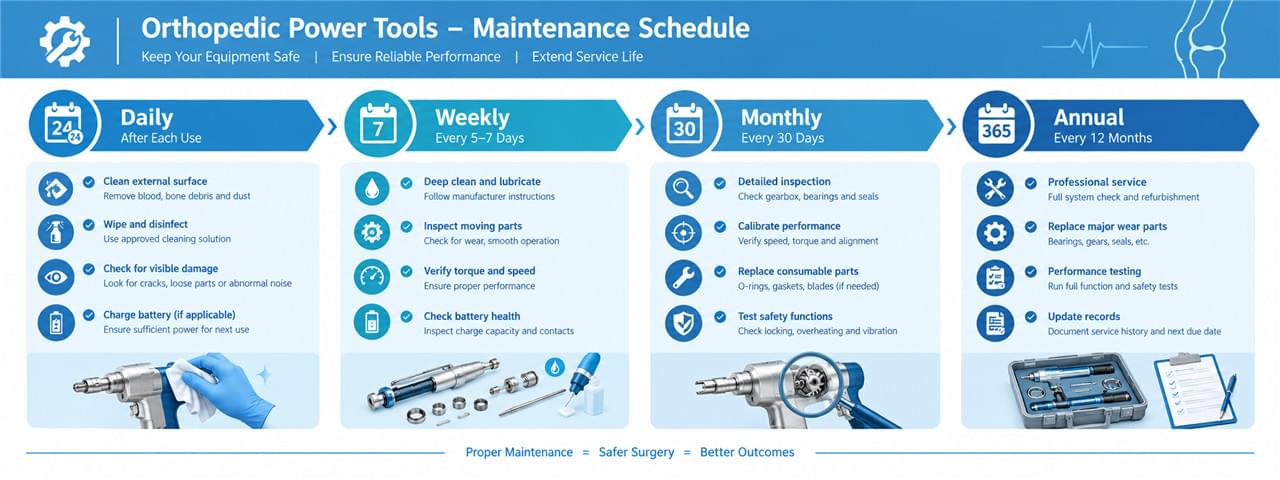
Regular preventive maintenance — the backbone of surgical drill maintenance — extends tool lifespan and keeps performance consistent:
After each procedure:
- Visual inspection for damage (chuck jaws, trigger mechanism, blade retention)
- Lubrication of moving parts per IFU
- Blade/bit replacement if worn
Weekly / every 10 procedures:
- Torque output test (using a calibration torque gauge)
- Speed test at rated RPM
- Chuck retention force test
- Battery capacity test (discharge cycle)
Monthly / quarterly:
- Full disassembly inspection by a trained biomedical technician
- Bearing inspection and replacement if worn
- Motor brush inspection (where applicable)
- Seal and O-ring inspection
Annual:
- Full manufacturer service inspection
- Calibration certificate renewal
- Battery replacement assessment
📡 Cycle Tracking & Maintenance Records
Digital Tracking for Orthopedic Power Tool Sterilization Programs
Modern orthopedic power tool sterilization management increasingly runs on digital tracking — and frankly, it’s about time:
- RFID tags on instruments enable automated sterilization cycle logging
- Cycle counter databases track total autoclave exposures per tool
- Alerts fire when tools approach manufacturer-specified maximum cycle counts
- Integration with hospital CSSD (Central Sterile Services Department) workflow systems
If your facility is still logging cycles on paper, this is the upgrade that pays for itself in prevented equipment failures.
❓ FAQ: Orthopedic Power Tool Sterilization
Q1: Can orthopedic power tool handpieces be autoclaved?
Yes — orthopedic power tool sterilization for most modern handpieces uses the 134°C pre-vacuum steam autoclave cycle. Always follow the manufacturer IFU for exact parameters and maximum cycle limits.
Q2: How are battery packs sterilized?
Via low-temperature methods: EtO, hydrogen peroxide plasma (STERRAD), or manufacturer-validated sterilization containers. Autoclaving battery packs will damage the electronics and void the warranty — a costly mistake.
Q3: How many autoclave cycles can a typical orthopedic drill handpiece withstand?
Manufacturer ratings vary: typically 500–1,500 autoclave cycles before recommended inspection or replacement. Track tools against these counts using RFID or manual logging.
Q4: What lubricant is used for orthopedic power tools?
Medical-grade instrument lubricants specifically validated for the device. Never use general machine oil or WD-40 equivalents — they’re not biocompatible and may interfere with sterilization. Use only products listed in the manufacturer IFU.
Q5: What is the consequence of inadequate cleaning before sterilization?
Organic residue (blood, bone, protein) can shield microorganisms from the sterilant. Inadequately cleaned instruments may be declared sterile while actually harboring viable pathogens. Pre-cleaning matters more to sterility assurance than the sterilization cycle itself.
🏁 Conclusion
Orthopedic power tool sterilization is a patient safety imperative built on three pillars: rigorous IFU adherence, systematic pre-cleaning, and disciplined cycle tracking. For manufacturers, sterilization compatibility and validated cleaning protocols are product attributes that directly influence hospital adoption. For OR managers, structured maintenance programs protect the capital investment and keep every handpiece performing like day one.
Return to: Orthopedic Surgical Power Tools: Technology, Selection & Maintenance.
Medical Disclaimer
Informational purposes only. All sterilization and maintenance must follow device-specific IFU and institutional sterile processing protocols.

 English
 Arabic
 French
 German
 Italian
 Japanese
 Korean
 Portuguese
 Turkish
 Russian
 Spanish