


Orthopedic surgical power tools are the quiet enablers of modern bone surgery. Drill a pilot hole for a screw, resect bone for a joint replacement, ream a canal for a nail — none of it happens without a motorized instrument that performs consistently, case after case, under the most demanding sterile conditions.
For manufacturers, OEM/ODM partners, procurement specialists, and global distributors, understanding the technology, selection criteria, and maintenance demands of orthopedic surgical power tools is the foundation of competitive product development and evidence-based purchasing. Get the fundamentals right and everything downstream — sales, service, trust — gets easier.
This guide covers all major tool categories. For specific subjects, see our cluster articles: Types of Orthopedic Power Tools, Corded vs Battery-Powered Tools, Key Performance Parameters, Sterilization and Maintenance, and Quality and Safety in Manufacture.
🛠️ Introduction to Orthopedic Surgical Power Tools
Orthopedic surgical power tools cover every motorized device used to cut, drill, ream, drive, or shape bone and surrounding structures. They’re the critical enablers for:
- Implant insertion — drilling, reaming, driving
- Bone resection — oscillating and sagittal saws
- Canal preparation — intramedullary reamers
- Fixation — wire drivers and screwdrivers
- Arthroplasty — reciprocating saws, oscillating saws, reamers
The global market sits at roughly USD 1.8–2.2 billion in 2026, growing at about 5% CAGR. Major players include Stryker (System 7), DePuy Synthes (eMMC), Zimmer Biomet, ConMed Linvatec, and a growing roster of OEM/ODM manufacturers across Asia and Europe.
For market context, see: Global Orthopedic Devices Market.
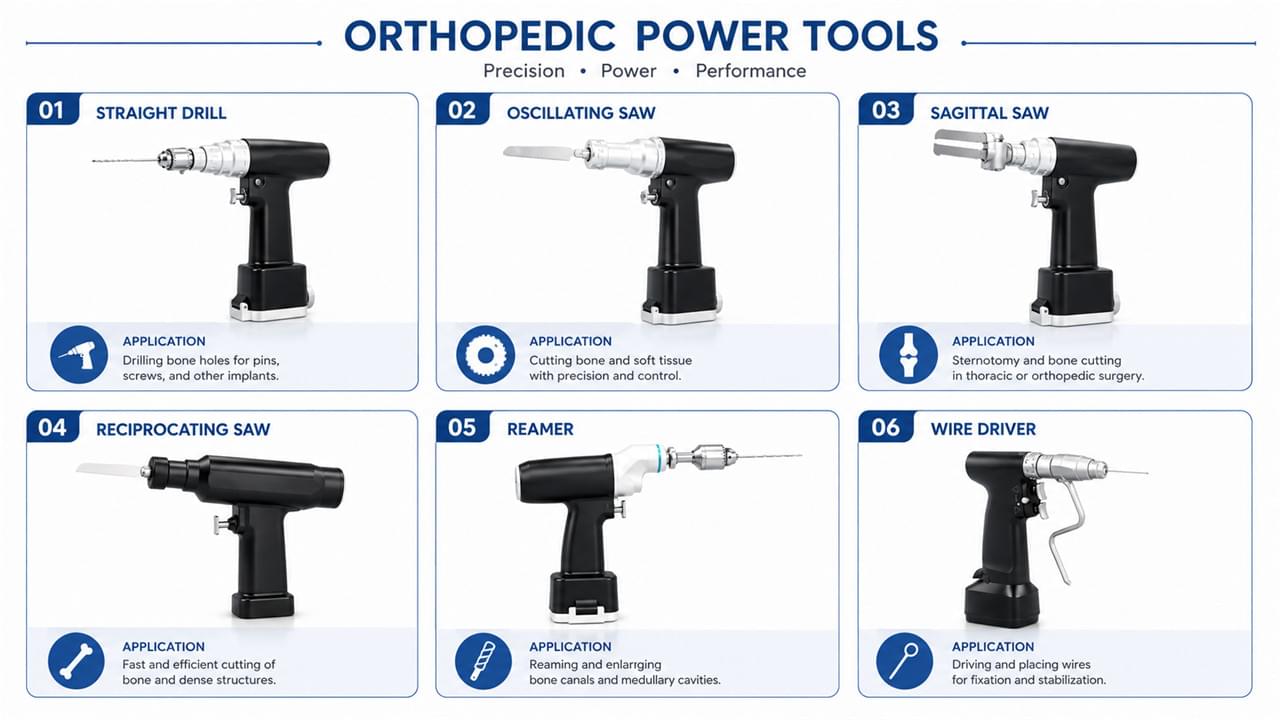
🧰 Main Types of Orthopedic Surgical Power Tools
These are the surgical power tools orthopedic teams reach for every day. Each type has its own personality, and knowing the differences is where smart buying starts.
1. Drills: The Essential Orthopedic Surgical Power Tool
The most fundamental orthopedic surgical power tool on any tray. Uses include:
- Drilling pilot holes for bone screws in trauma fixation
- Reaming femoral canals for IM nail placement
- Creating K-wire entry points
- Cannulated drilling over guide wires
Design variants:
- Straight drill: standard straight-handle configuration
- Pistol-grip drill: angled handle for better ergonomics and control
- Angled attachments: reach anatomically restricted areas like the acetabulum and spine
Key specs:
- Speed: 1,000–2,000 RPM for bone drilling
- Torque: variable; stall torque of 2–6 Nm is typical
- Chuck: AO quick-release (standard in orthopedics) or Jacobs chuck
When you’re specifying an orthopedic drill and saw system, remember the chuck matters as much as the motor — it’s the interface every accessory depends on.
2. Oscillating Saws: The Workhorse Orthopedic Surgical Power Tool
Oscillating saws drive a blade in a rapid back-and-forth arc:
- Application: total knee arthroplasty (TKA) bone cuts; total hip calcar resection; general bone resection
- Frequency: 10,000–18,000 oscillations per minute (OPM)
- Arc: typically 2–6°
- Blades: wide resection, narrow, and angled options
- Key advantage: precise, controllable cuts with lower thermal generation than sagittal saws
3. Sagittal Saws: The Precision Orthopedic Surgical Power Tool
Sagittal saws oscillate in the plane of the handle rather than across it:
- Application: soft tissue splitting, fibula resection, cortical bone cuts
- Motion: in-line oscillation, versus the transverse motion of oscillating saws
- Arthroplasty roles: tibial cuts, acetabular rim preparation
4. Reciprocating Saws: The Heavy-Duty Orthopedic Surgical Power Tool
Reciprocating saws use aggressive back-and-forth linear motion:
- Applications: implant removal (cutting around well-fixed implants), bone resection in tumor surgery, cement removal in revision arthroplasty
- Key feature: aggressive cutting action with variable blade widths
5. Reamers: The Specialized Orthopedic Surgical Power Tool
Dedicated to intramedullary canal preparation:
- Application: femoral and tibial IM nail canals; acetabular reaming for hip cups
- Tip types: flexible reamers for curved canals, solid reamers, acetabular hemispherical reamers
- Speed: 100–300 RPM for IM reaming; 200–400 RPM for acetabular reaming
6. Wire Drivers and Screwdrivers: The High-Speed and High-Torque Orthopedic Surgical Power Tools
- Wire drivers: high-speed (up to 1,500 RPM) for K-wire insertion
- Screwdrivers: low-speed, high-torque for bone screws; torque-limiting models prevent over-tightening
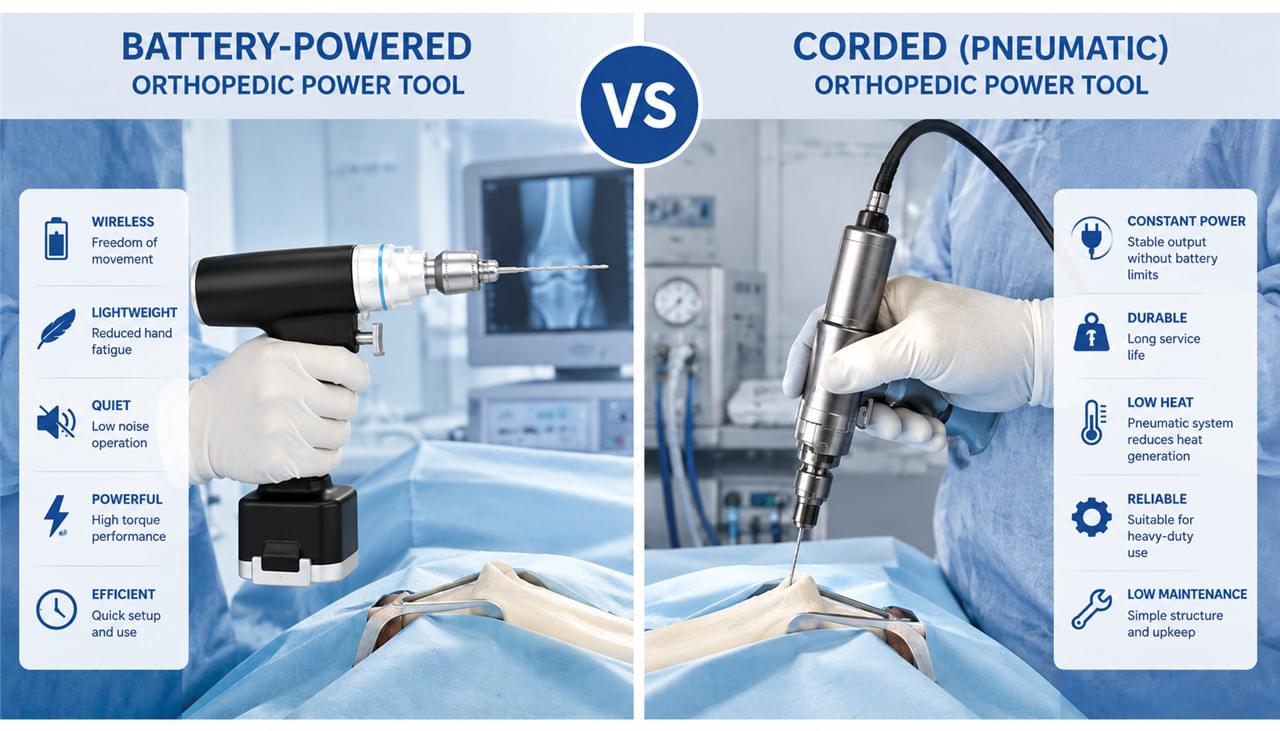
🔋 Corded vs. Battery-Powered Systems
This is one of the most commercially significant decisions in orthopedic surgical power tools. See the detailed comparison: Corded vs Battery-Powered Orthopedic Tools.
| Parameter | Battery-Powered | Corded (Pneumatic or Electric) |
|---|---|---|
| Mobility | Excellent | Limited by cable/hose |
| Power consistency | Degrades as battery depletes | Consistent |
| Sterilization | Battery + handpiece (complex) | Handpiece only |
| Purchase cost | Higher (battery, charger) | Lower upfront |
| Operating cost | Battery replacement cycle | Lower long-term |
| Emergency backup | Extra batteries needed | Air supply backup |
The honest truth: modern lithium-ion packs (14.4V–18V) have largely closed the performance gap with corded systems. Battery powered orthopedic tools now handle most standard procedures without complaint — the trade-off has shifted from capability to logistics.
⚙️ Performance, Torque and Speed Considerations
Orthopedic surgical power tools only perform as well as their parameters match the clinical task. Three rules of thumb:
Drilling: Heat Is the Enemy
- Too fast = thermal necrosis of bone (above 47°C kills osteocytes)
- Too slow = excessive force and chatter
- Optimal: 800–1,500 RPM for 3.2–4.5mm bits in cortical bone
The numbers aren’t guesswork. A landmark study on bone drilling parameters demonstrated that external irrigation keeps bone temperature below the critical threshold across virtually all speed and diameter combinations — which is why irrigation isn’t optional, it’s mandatory.
Bone Cutting: Blades Do Half the Work
- Blade selection matters as much as speed
- Worn blades = more heat + worse cutting efficiency
- Sharp blade + adequate irrigation = acceptable thermal profile
Reaming: Patience Pays
- Flexible reamers: 150–250 RPM to prevent canal perforation
- Sharp reamers essential to prevent thermal damage
- Sequential reaming (0.5mm increments) reduces perforation risk
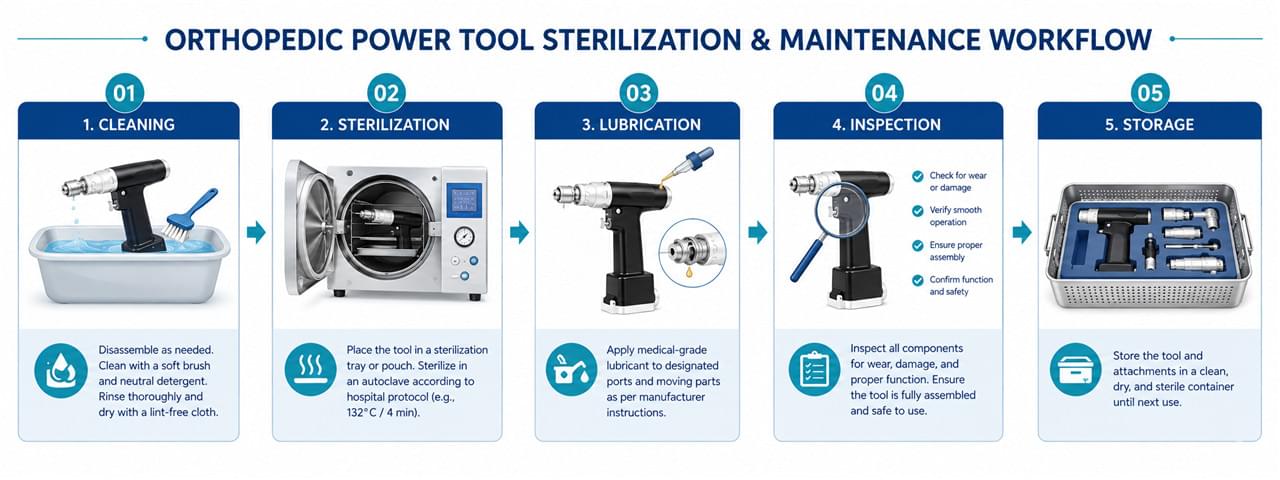
🧼 Sterilization, Maintenance, and Safety
All orthopedic surgical power tools must survive repeated sterilization without performance degradation. See the detailed guide: Sterilization and Maintenance.
Sterilization compatibility:
- Steam autoclave (134°C pre-vacuum): standard for most handpieces; follow IFU cycle parameters
- EtO (ethylene oxide): for battery packs that can’t take autoclave heat
- Liquid chemical sterilization: occasional use for temperature-sensitive components
The CDC’s steam sterilization guidance is worth keeping in the file for every reprocessing team — it details the temperature, time, and monitoring parameters that keep instruments truly sterile, load after load.
Maintenance essentials:
- Post-use cleaning: disassembly per IFU, manual cleaning, enzymatic soak
- Lubrication: instrument lubricant per manufacturer protocol before each autoclave cycle
- Inspection: chuck function, blade retention, motor performance
- Battery cycle tracking: monitor discharge/charge cycles; replace at the manufacturer-specified count
🏭 How Manufacturers Ensure Reliability and Compliance
Quality and safety in orthopedic surgical power tools manufacturing requires layered controls:
Design controls:
- Risk management per ISO 14971
- Biocompatibility testing per ISO 10993 for all tissue-contacting materials
- IEC 60601-1 electrical safety compliance for powered equipment
- EMC testing for battery-powered tools
Manufacturing controls:
- ISO 13485 quality management system
- Process validation for motor assembly, chuck mechanisms, battery cell selection
- 100% functional testing before shipment
Regulatory registration:
- FDA 510(k) clearance (Class II)
- CE marking under EU MDR — Class IIa or IIb depending on intended use
- ISO 13485 required across manufacturing
See our full guide: Orthopedic Device Regulatory Compliance.
❓ FAQ: Orthopedic Surgical Power Tools
Q1: What’s the most commonly used orthopedic power tool in joint replacement surgery?
The oscillating saw — it handles all five bone cuts in total knee arthroplasty (distal femur, posterior femur, chamfer, tibial, patellar). In total hip arthroplasty, the acetabular reamer and oscillating saw are both workhorses.
Q2: How long do orthopedic power tool batteries last?
Modern lithium-ion packs typically support 300–500 charge cycles before performance drops below clinical acceptability. Manufacturers build cycle-counting systems into chargers to track battery life.
Q3: What causes bone drill thermal necrosis?
Excessive speed, dull bits, and inadequate irrigation — in that order. Sharp bits, appropriate speed (800–1,500 RPM for cortical drilling), and intermittent drilling with irrigation dramatically reduce thermal injury.
Q4: Can orthopedic power tools be used in MRI environments?
Standard battery and corded electric tools are not MRI-compatible. MRI-conditional pneumatic tools and non-magnetic titanium/carbon fiber options exist for intraoperative MRI suites, though they’re rarely required in routine orthopedic work.
Q5: What certifications should I require from an orthopedic power tool manufacturer?
Minimum: ISO 13485 quality management, IEC 60601-1 electrical safety, and FDA 510(k) clearance or CE marking under EU MDR. Ask for calibration records, sterilization validation reports, and independent biocompatibility documentation.
🏁 Conclusion
Orthopedic surgical power tools are mission-critical in every orthopedic OR. Their performance directly shapes surgical efficiency, patient safety, and implant fixation quality. For manufacturers, precision engineering, robust sterilization compatibility, and rigorous quality management remain the foundation of durable competitive advantage.
Ready to explore OEM manufacturing or distribution partnerships for orthopedic surgical power tools? Contact our team to discuss capabilities, certifications, and product development opportunities.
⚠️ Medical Disclaimer
This article is for informational purposes only, directed at medical device industry professionals. All device selection, sterilization, and maintenance decisions must follow manufacturer Instructions for Use and applicable clinical protocols.

 English
 Arabic
 French
 German
 Italian
 Japanese
 Korean
 Portuguese
 Turkish
 Russian
 Spanish