


Choosing a qualified orthopedic power tool manufacturer means understanding the quality systems, testing protocols, and regulatory frameworks that separate world-class suppliers from commodity producers. For hospital procurement teams, that knowledge turns vendor evaluation into a structured process instead of a gut call. For OEM partners, it defines the capability bar you need to clear to compete internationally.
This article is part of: Orthopedic Surgical Power Tools: Technology, Selection & Maintenance.
📜 ISO 13485: The Quality Management Foundation
Every credible orthopedic power tool manufacturer operates under an ISO 13485-certified Quality Management System (QMS). ISO 13485:2016 sets out the requirements for a QMS where an organization must demonstrate its ability to provide medical devices and related services that consistently meet customer and regulatory requirements.
The ISO 13485 Foundation Every Orthopedic Power Tool Manufacturer Shares
Key ISO 13485 elements for power tool manufacturers:
- Design and development controls (design history file, risk management per ISO 14971)
- Purchasing controls (approved supplier lists, incoming inspection)
- Production and process controls (work instructions, first-article inspection)
- Measurement, analysis, and improvement (CAPA, internal audits, management review)
- Post-market surveillance and vigilance reporting
The ISO website has the full standard details — but remember, a certificate alone proves nothing until you verify it.

🧪 Testing Standards for Orthopedic Power Tools
Testing Standards an Orthopedic Power Tool Manufacturer Must Prove
Orthopedic power tool testing isn’t a formality — it’s where design claims meet measurable evidence. Here’s what a serious supplier documents:
Electrical Safety: IEC 60601-1
All battery-powered and corded electric orthopedic surgical power tools must comply with IEC 60601-1 (Medical Electrical Equipment — General Requirements for Basic Safety and Essential Performance):
- Dielectric strength testing
- Earth leakage current measurement
- Insulation resistance testing
- Protection against overvoltage, overcurrent, and fault conditions
Battery Safety: IEC 62133 / UN 38.3
Lithium-ion battery packs must comply with:
- IEC 62133: Safety requirements for portable sealed rechargeable lithium cells
- UN 38.3: Transport testing for lithium batteries (vibration, altitude simulation, thermal cycling, shock)
Electromagnetic Compatibility: IEC 60601-1-2
This ensures the device doesn’t interfere with other OR equipment (ECG, monitoring systems, electrosurgical units) and isn’t knocked offline by common electromagnetic disturbances.
Mechanical Performance Testing
Torque and speed testing:
- Dynamometer testing of stall torque, rated torque, and no-load speed
- Tested at beginning-of-life, mid-life, and end-of-battery-cycle conditions
- The test fixture must replicate clinical loading conditions
Vibration testing:
- Per ISO 28927 (hand-arm vibration)
- Measurements taken under loaded and unloaded conditions
Drop testing:
- Tools must maintain functional performance after representative drop events
- Typically: 1-meter drop onto concrete in three orientations
Sterilization durability testing:
- Performance testing before and after 500+ sterilization cycles
- Torque retention, speed retention, and chuck function evaluated
- Motor insulation integrity verified after repeated steam exposure
🌍 Regulatory Compliance Pathway
The Regulatory Pathway for an Orthopedic Power Tool Manufacturer
United States (FDA):
- Orthopedic surgical power tools are Class II medical devices
- 510(k) premarket notification required, demonstrating substantial equivalence to a predicate — the FDA’s 510(k) clearance database lets you verify a supplier’s claim in minutes
- Quality System Regulation (21 CFR Part 820) compliance required
European Union (CE Marking):
- Class IIa or IIb under EU MDR 2017/745, depending on intended use — the European Commission’s MDR framework governs the whole pathway
- Technical documentation including clinical evaluation, risk management file, and post-market surveillance plan
- Notified Body review required for Class IIb
China (NMPA):
- Class II medical device registration required
- Chinese clinical data may be required for novel designs
- Manufacturing site inspection by NMPA
See our full regulatory guide: Orthopedic Device Regulatory Compliance.
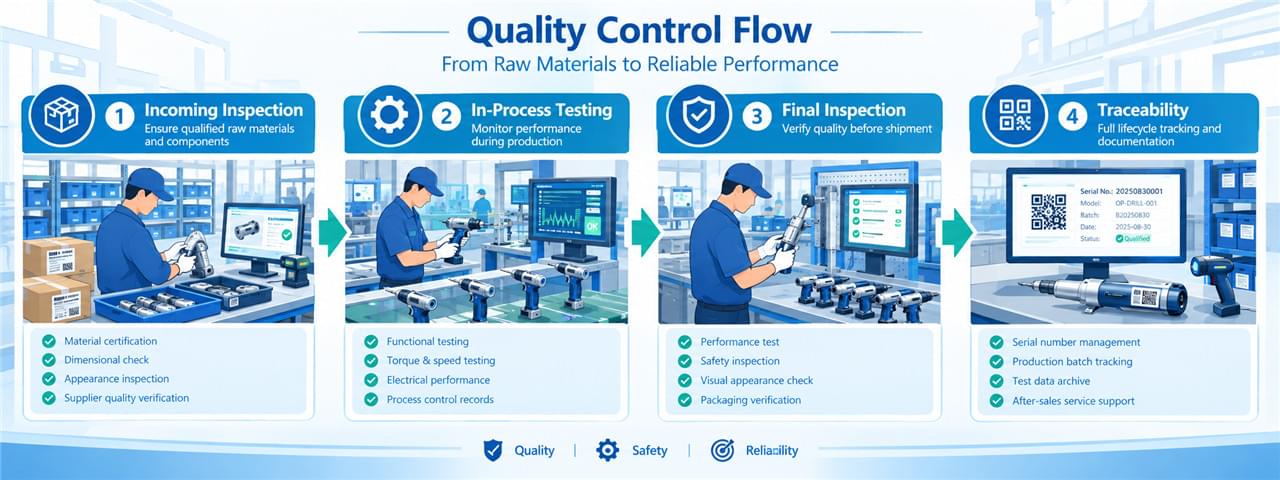
🏭 Quality Control at Manufacturing Level
Quality Control on an Orthopedic Power Tool Manufacturer’s Line
Incoming material inspection:
- Motor components: torque, speed, current draw
- Battery cells: capacity, internal resistance, temperature performance
- Mechanical components: dimensional inspection to engineering drawings
In-process inspection:
- Motor assembly torque signature verification
- Chuck retention force testing (100% of units)
- Speed and torque performance testing (100% of units or AQL sampling)
Final inspection:
- Full functional test: all speed settings, forward/reverse, trigger response
- Battery charge/discharge cycle test
- Cosmetic inspection
Traceability:
- Unique Device Identification (UDI) compliance per FDA and EU MDR
- Batch records linking each unit to all components and test results
- Sterilization cycle tracking capability built in (RFID or barcode)
This is where surgical power tool quality control stops being a policy document and becomes a daily discipline. If a supplier can’t show you inspection records, they don’t have the system.
🔍 Post-Market Surveillance Requirements
A modern orthopedic power tool manufacturer‘s quality obligations extend well beyond initial clearance:
Complaint handling:
- All adverse events reported to FDA (MDR) and EU Competent Authorities (EUDAMED)
- Defined complaint investigation and CAPA processes
- Trending analysis to detect emerging failure modes
Post-market clinical follow-up (PMCF):
- EU MDR requires PMCF studies demonstrating continued safety and performance
- Literature reviews and registry data analysis contribute to PMCF
Periodic Safety Update Reports (PSUR):
- Required under EU MDR — a systematic review of post-market safety data
- Triggers Notified Body notification when new safety-relevant information emerges
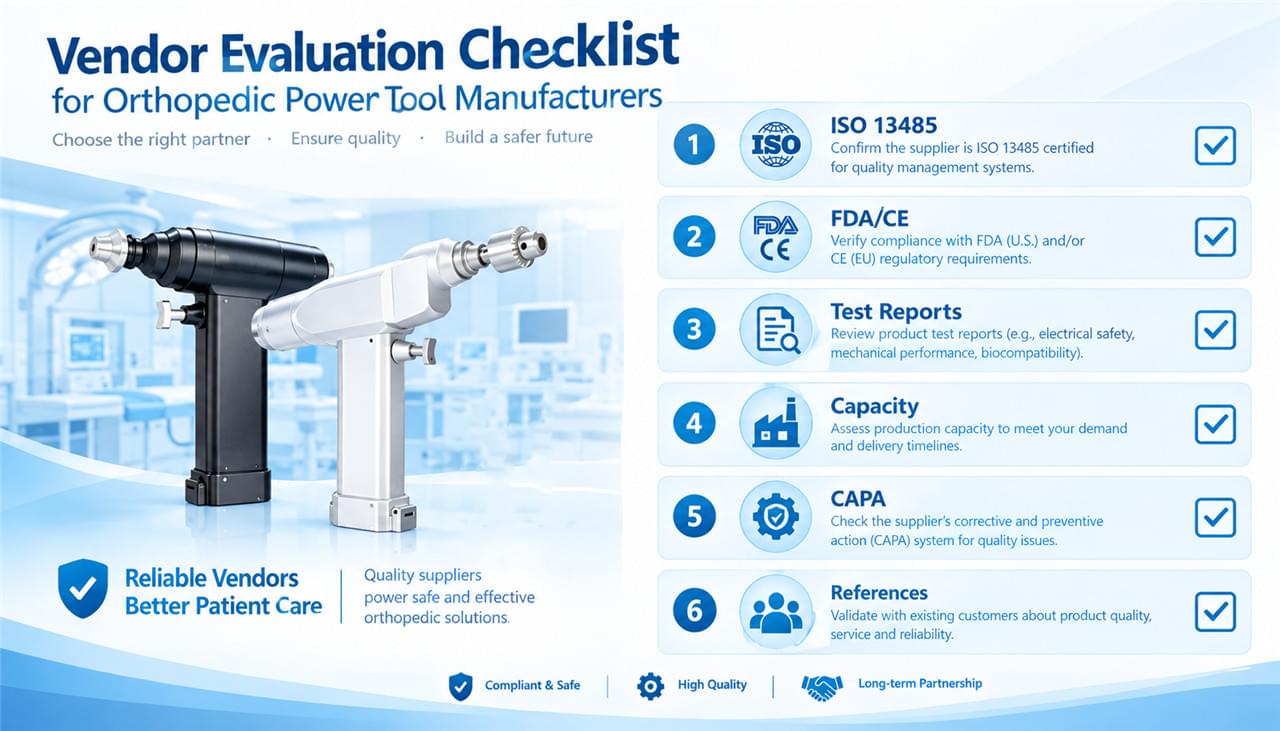
✅ What to Ask When Evaluating an OEM Power Tool Manufacturer
For hospital procurement and distribution partners vetting a new orthopedic power tool manufacturer, these questions do most of the work:
What to Ask an Orthopedic Power Tool Manufacturer Before You Sign
- Quality system: ISO 13485 certificate — scope, certification body, last audit date?
- Regulatory status: FDA 510(k) number(s), CE certificate number(s), Notified Body identity?
- Testing documentation: Can you provide IEC 60601-1 test reports, sterilization validation data, and battery safety certifications?
- Production capacity: Current capacity, lead times, production flexibility?
- Post-market system: CAPA database, complaint rate by product line?
- Track record: References from existing customers in your target markets?
❓ FAQ: Orthopedic Power Tool Manufacturer Quality
Q1: What is the minimum quality certification required from an orthopedic power tool manufacturer?
ISO 13485 is the baseline. FDA 510(k) clearance (US) or CE marking under EU MDR (Europe) is required for those markets. Manufacturers supplying both should hold both.
Q2: How do I verify a manufacturer’s ISO 13485 certification is genuine?
Request the certificate including the accreditation body name and certificate number, then verify directly with the certification body’s online registry. Certificates can be forged — direct verification is essential for new supplier qualification.
Q3: What testing must a new power tool design undergo before regulatory submission?
At minimum: IEC 60601-1 electrical safety, IEC 62133 battery safety (if applicable), IEC 60601-1-2 EMC, ISO 28927 vibration, mechanical performance testing, biocompatibility per ISO 10993 for tissue-contacting components, and sterilization validation.
Q4: How long does FDA 510(k) clearance take for an orthopedic power tool?
Average FDA review time for 510(k) submissions currently runs 6–12 months. Well-prepared submissions with complete testing data, strong predicate identification, and clear substantial-equivalence arguments move faster.
Q5: Can Chinese OEM manufacturers supply FDA-cleared orthopedic power tools?
Yes. Multiple Chinese manufacturers hold FDA 510(k) clearances for orthopedic power tools. The key requirements: ISO 13485 certification, an FDA-registered manufacturing facility, a complete 510(k) submission with US-compliant testing, and an authorized US agent.
🏁 Conclusion
A credible orthopedic power tool manufacturer is defined by ISO 13485 compliance, rigorous electrical and mechanical testing, regulatory clearances in target markets, and a robust post-market surveillance system. For procurement teams and distribution partners, these quality indicators aren’t wish-list items — they’re non-negotiable selection criteria. ISO 13485 power tools don’t happen by accident; they’re engineered, documented, and audited into existence.
Return to: Orthopedic Surgical Power Tools: Technology, Selection & Maintenance.
Evaluating orthopedic power tool manufacturers for your distribution or procurement program? Contact our team for vendor qualification support and technical evaluation frameworks.
Medical Disclaimer
Informational purposes only. Regulatory requirements vary by jurisdiction and change frequently. Consult qualified regulatory affairs professionals for current guidance.

 English
 Arabic
 French
 German
 Italian
 Japanese
 Korean
 Portuguese
 Turkish
 Russian
 Spanish