


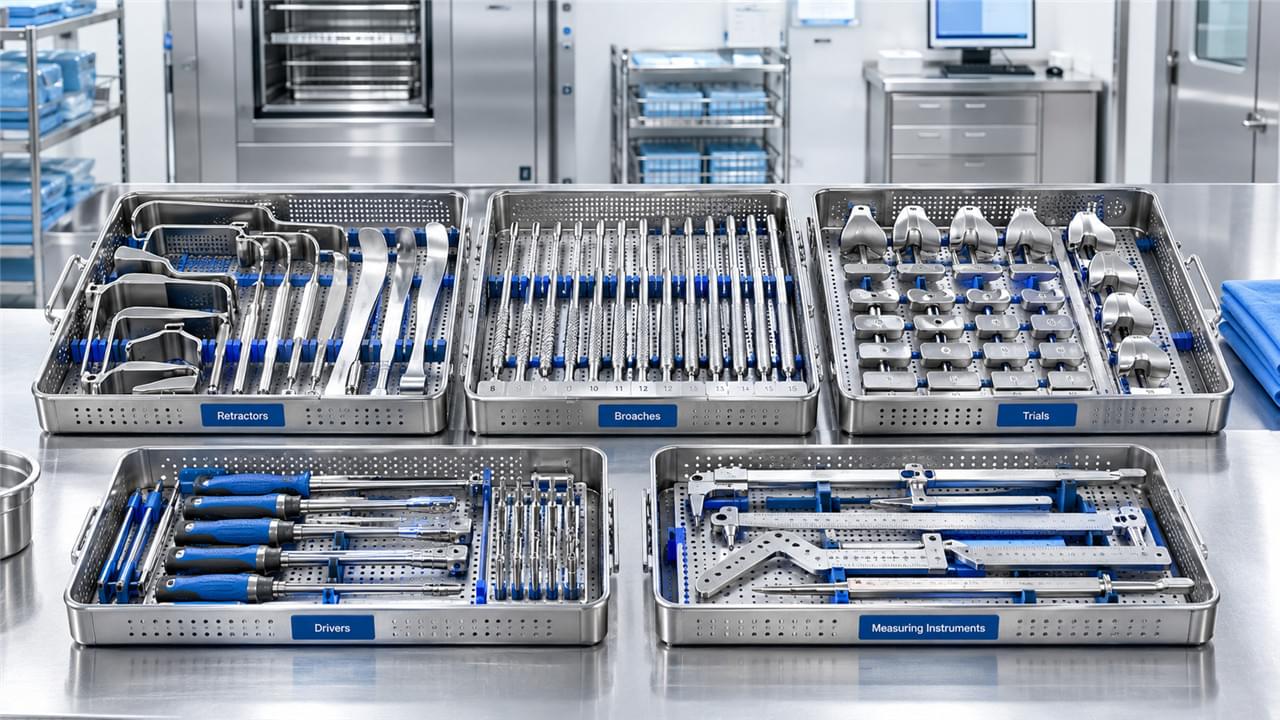
Orthopedic instrument configuration decisions directly impact hospital financial performance, OR efficiency, and sterile processing workload. A thoughtfully configured kit eliminates redundancy, reduces sterilization cost, and keeps every instrument a surgeon actually needs within arm’s reach.
Get it wrong in either direction and you pay — in dollars, minutes, or morale. Here’s the practical playbook.
This article is part of: Orthopedic Instrument Sets.
💸 The Cost of Suboptimal Instrument Configuration
The cost of poorly configured kits has several dimensions:
Over-configuration (too many instruments):
- Excessive CSSD processing time and labor
- Higher tray weight (physical strain on sterile processing staff)
- Greater storage space requirement
- Higher capital investment per set
- More instruments to count, inspect, and track
Under-configuration (missing instruments):
- Surgical delays while missing instruments are retrieved
- OR schedule disruption — downstream procedure impacts
- Patient safety risk if procedure cannot be completed as planned
- Staff frustration and surgeon dissatisfaction
The optimal kit contains exactly what is needed for the defined case mix — no more, no less.
Why Orthopedic Instrument Configuration Costs Spiral
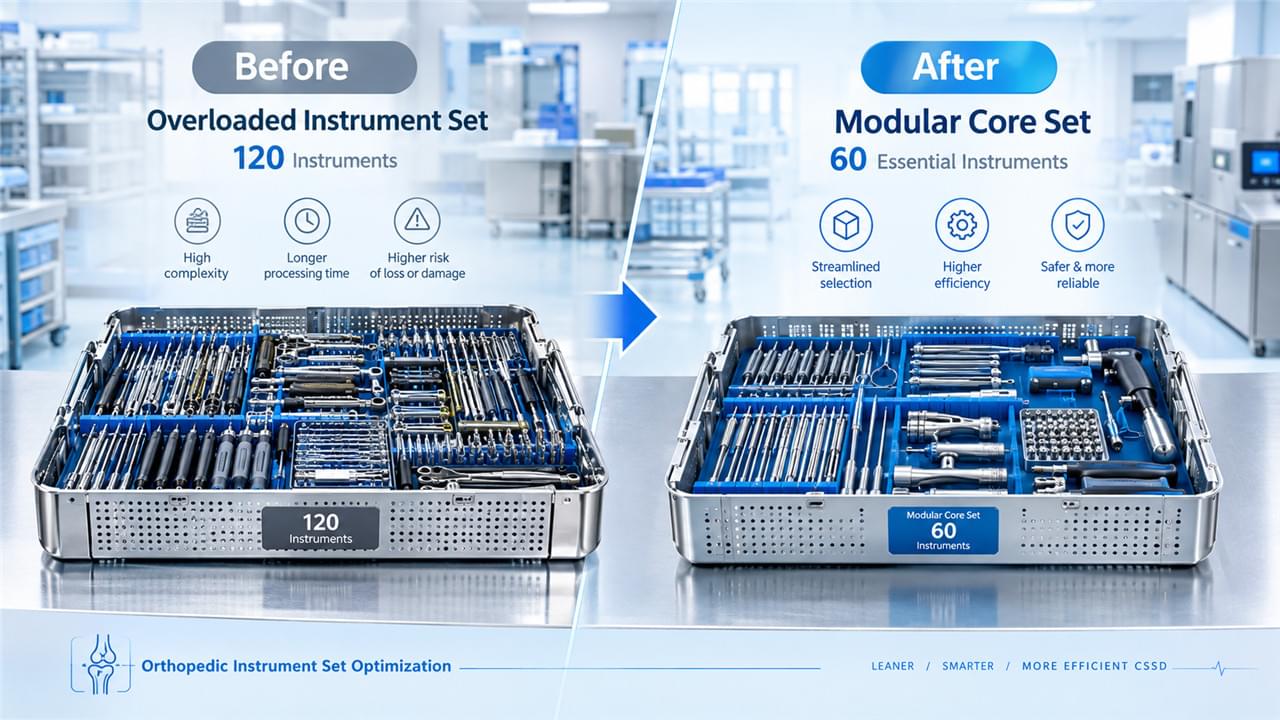
Here’s the uncomfortable truth: most trays were never really designed. They accreted — one surgeon request, one discontinued implant system, one “just in case” instrument at a time. Peer-reviewed data backs this up. A Landmark Lean-methodology study published in the Journal of Arthroplasty found that 55% of instruments in 11 orthopedic trays were rarely used — and removing them cut tray weight by 22% and saved over $270,000 a year at a single center.
🗺️ Step 1: Define Your Case Mix
Effective orthopedic instrument configuration begins with case mix analysis:
- Which procedures are performed at this facility?
- What is the relative volume of each procedure type?
- What implant systems are in use?
- What is the range of patient anatomy sizes served?
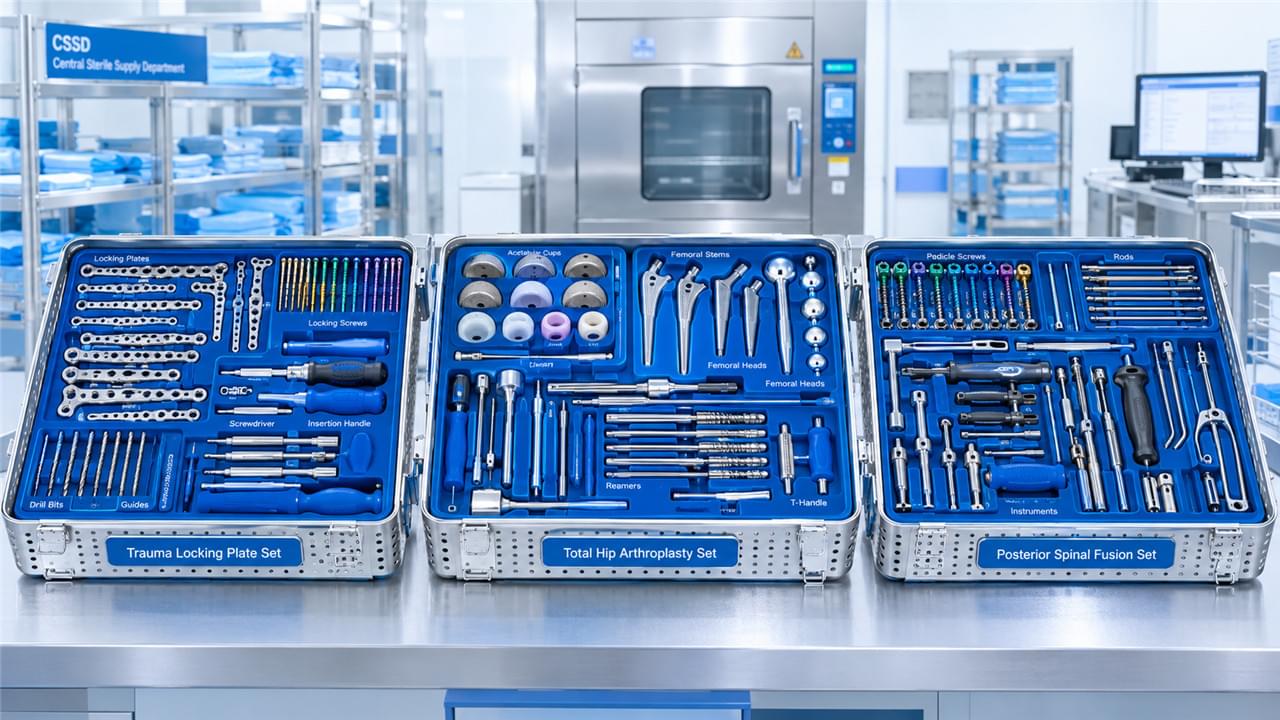
For ambulatory surgery centers (ASCs) focusing on primary TKA, the full complex revision instrument complement is rarely needed and should be excluded from the core configuration.
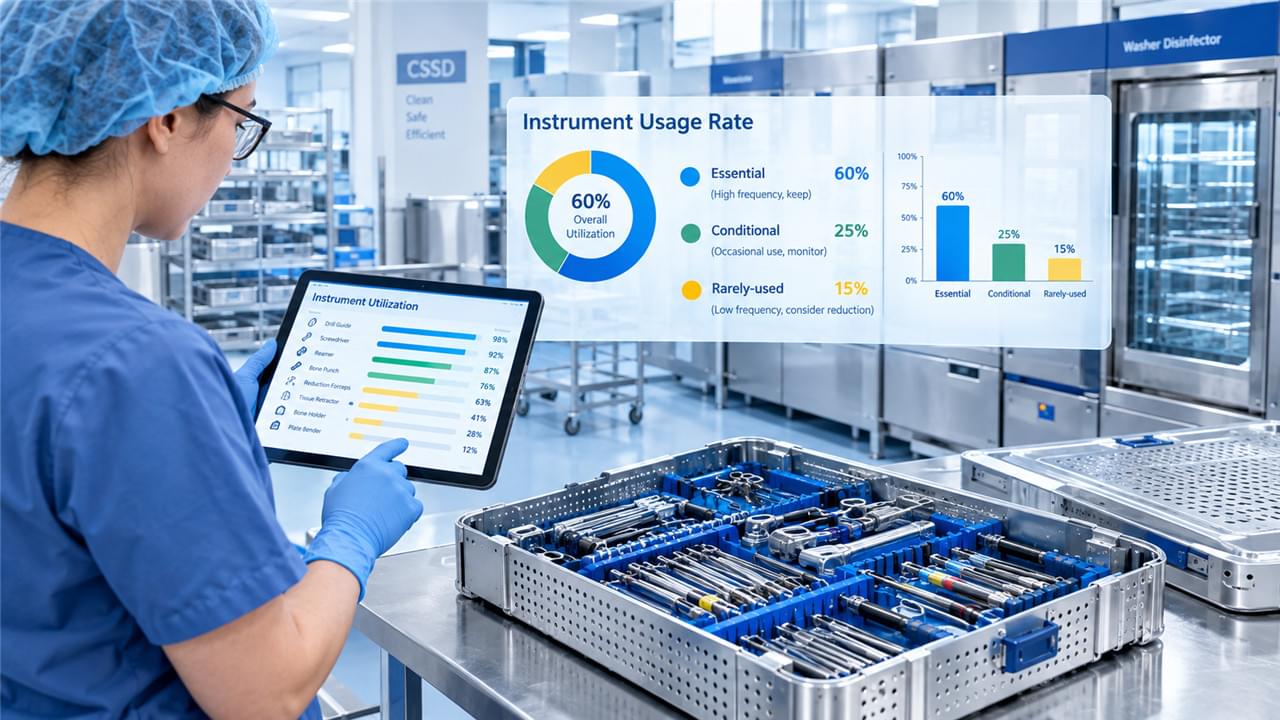
📈 Step 2: Conduct Instrument Utilization Analysis
Review sterilization records and OR logs to identify:
- Which instruments in each set are used in >90% of cases (essential)
- Which instruments are used in 50–90% of cases (conditional)
- Which instruments are used in <25% of cases (rarely needed)
Instruments in the “rarely needed” category are candidates for removal from the core set and provision as supplemental add-ons requested for specific cases.
The AAOS Surgical Technique guidelines often identify which instruments are essential vs. optional for each procedure.
Let the Data Decide the Orthopedic Instrument Configuration
Surgeon opinion alone under-optimizes. A Canadian study in CMAJ compared clinician review against a mathematical inventory model on a major orthopedic tray: the model cut the tray from 88 to 47 instruments (47%), versus just 23% for clinician review alone — nearly doubling the annual savings. The lesson for any orthopedic instrument kit optimization project: combine usage data with clinical judgment, don’t rely on either alone.
🧰 Essential vs. Optional Tools
Essential instruments (always in set):
- All implant-specific sizing and trialing instruments
- Primary cutting/drilling instruments
- Screw drivers for all implant fixation screws
- Primary reduction and exposure instruments
Conditional instruments (case-dependent):
- Extended/offset retractor variants
- Revision-specific components
- Rarely-used screw size drivers
- Specialty saw blades
Supplemental (on-request only):
- Implant extraction instruments (revision cases)
- Specialty osteotomy guides
- Very large or very small size implant trials (outside common size range)
🔄 Inventory Optimization Strategies
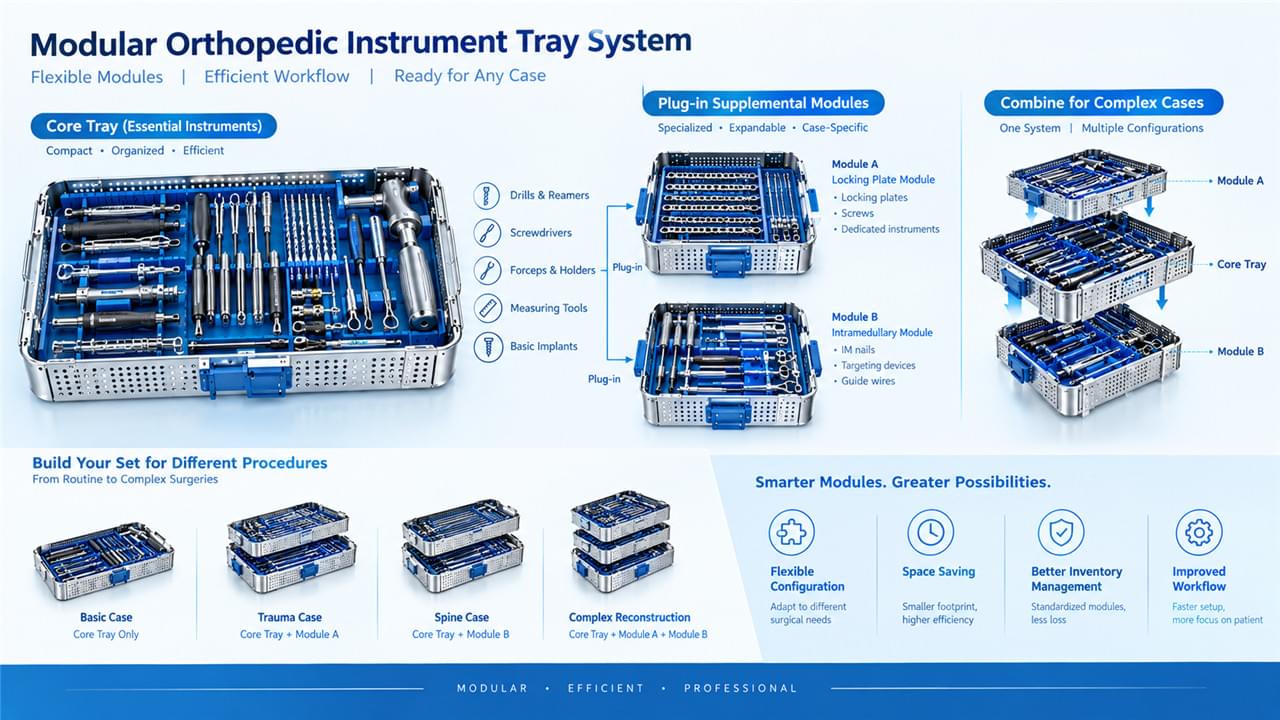
1. Modular tray design:
Core tray contains essential instruments. Supplemental modules (plug-in trays) provide additional instruments for complex cases. This allows the core set to be smaller and faster to process for standard cases.
2. Cross-system compatibility:
Where possible, configure instrument sets that share components across multiple implant systems (retractors, general drilling instruments, mallets). Reduces total set count without sacrificing procedure coverage.
3. Single-use (disposable) substitution for high-cost items:
Complex assembly instruments that are expensive to maintain (e.g., precision cutting guides with small moving parts) may be more cost-effective as single-use disposables. Total cost analysis (purchase + reprocessing + lifecycle) guides this decision. See: Reusable vs Disposable Orthopedic Instruments.
4. Set consolidation scheduling:
Where procedure volume allows, schedule similar cases consecutively to enable one set to serve multiple cases before reprocessing (when case timing and sterilization turnaround allow).
📋 The 6-Step Orthopedic Instrument Configuration Process
A systematic orthopedic instrument configuration optimization typically follows:
- Current state assessment: Catalog all instruments in each set; document current surgical instrument set cost per tray (CSSD processing + capital)
- Usage analysis: Utilization data from OR and CSSD logs
- Surgeon consultation: Confirm which instruments are surgeon-essential vs. rarely used
- Proposed configuration: Draft reduced/optimized set
- Trial period: Run optimized configuration for 30–60 cases; track any missing instrument incidents
- Final configuration: Validate and standardize
❓ FAQ: Orthopedic Instrument Configuration
Q1: How much can hospitals save by optimizing instrument set configuration?
Studies report 20–35% reduction in instrument set complexity through systematic optimization, translating to measurable CSSD cost savings, reduced storage, and lower capital requirements. Exact savings depend on current set size and case mix. One widely cited study achieved a 20% overall cost reduction in a single year.
Q2: Is it safe to reduce instrument set size?
Yes, when done systematically. Safety requires maintaining all essential instruments for the defined case mix. The key is evidence-based reduction (utilization data) combined with surgeon validation, not arbitrary removal.
Q3: Should hospitals or manufacturers drive instrument configuration decisions?
Both. Manufacturers design standard validated sets. Hospitals — with manufacturer collaboration — can customize configurations for their specific case mix. Manufacturer approval may be required for regulatory compliance of modified sets.
Q4: What role does CSSD play in instrument set optimization?
CSSD teams provide critical data on processing time, tray weight, and problem instruments (hard-to-clean areas, frequent damage). Their input is essential in any optimization process.
Q5: How do disposable instrument components affect set configuration?
Disposable substitutions for specific components can reduce set complexity and eliminate high-maintenance items. The key is total cost analysis: disposable purchase cost must be weighed against reusable processing and lifecycle costs.
🏁 Conclusion
Systematic orthopedic instrument configuration optimization delivers measurable cost savings, improved OR efficiency, and reduced CSSD workload — without compromising surgical safety. The foundation is evidence-based utilization analysis combined with surgeon and CSSD team engagement. If your trays haven’t been audited in the last two years, odds are you’re sterilizing instruments nobody uses.
Return to: Orthopedic Instrument Sets.
Medical Disclaimer
Informational purposes only. Instrument set modifications require surgeon validation and manufacturer consultation.
 English
 Arabic
 French
 German
 Italian
 Japanese
 Korean
 Portuguese
 Turkish
 Russian
 Spanish