


The debate between battery powered orthopedic tools and corded (pneumatic or electric) systems has moved on dramatically in the last decade. Modern lithium-ion packs have closed the performance gap that once made pneumatic drills the default choice — but corded systems still hold real advantages in specific clinical settings.
Here’s the honest version of the surgical power tool comparison — built for hospitals, procurement teams, and distributors who need to spend their budget wisely. Part of our complete guide: Orthopedic Surgical Power Tools.
⚡ The Three Power Source Options
Before weighing battery powered orthopedic tools against corded systems, get clear on the three architectures you’ll actually encounter:
1. Battery Powered Orthopedic Tools (Cordless)
- Power source: Rechargeable lithium-ion battery pack (14.4V–24V)
- Current standard: Lithium-ion polymer cells, 2.0–4.0 Ah capacity
- Advantages: Complete freedom of movement; no pneumatic infrastructure required; rapid surgical setup
- Market trend: The cordless surgical drill is now the dominant growth segment — most major manufacturers have shifted their primary product lines to battery power
2. Pneumatic (Compressed Air-Powered)
- Power source: Compressed air from hospital medical gas lines or portable compressors
- Pressure: Typically 90–120 PSI
- Advantages: Consistent power output regardless of “battery” level; MRI-compatible variants available; simple steam sterilization (no battery electronics involved)
- Applications: OR suites with existing pneumatic infrastructure; intraoperative MRI suites using non-magnetic pneumatic tools
3. Corded Electric (AC-Powered)
- Power source: OR electrical outlet
- Advantages: Unlimited run time; consistent power; no battery or compressed air infrastructure needed
- Disadvantages: Cable management headaches; impractical in field or austere environments
- Market position: Largely displaced by cordless systems in developed markets; still viable in low-resource settings
🎯 Performance: Battery vs. Pneumatic
What Battery Powered Orthopedic Tools Deliver Today
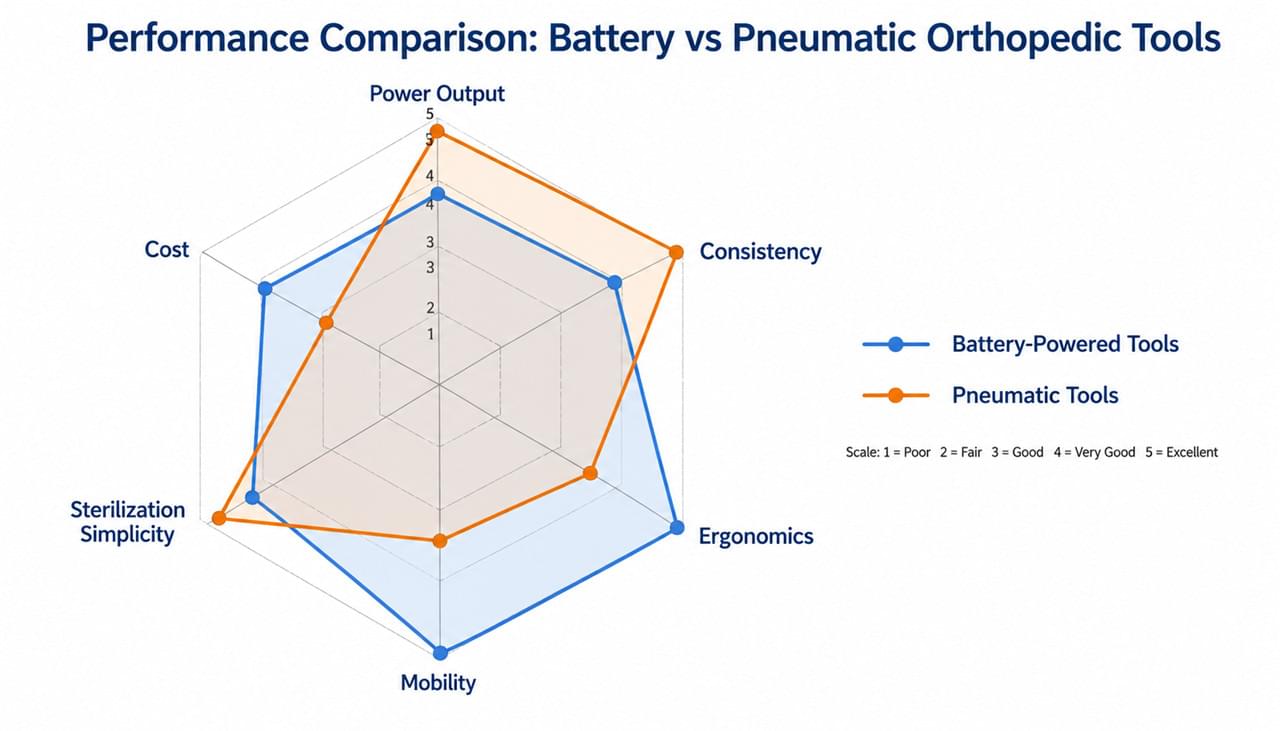
Any honest battery vs pneumatic orthopedic power tools comparison has to start with raw performance — and acknowledge how much has changed.
The historical gap:
Early-generation battery tools had noticeably lower power output than their pneumatic rivals, especially on demanding jobs like canal reaming. That reputation still lingers in some procurement committees — unfairly so.
Current reality:
Modern 18V–24V lithium-ion packs deliver power matching or exceeding pneumatic systems for most clinical applications. Flagship systems from the major manufacturers demonstrate equivalent or superior torque to their pneumatic predecessors. As far back as the late 1980s, researchers were already showing battery-powered electric drills could genuinely substitute for air drills in orthopaedic surgery — minus the hoses (Railton et al., Evaluation of Makita electric drills for orthopaedic surgery).
Where pneumatic still wins:
- Consistent output from first cut to last (no battery depletion curve)
- Sustained high-torque demands over very long procedures
Speed and Torque Consistency
Battery tools:
- Advanced motor management holds speed relatively constant under load
- State-of-charge monitoring warns the surgeon before power fade affects the case
- The catch: power fade in the final 10–20% of battery capacity
Pneumatic tools:
- True constant output as long as air supply pressure holds
- Performance unaffected by procedure length
Ergonomics and Weight
Battery tools: The pack adds 200–400g to handpiece weight. Modern designs tuck the battery into the handle ergonomically — minimal balance penalty in practice.
Pneumatic tools: Lighter handpiece, but the air hose creates drag and the hose connections need sterilizing too.
🛡️ Safety Considerations
Battery Powered Orthopedic Tools: The Safety Profile
- Electrical safety: Battery packs must meet IEC 60601-1 and IEC 62133 (lithium battery safety) standards
- Thermal management: A battery management system (BMS) prevents overcharge, over-discharge, and thermal runaway
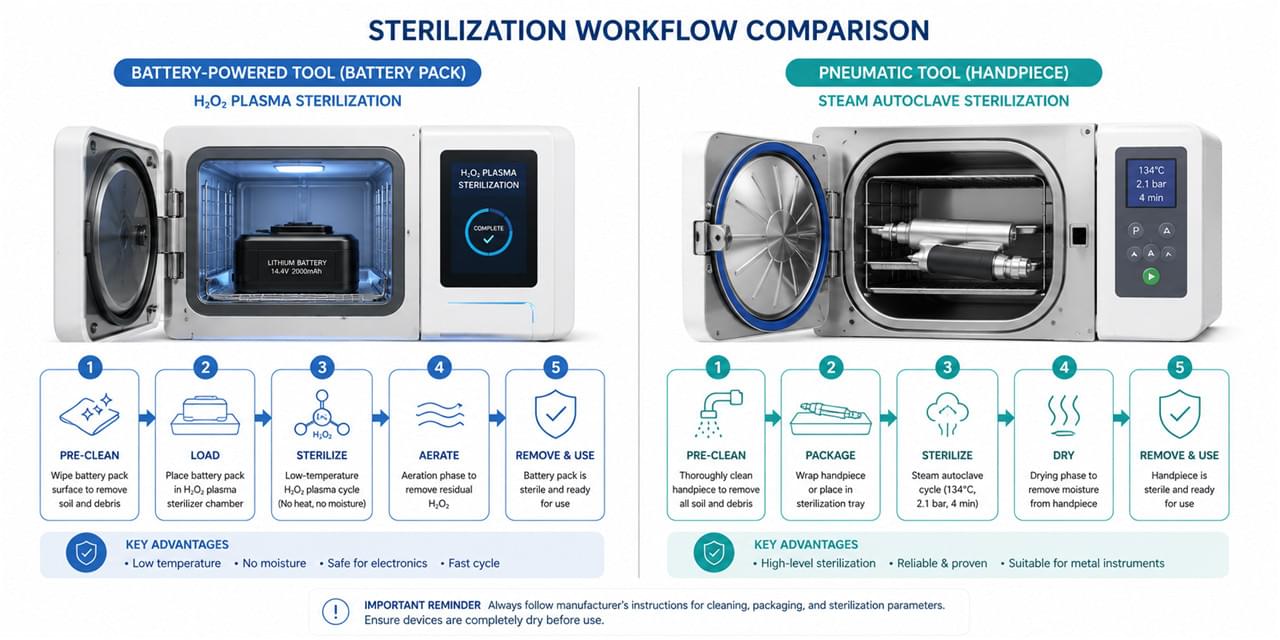
- Sterilization risk: Battery packs can’t survive autoclave temperatures — they require validated low-temperature sterilization (EtO or H₂O₂ plasma) or proprietary sterilization sleeve systems. This is the single biggest logistics challenge for cordless fleets.
Pneumatic Tool Safety: The Simpler Baseline
- No electrical hazards in the handpiece
- Simple steam autoclave sterilization
- Compressed air supply failure can interrupt a procedure — backup planning required
🧼 Sterilization Logistics
This is where the operational difference between battery powered orthopedic tools and pneumatic systems really bites. The CDC’s guidance on sterilization is explicit: heat- and moisture-sensitive devices require low-temperature technologies such as ethylene oxide or hydrogen peroxide gas plasma — exactly the category battery packs fall into.
| Aspect | Battery-Powered | Pneumatic |
|---|---|---|
| Handpiece sterilization | Autoclave (134°C) | Autoclave (134°C) |
| Battery sterilization | EtO, H₂O₂ plasma, or proprietary system | N/A |
| Turnover time | Longer (battery sterilization cycle) | Faster |
| Capital cost | Higher (multiple battery sets needed) | Lower (no batteries) |
| Infrastructure required | Charger station, sterilization validation | Compressor/medical gas lines |
| Field/austere use | Excellent | Requires compressor |
Hospitals with high procedure volume need multiple battery sets per handpiece to keep the OR moving — typically 3–5 packs per handpiece for busy centers. Skip that math, and your sterile processing department will let you know about it.
💰 Cost Analysis
Initial Capital Cost
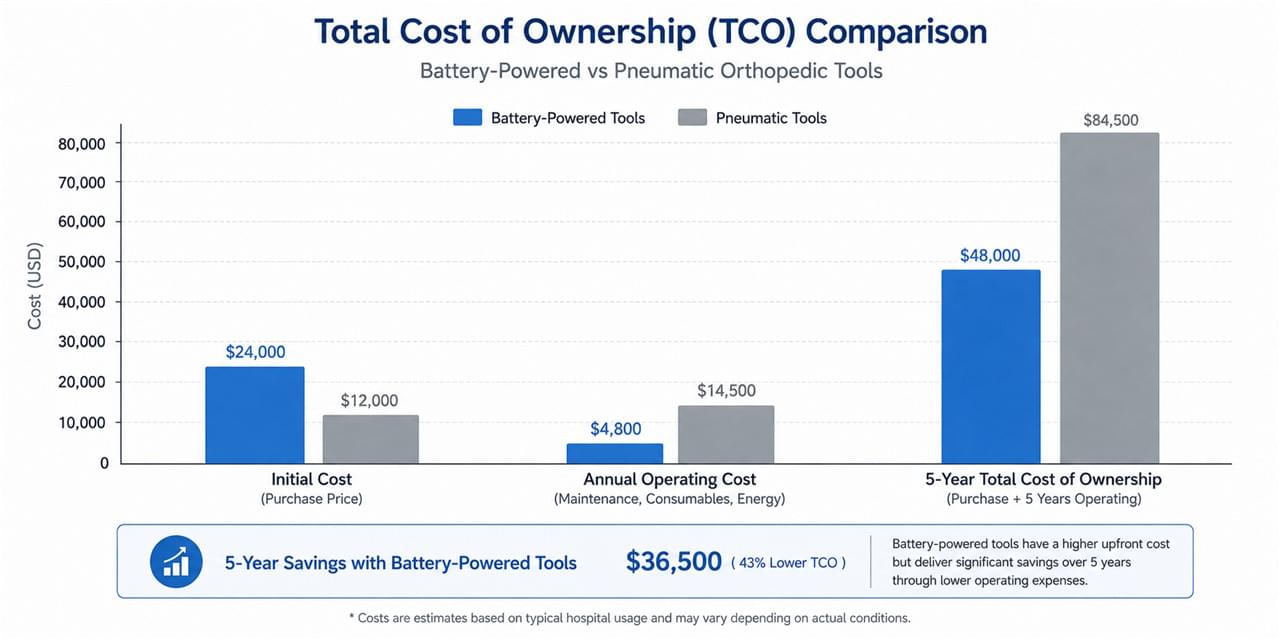
- Battery system: Higher upfront cost — battery packs, charger stations, and compatible sterilization containers all add up
- Pneumatic system: Lower initial cost if pneumatic infrastructure is already in place
Operating Cost
- Battery systems: Pack replacement every 300–500 charge cycles (~2–4 years at moderate use). Li-ion batteries are a real consumable cost — budget for them
- Pneumatic systems: Lower ongoing consumable costs; compressed air is cheap
Total Cost of Ownership for Battery Powered Orthopedic Tools
For most high-volume orthopedic centers, battery powered orthopedic tools deliver favorable total cost of ownership despite the steeper entry price, thanks to:
- Eliminated pneumatic hose maintenance and replacement
- Greater OR scheduling flexibility (no dependence on air supply positioning)
- Reduced setup time per procedure
⚖️ Which Is Better? The Clinical Verdict
Choose battery-powered when:
- OR mobility and a cable-free field are priorities
- Procedures run across multiple OR configurations
- You’re equipping a developing-market facility or field surgery environment without pneumatic infrastructure
- Surgeons prefer modern ergonomic systems
Choose pneumatic when:
- Existing pneumatic infrastructure is already in place
- You’re a very high-volume center where consistent power across long procedures is critical
- You run an intraoperative MRI suite that needs non-magnetic tools
- Budget-constrained procurement prioritizes lower upfront cost
The market consensus:
Battery-powered systems now represent more than 65% of new orthopedic power tool installations globally, and they’re where industry investment is heading. For most new procurement decisions, the forward-looking choice is clear — the clinical verdict on battery powered orthopedic tools favors them in the majority of modern settings.
❓ FAQ: Battery vs. Corded Orthopedic Tools
Q1: Are battery-powered orthopedic drills as powerful as pneumatic ones?
Yes, for most clinical applications. Modern 18V–24V lithium-ion systems match pneumatic tools in sustained torque and speed for standard drilling, sawing, and reaming.
Q2: How are battery packs sterilized?
Battery packs can’t withstand autoclave temperatures. They’re sterilized via EtO (ethylene oxide), hydrogen peroxide plasma, or proprietary validated containers using low-temperature cycles — always per the manufacturer’s IFU.
Q3: How many battery packs does a high-volume OR need?
Typically 3–5 packs per handpiece for a center running 3–5 orthopedic procedures per day. That keeps enough packs in the sterilization rotation to avoid case delays.
Q4: Can battery orthopedic tools be used in remote or austere settings?
Absolutely — it’s one of their biggest advantages over pneumatic systems. Portable chargers (including 12V vehicle adapters) keep battery tools running in field hospitals, humanitarian missions, and remote locations with no medical gas infrastructure.
Q5: What is the expected battery pack lifespan?
300–500 charge cycles is the typical manufacturer rating — roughly 2–5 years depending on usage. Most manufacturers offer replacement programs with cycle tracking built in.
🏁 Conclusion
Choosing between battery powered orthopedic tools and corded alternatives comes down to your institution’s infrastructure, procedure volume, budget, and workflow priorities. But the direction of travel is unmistakable: the industry has shifted toward battery power for its unmatched mobility, modern ergonomics, and now-comparable performance.
Return to: Orthopedic Surgical Power Tools: Technology, Selection & Maintenance.
Comparing orthopedic power tool systems for your facility or distribution portfolio? Contact our team for detailed product specifications and cost analysis.
Medical Disclaimer
Informational purposes only. Device purchasing decisions should involve biomedical engineering evaluation and clinical team input.

 English
 Arabic
 French
 German
 Italian
 Japanese
 Korean
 Portuguese
 Turkish
 Russian
 Spanish