


Orthopedic instrument sterilization is governed by a comprehensive framework of international standards and regulatory requirements. For manufacturers designing instruments, for CSSD professionals processing them, and for procurement teams evaluating suppliers, understanding these standards is essential for patient safety compliance.
This isn’t box-ticking. A failed cycle on a tray heading into an implant case is a patient safety event, full stop. Here’s the framework — and where the failures actually happen.
This article is part of: Orthopedic Instrument Sets.
📜 The Regulatory and Standards Framework
The 7 Pillars of Orthopedic Instrument Sterilization
Key standards governing orthopedic instrument sterilization:
- ISO 17665-1: Sterilization of health care products — Moist heat (steam)
- ISO 11135: Sterilization with EtO (ethylene oxide)
- ISO 11137: Radiation sterilization (gamma, e-beam)
- EN ISO 15883: Washer-disinfectors for medical devices
- AAMI ST79: Comprehensive guide to steam sterilization (US)
- EN 13060: Small steam sterilizers
- EN 285: Large steam sterilizers for healthcare
Additionally, the FDA’s Center for Devices and Radiological Health (CDRH) publishes guidance on device reprocessing, and WHO guidelines on infection prevention provide global context.
🧼 Cleaning Processes: The Critical Foundation
Where Orthopedic Instrument Sterilization Really Begins
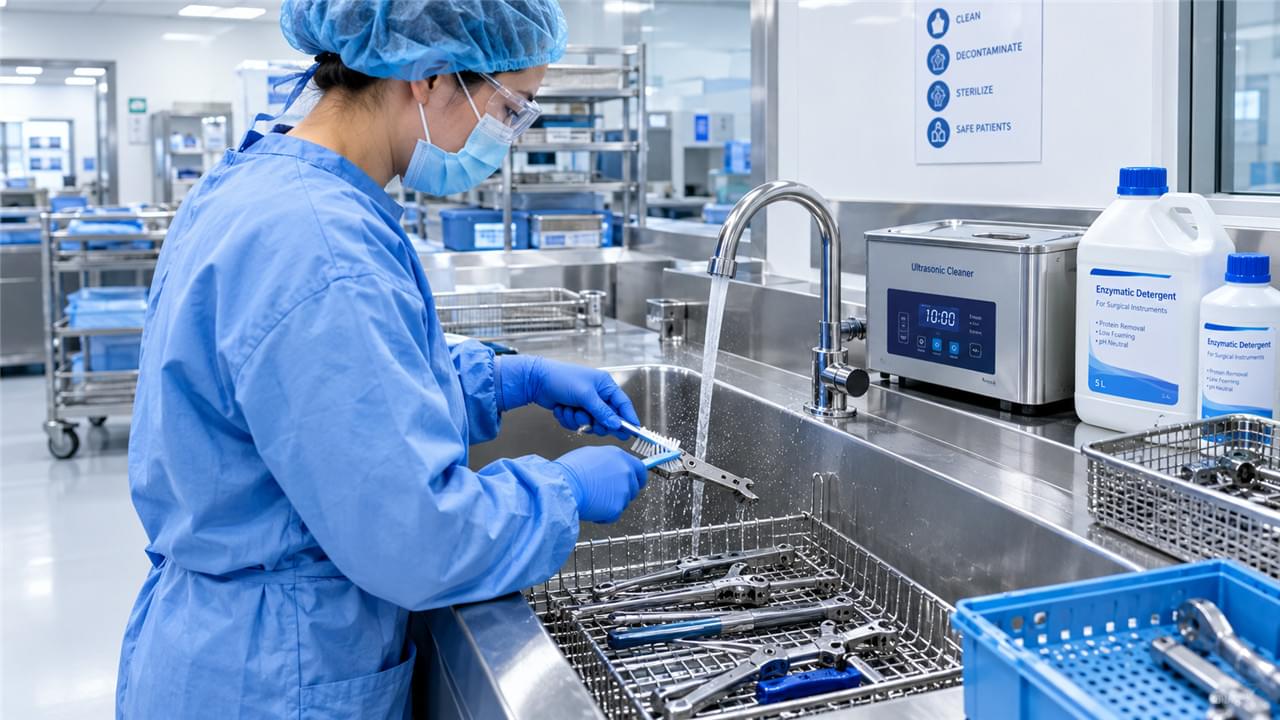
Sterilization does not equal decontamination if instruments are not properly cleaned first:
Validated cleaning parameters:
- Detergent type, concentration, and temperature per validation protocol
- Manual brushing where automated cleaning cannot reach
- Ultrasonic bath duration and frequency
- Rinse water quality (purified/RO water)
- Lubrication pre-sterilization
Cleaning validation requirements (ISO 15883 / AAMI ST79):
Manufacturers must demonstrate that their cleaning protocol achieves >4-log reduction in bioburden on instruments. Validated cleaning SOPs must be provided in manufacturer IFU.
Here’s the part people skip: you cannot sterilize dirt. Bioburden baked onto a rongeur joint survives the cycle and lands on the sterile field anyway. Clean first, sterilize second — always in that order.
🔥 Steam Sterilization Validation
Autoclave Parameters to Sterilize Orthopedic Instruments Correctly
Standard cycle parameters when you autoclave orthopedic instruments:
- Pre-vacuum (fractioned vacuum) cycle
- Temperature: 134°C (274°F)
- Pressure: 2.2 bar
- Exposure time: 3–4 minutes at temperature
- Total cycle time: ~30–45 minutes (including pre-conditioning, exposure, and drying)
Sterilization validation requirement (ISO 17665 sterilization standard):
Manufacturers must validate that their sterilization cycle achieves sterility assurance level (SAL) of 10⁻⁶ — no more than one non-sterile item per million sterilized items.
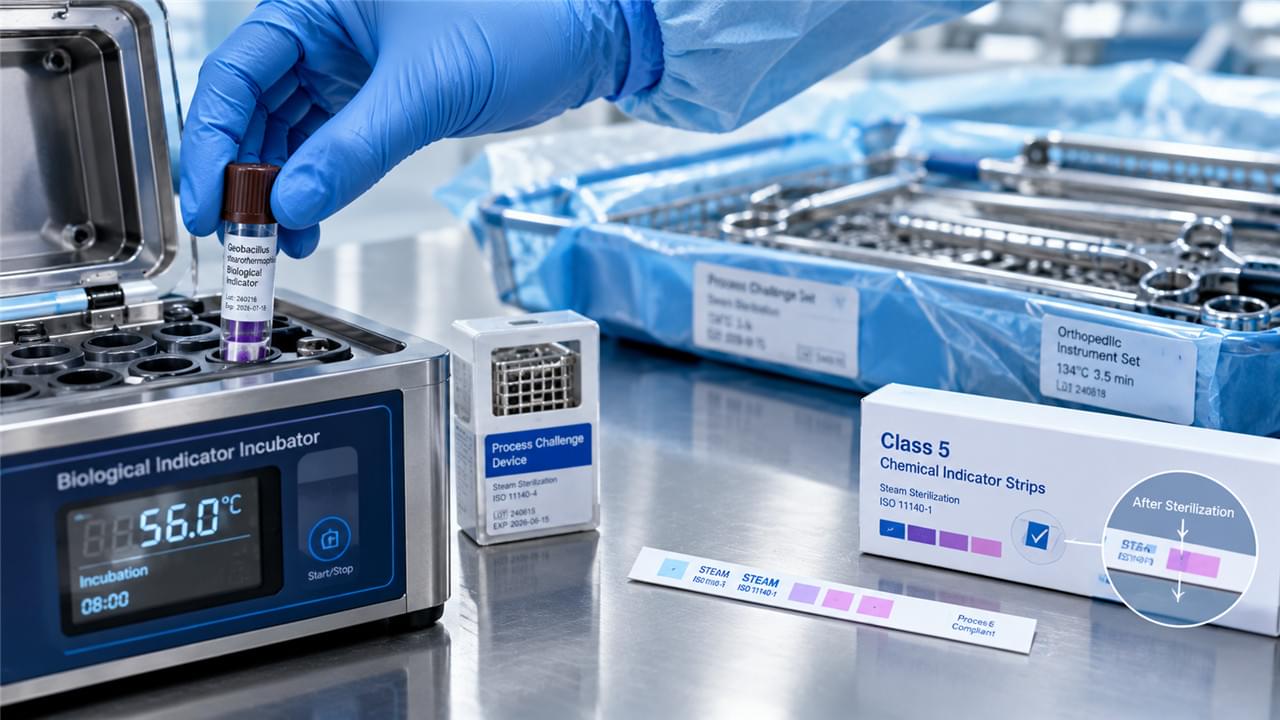
Biological indicators:
- Geobacillus stearothermophilus spore strips/vials used for steam sterilization validation
- Routine monitoring uses class 5 or class 6 chemical indicators
- Process challenge devices (PCDs) simulate worst-case sterilization conditions
For official cycle parameter context, the CDC’s steam sterilization guidance details exposure times and temperature setpoints for healthcare autoclaves.
📐 Instrument Design for Sterilization Compatibility
Instrument designers must consider sterilization compatibility from the first design iteration:
Design principles:
- Avoid blind holes and internal channels that trap moisture and prevent steam penetration
- Hinged instruments must be sterilized in the open position
- Dissemble instruments that cannot be effectively cleaned when assembled
- Material selection: all materials must withstand 134°C/2.2 bar repeatedly (stainless steel, titanium, PEEK — all autoclave-compatible; certain polymers and electronics require alternative approaches)
Testing for design validation:
- Expose instrument to 1,000+ autoclave cycles; test dimensional stability and functional performance
- Demonstrate sterilization penetration to all internal surfaces
📄 Sterilization Validation: What Manufacturers Must Supply
Manufacturers supplying orthopedic instrument sterilization solutions must provide:
- IFU (Instructions for Use): Detailed cleaning and sterilization procedures
- Cleaning validation data: Evidence that prescribed cleaning protocol removes biological contamination
- Sterilization validation data: Overkill or bioburden-based validation cycle development
- Material compatibility: Data confirming instruments tolerate repeated sterilization without functional degradation
For CSSD managers, this documentation forms the basis for local procedure development and compliance auditing. The CDC’s sterilizing practices summary is a solid companion when building facility-level SOPs from manufacturer IFUs.
📊 Compliance Standards Summary
| Standard | Scope | Applicable to |
|---|---|---|
| ISO 17665-1 | Steam sterilization process | Manufacturers, CSSD |
| ISO 11135 | EtO sterilization | Battery packs, polymers |
| EN ISO 15883 | Washer-disinfectors | CSSD equipment |
| AAMI ST79 | Comprehensive steam guide (US) | US hospitals |
| ISO 11607 | Packaging for sterile devices | Manufacturers |
| ISO 13485 | QMS | Manufacturers |
❓ FAQ: Orthopedic Instrument Sterilization
Q1: What is the Sterility Assurance Level (SAL) required for orthopedic surgical instruments?
SAL 10⁻⁶ is the required standard for terminally sterilized implantable and surgical instruments — meaning a probability of not more than one non-sterile unit per million processed items.
Q2: How long can sterilized orthopedic instruments remain sterile in storage?
Event-related sterility (not time-related) is the modern standard. Sterilized instruments remain sterile until the packaging integrity is compromised. Manufacturers specify storage conditions (temperature, humidity, protection from puncture).
Q3: What biological indicator is used for steam sterilization?
Geobacillus stearothermophilus (formerly Bacillus stearothermophilus) spore strips or self-contained biological indicators. These are the most resistant organisms to steam sterilization.
Q4: Must manufacturers provide sterilization validation data in their IFU?
Yes. Under FDA and EU MDR requirements, manufacturers must provide validated reprocessing instructions (cleaning and sterilization) in their IFU. CSSD must follow manufacturer IFU to maintain regulatory compliance.
Q5: What happens if the wrong sterilization cycle is used?
Using a cycle with inadequate temperature, pressure, or time may result in non-sterile instruments. This constitutes a serious patient safety event. CSSD staff must be trained in cycle verification and biological/chemical indicator interpretation.
🏁 Conclusion
Orthopedic instrument sterilization compliance is a non-negotiable patient safety requirement governed by international standards. Manufacturers, CSSD professionals, and procurement teams all have roles in ensuring instruments are properly cleaned, sterilized, and maintained to protect patients and comply with regulatory requirements.
Return to: Orthopedic Instrument Sets.
Medical Disclaimer
Informational purposes only. Sterilization protocols must follow device IFU and applicable national standards.


 English
 Arabic
 French
 German
 Italian
 Japanese
 Korean
 Portuguese
 Turkish
 Russian
 Spanish