


Orthopedic instrument innovation is accelerating, driven by the convergence of digital technology, advanced manufacturing, human factors engineering, and sustainability imperatives. The instrument sets of tomorrow will look, feel, and function very differently from their predecessors.
If your mental image of orthopedic instruments is “shiny steel, heavy trays, sore hands,” it’s time for an update. Here are the five trends doing the reshaping.
This article is part of: Orthopedic Instrument Sets.
🖐️ Trend 1: The Ergonomic Revolution in Orthopedic Instrument Innovation
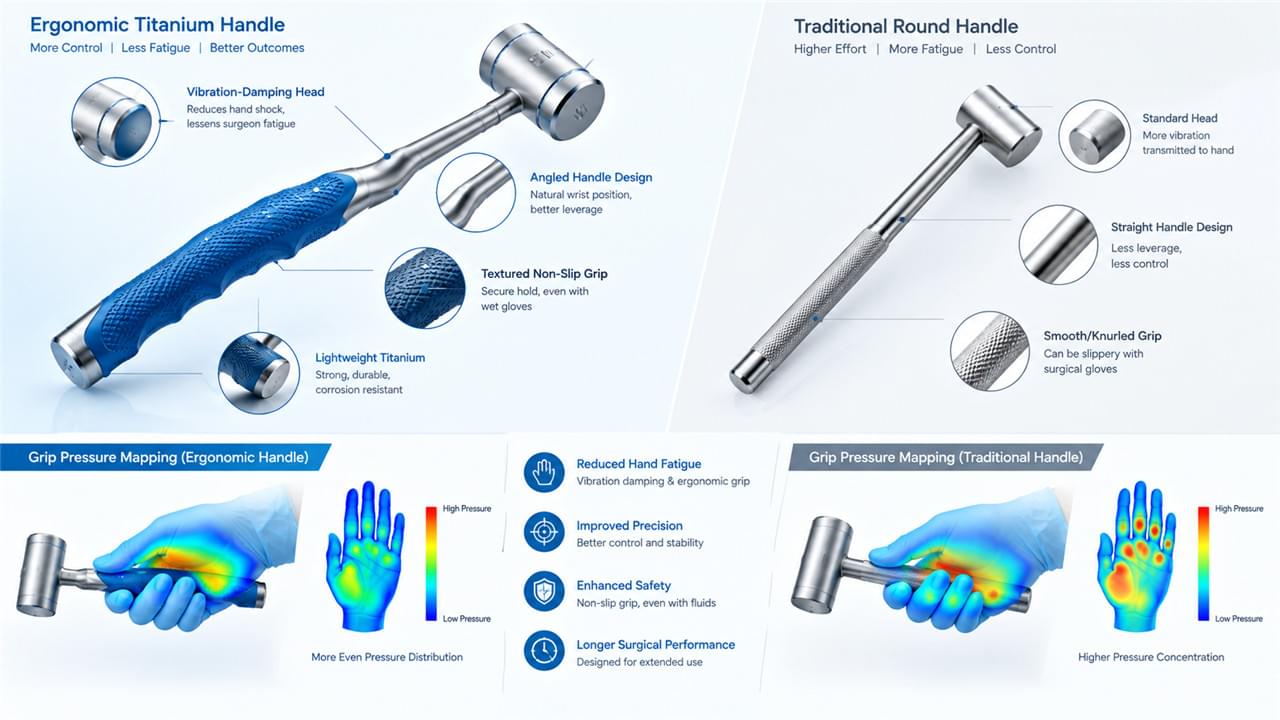
Traditional instruments were designed primarily for mechanical function, with ergonomics as a secondary consideration. This is changing rapidly:
Driver: Cumulative trauma disorders (CTD) in surgeons — including hand, wrist, and forearm injuries from repetitive forceful motions — are a significant occupational health issue. A 2024 survey by the American Orthopaedic Association found that >70% of orthopedic surgeons report some work-related musculoskeletal symptoms.
Design responses:
- Handle geometry optimization: Finite element analysis and grip pressure mapping to minimize surgeon hand fatigue
- Textured, non-slip grip surfaces: Reducing required grip force during retraction and tissue manipulation
- Weight reduction: Titanium and carbon fiber handles replacing stainless steel — reducing set weight by 20–35%
- Angled handle designs: Reducing wrist deviation during instrument use
- Vibration damping: Polymer-damped mallet heads reducing jarring during impaction
The occupational health case for ergonomic surgical instruments is well documented — the EU-OSHA overview of hand-arm vibration and physical agents outlines why repetitive force and vibration exposure cause permanent, preventable damage.
Market implication: Manufacturers who invest in human factors studies and ergonomic testing differentiate significantly from commodity producers.
🧩 Trend 2: Modular Orthopedic Instruments Over Monolithic Sets
Instrument design increasingly favors modular systems over fixed monolithic designs:
Benefits of modular design:
- Core handle shared across multiple procedure-specific tips
- Reduces total set count and storage requirements
- Enables instrument set configuration for specific case needs
- Simplifies sterilization logistics (fewer large assemblies)
Current examples:
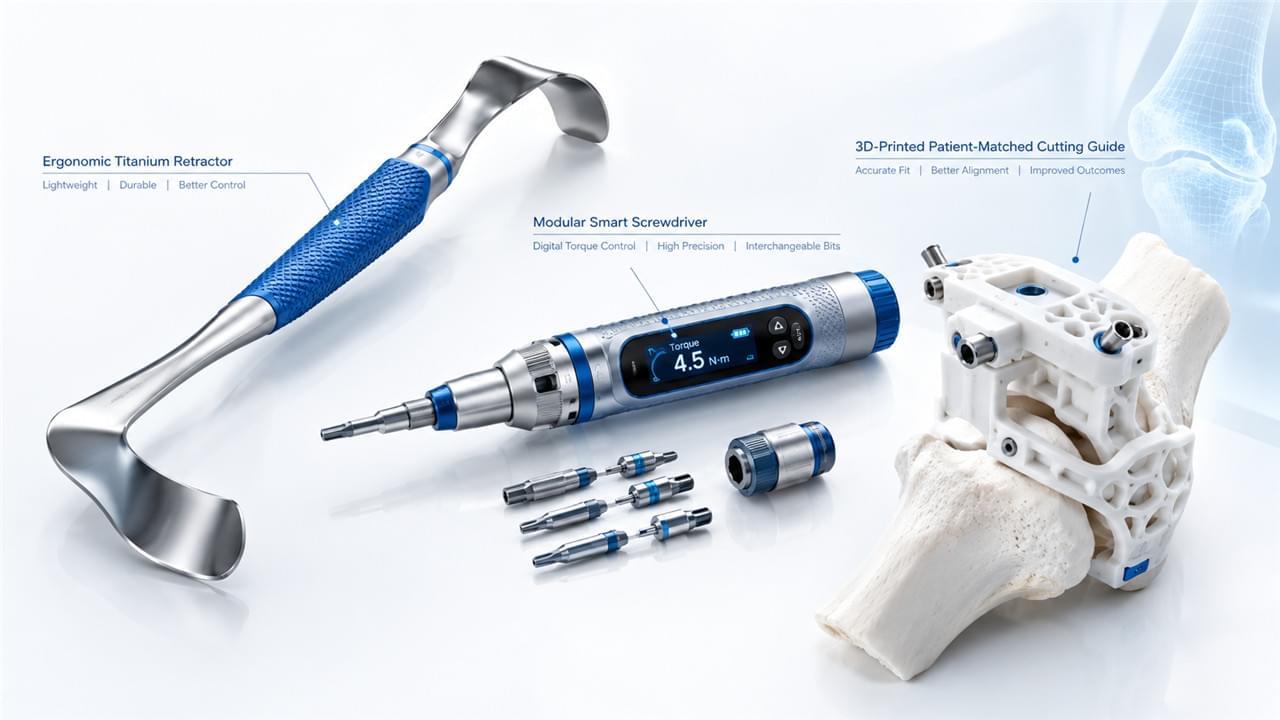
- Universal screwdriver handles with interchangeable bit holders
- Modular retractor systems with interchangeable blade attachments
- Adaptable impactor handles for multiple cup/stem systems
- Modular cutting guide systems (femoral + tibial modules combining for TKA)
For procurement teams, modular orthopedic instruments do something subtle but powerful: they turn tray planning from a fixed equation into a mix-and-match exercise. Fewer trays, more coverage.
🤖 Trend 3: Smart Surgical Instruments — Sensing, Feedback, Connectivity
The integration of sensing, computing, and communication technology into instruments is emerging — the next frontier of orthopedic instrument innovation:
Force and torque sensing:
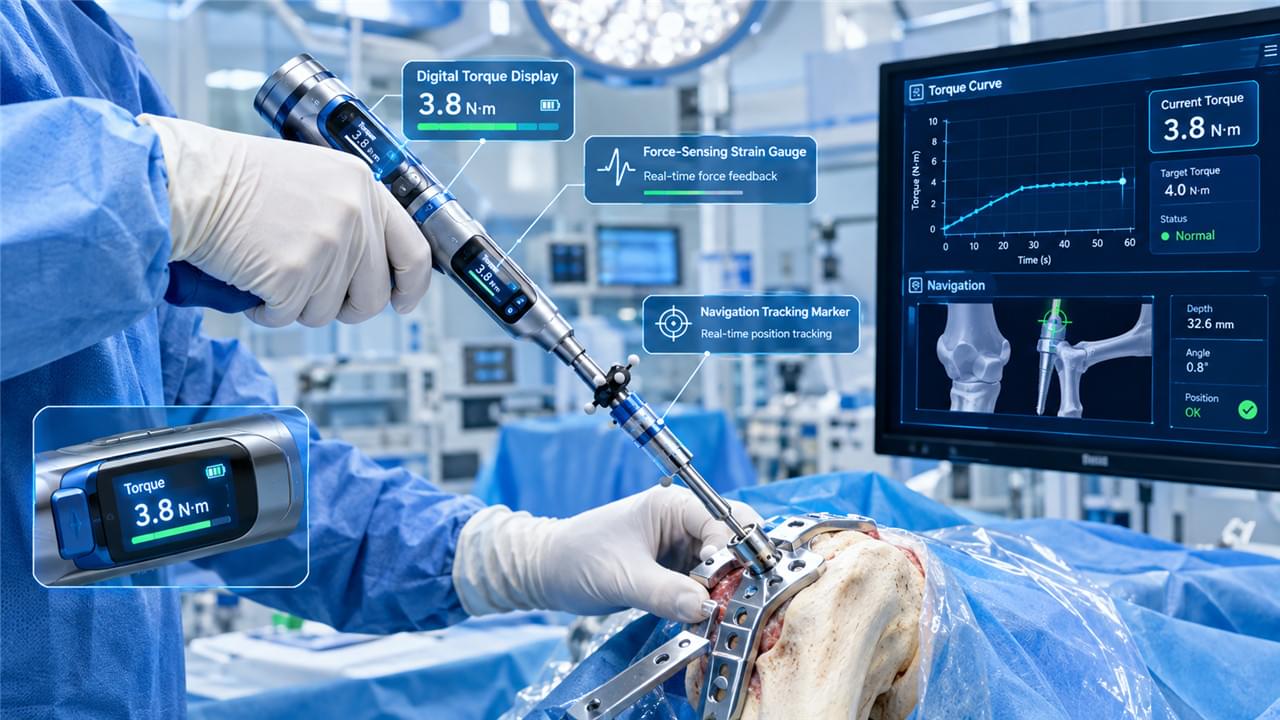
- Instruments with built-in strain gauges providing real-time force feedback
- Haptic feedback overlay when safe tissue force limits are approached
- Torque monitoring in screw insertion (replaces dedicated torque wrench)
Navigation-integrated instruments:
- Instruments with embedded tracking markers for surgical navigation systems
- Eliminates need for separate reference arrays on instruments
- Real-time positional guidance for cutting guide placement
Connected instruments:
- Digital depth gauges with OR display integration
- Drill bit depth monitoring with audible/visual stop-point alerts
- Data logging of instrument-applied forces for post-procedure analysis
Regulatory consideration: Smart instruments integrating electronics are regulated as combination products — adding software validation requirements to standard mechanical device requirements. Early-stage smart surgical instruments are commercially available in torque-limiting drivers; fully navigation-integrated families remain in active development.
🖨️ Trend 4: 3D Printing and Patient-Matched Instruments
Additive manufacturing is enabling a new category of orthopedic instrument innovation — patient-matched and procedure-optimized custom instruments:
Patient-Matched Instruments (PMI):
- TKA and THA cutting guides designed from patient CT data
- Precisely match patient anatomy — eliminating intraoperative sizing steps
- Typically single-use polymer (PA12, PC, PEEK) printed per patient
- Growing evidence for improved alignment accuracy vs. conventional instruments
Procedure-Optimized Custom Instruments:
- Instrument geometries optimized for specific surgeon technique preferences
- Novel access instruments for emerging MIS approaches
- Rapid prototyping for instrument design iteration
The FDA’s overview of 3D-printed medical devices covers the regulatory framework for exactly this class of patient-specific, additively manufactured products — required reading for anyone bringing PMI guides to market.
♻️ Trend 5: Sustainability-Driven Design
Environmental considerations are increasingly influencing instrument development:
Eco-design principles:
- Minimize total material volume per instrument
- Design for disassembly — separating materials for end-of-life recycling
- Recyclable packaging for instrument sets
- Reduced sterilization packaging waste
Carbon footprint reduction:
- Lightweight instruments reduce autoclave energy consumption per sterilization cycle
- Modular systems reduce total instrument count — lower manufacturing and processing energy
- Manufacturers publishing lifecycle assessment data increasingly required by European hospital procurement criteria
❓ FAQ: Orthopedic Instrument Innovation
Q1: What is the impact of ergonomic instrument design on surgical outcomes?
Ergonomic instruments reduce surgeon fatigue — which is associated with decreased precision in the late stages of complex procedures. Reduced occupational injury rates in surgical staff are a documented benefit.
Q2: Are smart instruments widely available in orthopedics today?
Limited commercial availability exists for sensing-enabled instruments. Torque-limiting electronic screwdrivers are commercially available. Navigation-integrated instruments with tracking markers are in active development and early commercial deployment.
Q3: What are patient-matched instruments (PMI) and are they better than standard instruments?
PMI are 3D-printed single-use cutting guides customized to patient anatomy from CT data. Clinical evidence shows equivalent or improved coronal alignment vs. conventional guides in TKA. Their primary advantages are procedure simplicity and reduced intraoperative steps.
Q4: Will smart instruments replace traditional surgical navigation systems?
Smart instruments and navigation systems are complementary. Navigation systems provide comprehensive spatial tracking. Smart instruments add local force, torque, and depth intelligence that navigation systems do not provide.
Q5: How are manufacturers addressing sustainability in instrument sets?
Through: lightweight material substitution (titanium, carbon fiber), modular design reducing set count, recyclable packaging programs, disposable component lifecycle analyses, and carbon footprint reporting in product documentation.
🏁 Conclusion: Where Orthopedic Instrument Innovation Goes Next
Orthopedic instrument innovation — across ergonomics, modularity, smart technology, custom manufacturing, and sustainability — is creating new competitive differentiation opportunities. Manufacturers who invest in these innovation vectors will capture premium segments and build deeper hospital partnerships. The tray of 2030 will be lighter, smaller, smarter, and cleaner — and the winners will be the companies that started designing for it today.
Return to: Orthopedic Instrument Sets.
Looking to develop next-generation orthopedic instrument systems? Contact our team for innovation partnership and OEM development capabilities.
Medical Disclaimer
Informational purposes only. Specific product claims referenced are for illustrative purposes. Independent verification required before procurement decisions.


 English
 Arabic
 French
 German
 Italian
 Japanese
 Korean
 Portuguese
 Turkish
 Russian
 Spanish