


If you’ve spent any time in an orthopedic trauma bay, you already know this truth: when internal fixation isn’t an option, the external fixator saves the day. It’s the workhorse that orthopods reach for when wounds are contaminated, soft tissues are angry, or the patient simply can’t tolerate a big open procedure.
Unlike plates and nails buried deep inside the body, an external fixator does its job from the outside — pins or wires go through the skin into bone, connecting to a frame that holds everything in place. Simple concept, brilliant execution.
For manufacturers and distributors, orthopedic external fixation devices aren’t just another product category. They’re a growth engine — especially across emerging markets where trauma infrastructure is expanding fast. Procurement teams and clinical buyers need to understand what separates a well-designed system from the rest. This guide breaks it all down, starting with the fundamentals and working through to market realities.
Need a deeper dive on a specific topic? Check out our cluster articles: How External Fixators Work in Fracture Treatment, Monolateral vs Circular External Fixators, Materials in External Fixators, External Fixation for Complex Fractures, and Postoperative Care of External Fixators. For broader market context, see: Global Orthopedic Devices Market.
🔩 What Is an External Fixator, Exactly?
Let’s strip it down to the basics. An external fixator is essentially three things working together:
- Transcutaneous pins or wires — Schanz screws, Kirschner wires, or Steinmann pins drilled into bone through the skin
- An external frame — rods, clamps, rings, or hybrid connectors that lock those pins into the right spatial relationship
- Adjustment mechanisms — telescoping rods, hinges, ball joints, or struts that let surgeons fine-tune alignment after the frame is on
The beauty of this setup? Nothing sits inside the primary surgical zone. The fracture gets stabilized, the wound stays accessible, and the surgeon keeps full control — all without burying hardware in compromised tissue.
The American Academy of Orthopaedic Surgeons (AAOS){target=“_blank” rel=“noopener noreferrer”} considers external fixation a first-line technique for open fracture management, damage control orthopedics, and limb lengthening. It’s not a workaround — it’s the right tool for the right job.
📋 Main Types of External Fixation Systems
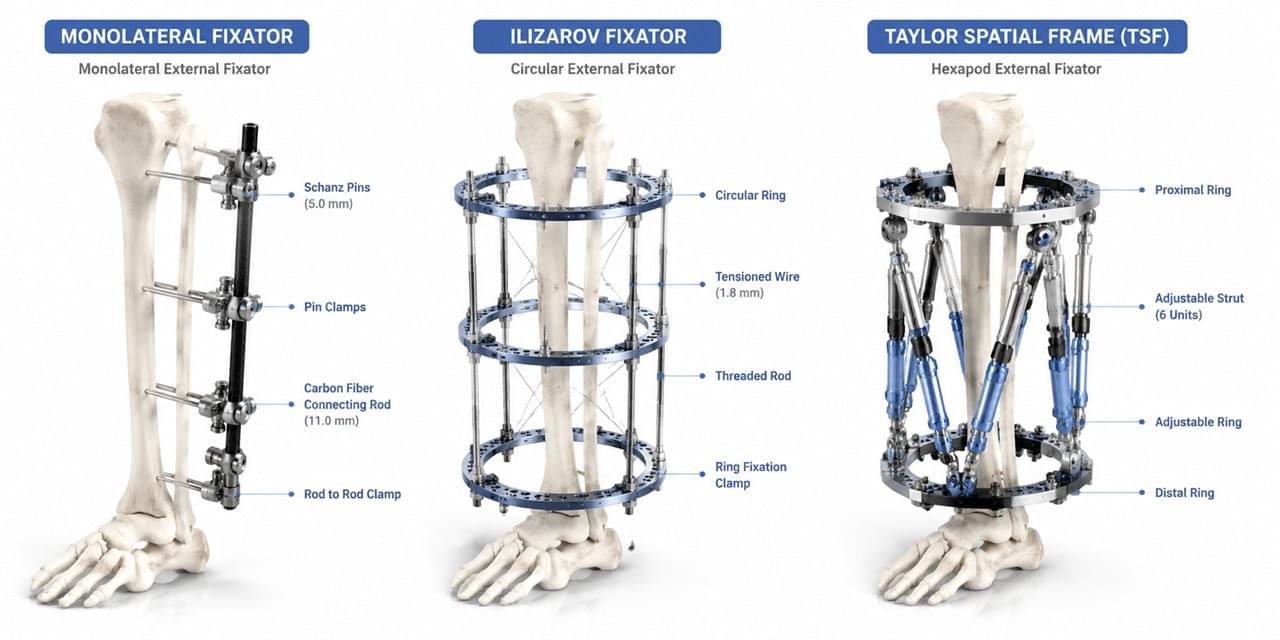
Understanding external fixator types and applications is where the rubber meets the road. Each configuration serves a different clinical purpose, and picking the wrong one can mean the difference between smooth healing and a world of complications.
1. 🏗️ Monolateral External Fixators
The most widely used external fixator on the planet — and for good reason. A single bar running parallel to the bone, anchored by multiple Schanz pins inserted from one side of the limb. Simple, fast, effective.
What you’re looking at:
- 2 to 4 Schanz pins placed above and below the fracture site
- A connecting rod — usually carbon fiber, aluminum, or stainless steel
- Pin-to-rod clamps, either universal or fixed-angle depending on the system
Why surgeons love it:
- Goes on in minutes, not hours
- The learning curve is practically flat
- Patients tolerate it well — lighter and less bulky than alternatives
- Budget-friendly for hospitals watching their procurement spend
Where it shines:
- Femoral and tibial shaft fractures, whether as definitive treatment or a bridge to internal fixation
- Periarticular fractures around the wrist and calcaneus
- Damage control scenarios where speed trumps everything else
The catch: Stability is primarily in one plane. If you need true multiplanar correction, you’ll want something more sophisticated.
2. 🔵 Circular (Ilizarov-Type) External Fixators
Named after Gavriil Ilizarov — the Soviet surgeon who revolutionized deformity correction — the circular external fixator gives you genuine three-dimensional control over bone segments. If monolateral frames are pickup trucks, circular frames are surgical Swiss Army knives.
The setup:
- Multiple rings encircling the limb at strategic positions
- Thin tensioned K-wires (1.5–2 mm) passing through bone and anchored to each ring
- Threaded rods connecting the rings, enabling distraction, compression, or angular correction
What makes it special:
- Full 3D deformity correction — lengthen, angulate, rotate, translate, all simultaneously
- The holy grail for complex deformity work, bone transport, and lengthening procedures
- Distributes loads across multiple fine wires — gentler on osteoporotic bone
Clinical sweet spots:
- Limb lengthening via distraction osteogenesis
- Complex deformity correction from developmental dysplasia or malunions
- Tibial plateau and pilon fractures where articular surfaces need precise control
- Infected non-unions where everything else has failed
The trade-off: These frames are complex to apply, demand serious patient compliance, and are bulkier than their monolateral cousins. When you’re comparing circular vs monolateral external fixator options, it really comes down to what the clinical situation demands.
3. 🔶 Hybrid External Fixators
Think of hybrid systems as the best-of-both-worlds solution. A circular ring at one end handles the tricky periarticular zone, while a monolateral bar spans the diaphysis. Common applications include periarticular fractures, tibial plafond injuries, and challenging proximal tibia fractures.
4. 🖥️ Hexapod / Computer-Assisted Fixators
The most advanced external fixator category — six independently adjustable struts configured as a hexapod, with software doing the heavy lifting. The Taylor Spatial Frame concept, in a nutshell: you input the deformity parameters, the computer spits out a daily strut adjustment schedule, and the correction happens gradually without repeated trips to the OR.
These systems command premium pricing and live primarily in dedicated deformity correction centers. For a detailed head-to-head, see: Monolateral vs Circular External Fixators.
🏥 When Do Surgeons Reach for External Fixation?
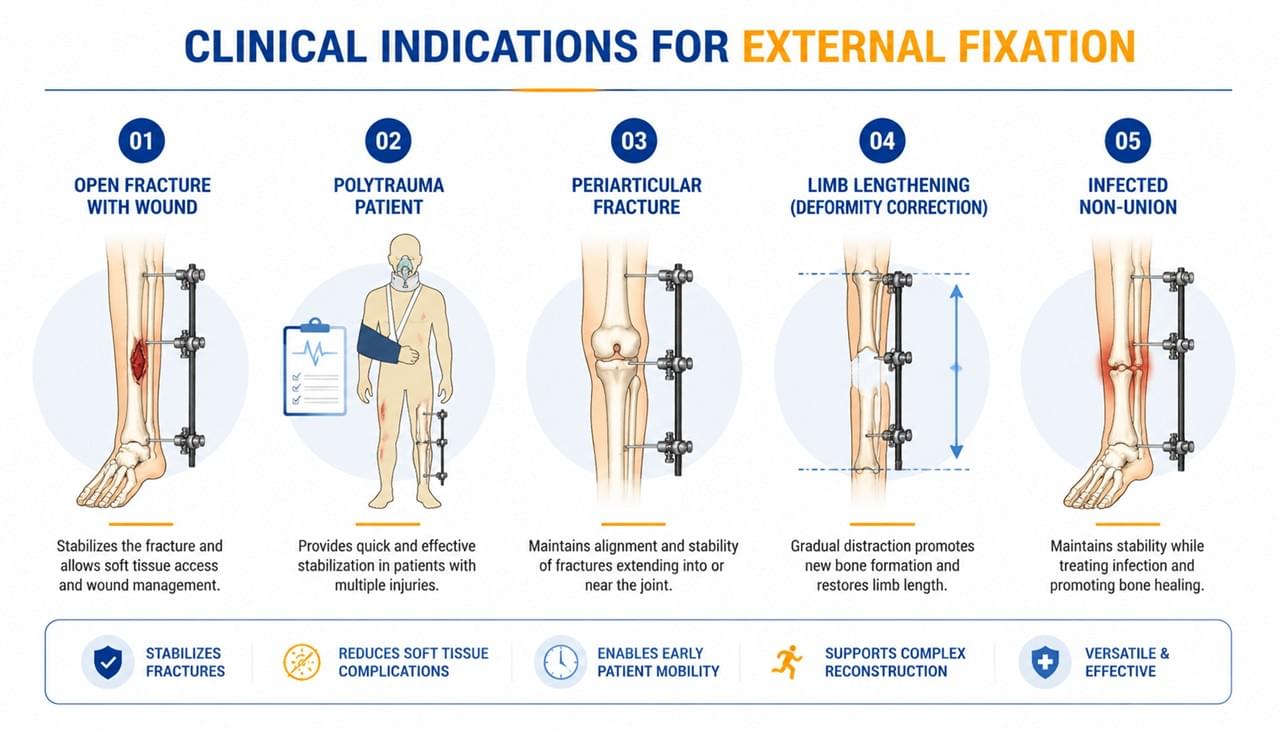
Understanding the clinical indications is what turns product knowledge into purchasing conviction. Here’s where an external fixator earns its keep.
1. 🚨 Open Fractures
This is the number-one emergency indication, period. When bone is exposed and contamination is a real concern, the last thing you want is a pile of internal hardware sitting in a dirty wound. External fixation maintains length and alignment while keeping the wound fully accessible for debridement and dressing changes — something no plate or nail can offer.
Stage I/II open fractures may eventually convert to internal fixation. Stage III? External fixation often stays as the definitive treatment plan.
2. ⚡ Damage Control Orthopedics (DCO)
Picture a polytrauma patient rolling in — hemodynamically unstable, multiple long bone fractures, physiology in freefall. You don’t have hours for definitive fixation. You have minutes.
The “ex-fix and go” approach uses rapid temporary external fixation to stabilize fractures, reduce ongoing blood loss, and dampen the inflammatory cascade from unstable bone ends. Once the patient’s physiology rebounds — days or weeks later — you convert to internal fixation on your terms.
3. 🦴 Complex Periarticular Fractures
High-energy injuries around joints — distal femur, tibial plateau, tibial plafond, calcaneus — benefit enormously from a staged approach. An external fixator bridges the gap: it maintains reduction, preserves soft tissue tension, and buys time for swelling to settle before definitive internal fixation. This is the backbone of the “fix and flip” protocol for pilon fractures specifically.
4. 📏 Limb Lengthening and Deformity Correction
The Ilizarov method harnesses distraction osteogenesis — a millimeter of gradual separation per day, stimulating the body to generate new bone in the gap. This requires the precise control only circular fixation can deliver. Whether you’re adding length or untwisting a complex angular deformity, the frame becomes both the scaffold and the steering wheel.
5. 🦠 Infected Non-Union
When infected hardware has to come out, you’ve got a problem: the bone still needs stabilization while antibiotics do their work. An external fixator solves that puzzle elegantly — it holds alignment during the infection-clearing phase, then bridges you to definitive reconstruction when the field is clean.
⚙️ Design and Material Considerations
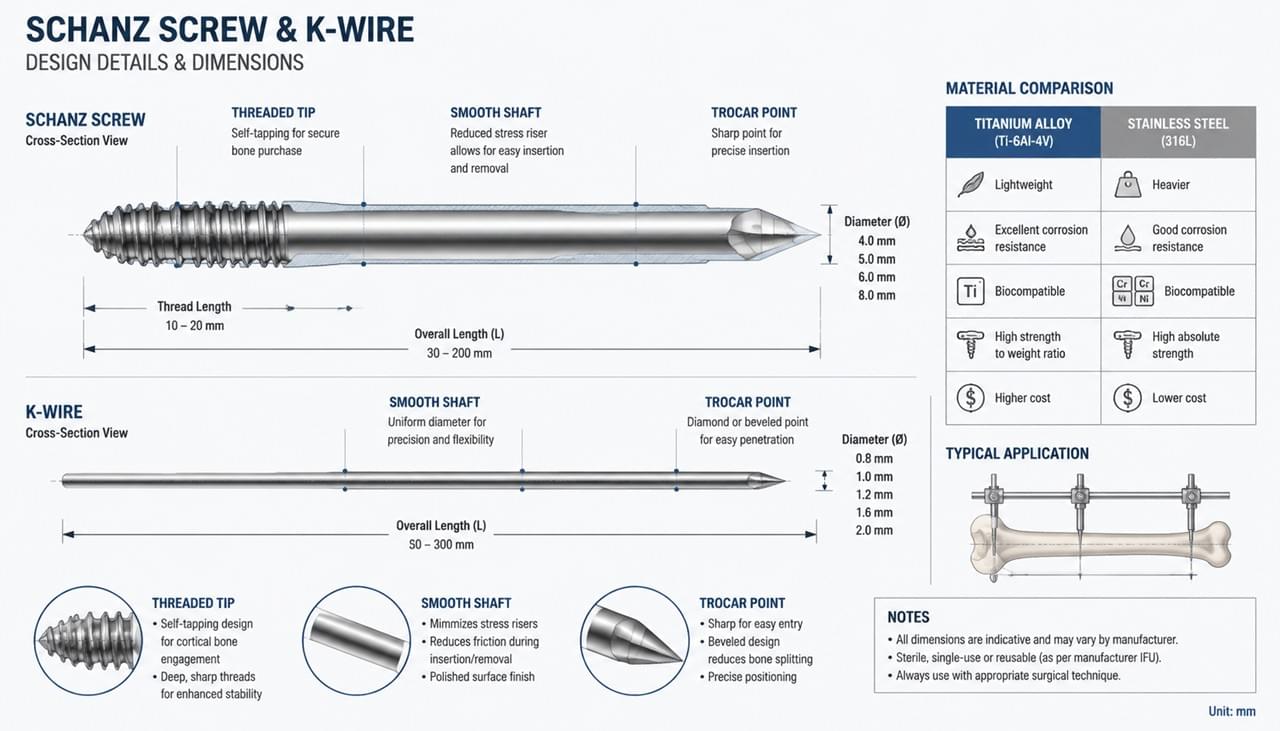
The difference between a premium orthopedic external fixation device and a commodity product lives in the details. Here’s what to look for.
Pin and Wire Geometry
Schanz screws (half-pins) aren’t just threaded rods. The core diameter determines bending stiffness; the thread geometry dictates pull-out strength; the tip design affects insertion torque and — critically — thermal damage to surrounding bone. Standard diameters run from 3.0 mm up to 6.0 mm, scaled to patient size and bone quality.
Kirschner wires (K-wires) are a different animal entirely. At 1.5–2.0 mm, these thin stainless steel or titanium wires pass completely through the bone and tension across Ilizarov rings. They need specialized tensioners and a surgeon who knows how to use them properly.
Frame Materials at a Glance
| Material | Weight | Stiffness | Corrosion Resistance | Cost | Best For |
|---|---|---|---|---|---|
| Carbon Fiber Composite | Very light | High | Excellent | High | High-performance monolateral |
| Aluminum Alloy | Light | Good | Good | Moderate | Standard monolateral, rings |
| Stainless Steel 316L | Heavy | Very high | Good | Low | Budget systems, rings |
| Titanium | Light | Good | Excellent | High | Premium systems |
For a full material deep-dive, see: Materials in External Fixators.
🔧 Postoperative Management
External fixation demands more from patients and care teams than internal fixation ever will. Here’s what the postoperative journey looks like.
Pin site care is non-negotiable. Daily cleaning with saline or antiseptic solution, constant vigilance for early signs of infection, and thorough patient education — because once they leave the hospital, they’re on their own with those pin sites. Pin track infection remains the most common complication across all external fixation series.
Frame maintenance isn’t set-and-forget. Clamps loosen over time and need regular tightening. Lengthening or correction cases require precise daily adjustments per the surgeon’s prescription. Weight-bearing progresses according to protocol, not patient preference.
As for duration: temporary frames for damage control or open fractures come off in days to weeks. Definitive fixation for tibial fractures? Three to six months. Limb lengthening can stretch to a year or more depending on how much length you’re after.
For detailed postoperative protocols, see: Postoperative Care and Complications of External Fixators.
📊 Market Landscape and OEM Opportunities
The global external fixator market sits around USD 2.8–3.2 billion in 2026, climbing at roughly 6.3% CAGR. What’s driving it?
- Road accident rates climbing across developing nations
- Trauma care infrastructure expanding rapidly in Africa, Southeast Asia, and Latin America
- Limb lengthening procedures gaining traction worldwide, not just in niche centers
For OEM manufacturers, the opportunities break down into a few clear lanes: complete system supply covering frames, pins, and accessories; pin-and-wire supply to existing frame manufacturers; private-label systems for regional distributors; and cost-optimized designs hitting developing-market price points without sacrificing quality.
ISO 13485 certification plus FDA 510(k) clearance or CE marking under EU MDR — that’s the baseline ticket to international markets. No shortcuts here.
❓ FAQ: External Fixators
Q1: What’s the difference between an external fixator and a cast?
A cast immobilizes with circumferential plaster or fiberglass — it can’t control alignment precisely and won’t let you near the wound. An external fixator provides adjustable, controlled stabilization through bone pins, giving you wound access and the ability to fine-tune position over time. Different tools for fundamentally different problems.
Q2: When is external fixation preferred over internal fixation?
External fixation takes the lead when you’re dealing with heavily contaminated open fractures, polytrauma patients with hemodynamic instability, severe soft tissue compromise, or situations where the infection risk of internal hardware is simply unacceptable. It’s not about one being better — it’s about matching the tool to the clinical scenario.
Q3: What’s the most common complication of external fixators?
Pin site infection tops the list, showing up in 20–30% of patients across published series. Good pin care reduces the risk but doesn’t eliminate it entirely. Deep infections tracking along pins into bone are less common but far more serious when they occur.
Q4: Can you leave an external fixator on permanently?
In practice, external fixators are temporary — weeks to months for most applications. Limb lengthening and complex deformity cases can push that to months or beyond a year, but true permanent external fixation is rarely used. Infection risk and quality of life impact make it a last-resort option.
Q5: What exactly is the Taylor Spatial Frame?
The Taylor Spatial Frame is a hexapod circular external fixator — six computer-adjusted struts working in concert. Software calculates the daily strut adjustments needed to correct any combination of multiplanar deformity simultaneously. It represents the most advanced circular fixation technology currently on the market.
✅ Conclusion
The external fixator isn’t just another orthopedic tool — it’s the solution surgeons turn to when the situation gets complicated. Open fractures, polytrauma, complex deformities, infected non-unions — scenarios where internal fixation either can’t go in or shouldn’t. Its versatility, speed of deployment, and adjustability make it irreplaceable in trauma and reconstruction.
For manufacturers and distributors, the orthopedic external fixation devices market isn’t standing still. Emerging markets are investing heavily in trauma infrastructure, and the demand for well-designed, certified systems at accessible price points has never been stronger.
Ready to explore external fixation product development or global distribution partnerships? Contact our team to discuss OEM manufacturing capabilities, certification requirements, and market entry strategies.
⚠️ Medical Disclaimer
This article is for informational purposes only, directed at medical device industry professionals. External fixation techniques require specialized surgical training. Clinical decisions must be made by qualified orthopedic surgeons on a patient-specific basis.
 English
 Arabic
 French
 German
 Italian
 Japanese
 Korean
 Portuguese
 Turkish
 Russian
 Spanish