


Spinal implants are among the most advanced devices used in modern orthopedic surgery. Positioned close to the spinal cord, nerve roots, and major blood vessels, these products require exceptional engineering precision, biocompatible materials, and strict manufacturing controls. As the global incidence of degenerative spine disorders continues to rise, spinal implants have become one of the fastest-growing segments of the orthopedic device market.
This article is part of our guide on Orthopedic Implants: Types, Materials & Manufacturing Technologies.
🦴 Understanding Spinal Implants and Spine Pathologies
The human spine consists of 33 vertebrae divided into cervical, thoracic, lumbar, sacral, and coccygeal regions. Each section experiences different biomechanical forces, which directly influence implant design requirements.
Common conditions that drive demand for spinal implants include:
✅ Degenerative disc disease
✅ Lumbar spinal stenosis
✅ Disc herniation with nerve compression
✅ Vertebral compression fractures
✅ Scoliosis and spinal deformities
✅ Spinal tumors
Among these conditions, lumbar degeneration remains the largest market segment due to the high mechanical loads placed on the lower spine throughout daily activities.
⚙️ Why Spinal Implants Must Match Complex Spinal Anatomy
Unlike many orthopedic devices, spinal implants must balance stability with biomechanical function. Excessive rigidity may increase stress on adjacent vertebral levels, while insufficient support can compromise fusion outcomes.
Manufacturers must carefully consider:
- Anatomical compatibility
- Load distribution
- Bone quality
- Surgical approach
- Long-term durability
Even small design changes can significantly affect clinical performance and patient outcomes.
🔄 Fusion vs. Non-Fusion Spinal Implants
One of the most important distinctions in modern spinal implants is whether the system promotes fusion or preserves motion.
Fusion-Based Systems
Fusion remains the most widely performed spinal procedure worldwide.
These systems typically include:
- Interbody cages
- Bone graft materials
- Posterior screw-and-rod constructs
The objective is to permanently stabilize adjacent vertebrae and encourage bone growth across the treated segment.
Motion-Preserving Solutions
Motion-preserving technologies aim to maintain natural spinal movement while reducing symptoms.
Examples include:
- Artificial disc replacement
- Dynamic stabilization devices
- Interspinous spacers
Although promising, these technologies generally require more extensive clinical evidence and regulatory approval.
🏗️ Interbody Cage Design: Key Engineering Principles
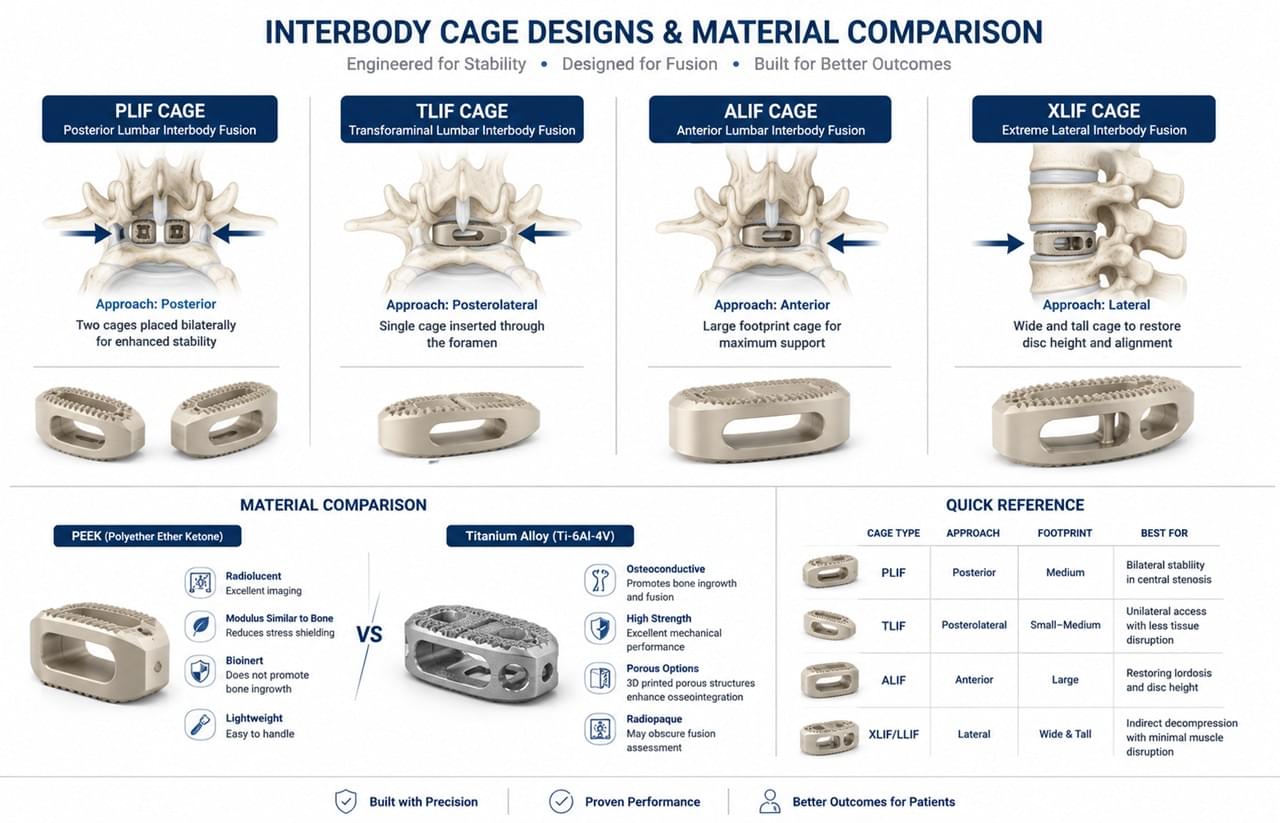
Interbody cage design plays a critical role in successful spinal fusion procedures. These devices are inserted between vertebral bodies to restore disc height and provide structural support.
Key objectives include:
✅ Maintaining spinal alignment
✅ Restoring foraminal height
✅ Supporting bone fusion
✅ Preventing vertebral collapse
Different surgical approaches require different cage geometries.
| Approach | Common Cage Design |
| PLIF | Kidney-shaped |
| TLIF | Curved or bullet-shaped |
| ALIF | Large footprint |
| XLIF/LLIF | Wide lateral design |
Expandable cages have also gained popularity because they allow surgeons to adjust implant height during surgery while minimizing insertion trauma.
🔬 Material Selection for Modern Spinal Implant Systems
Material choice significantly influences the performance of spinal implant systems.
PEEK
PEEK remains one of the most widely used materials because it offers:
- Excellent radiolucency
- Bone-like stiffness
- Clear postoperative imaging
However, it is biologically inert and does not actively promote bone growth.
Porous Titanium
Advances in additive manufacturing have accelerated the adoption of porous titanium cages.
Benefits include:
🔹 Superior osseointegration
🔹 High mechanical strength
🔹 Bone-mimicking porous structures
Many premium implants now utilize 3D-printed titanium architectures to improve fusion outcomes.
Carbon Fiber Reinforced PEEK
CF-PEEK combines radiolucency with improved mechanical properties, making it an attractive option for selected applications.
🔩 Pedicle Screw Fixation System Design
The pedicle screw fixation system remains the gold standard for posterior spinal stabilization.
A typical construct consists of:
- Pedicle screws
- Connecting rods
- Locking mechanisms
Screw Design Considerations
Critical design parameters include:
- Diameter
- Length
- Thread pitch
- Core geometry
- Head configuration
Polyaxial screws allow easier rod placement and are commonly used in deformity correction procedures, while monoaxial screws provide greater rigidity in selected cases.
Rod Materials
Titanium alloy remains the industry standard due to its strength and MRI compatibility. Cobalt-chrome rods provide greater stiffness and are often preferred in long-segment deformity correction procedures.
📋 Regulatory Standards and Testing for Spinal Implants
Because of their proximity to neural structures, spinal implants face some of the strictest regulatory requirements in orthopedics.
Important standards include:
📋 ASTM F1717 – Spinal fixation construct testing
📋 ASTM F2077 – Interbody fusion device testing
📋 ASTM F2267 – Cage subsidence testing
Manufacturers introducing novel devices must also provide robust clinical evidence to satisfy FDA and EU MDR requirements.
For more information, see Orthopedic Device Regulatory Compliance.
Spinal implants combine advanced engineering, biomaterials science, and clinical expertise to address some of the most challenging conditions in orthopedic medicine. From innovative interbody cage design to sophisticated pedicle screw fixation systems, modern technologies continue to improve stability, fusion rates, and patient outcomes. For manufacturers, distributors, and healthcare providers, understanding these design principles is essential for evaluating product performance and long-term clinical value.
Looking for qualified manufacturing partners for spinal implant systems? Contact our team to discuss OEM production, product development, and regulatory support.
 English
 Arabic
 French
 German
 Italian
 Japanese
 Korean
 Portuguese
 Turkish
 Russian
 Spanish