


Ask any orthopedic trauma surgeon which monolateral external fixator they reach for in an emergency, and you’ll get an answer in under a second. Ask when they’d pick a circular Ilizarov frame instead, and you’ll get a much longer conversation. That’s because these two devices aren’t really rivals — they’re tools for different jobs.
The choice between a monolateral external fixator and a circular system shapes treatment plans, patient comfort, surgical time, and hospital budgets. For manufacturers, distributors, and procurement teams, understanding the trade-offs isn’t optional — it’s how you position products correctly.
This article is part of our guide on External Fixators: Design, Types and Clinical Applications.
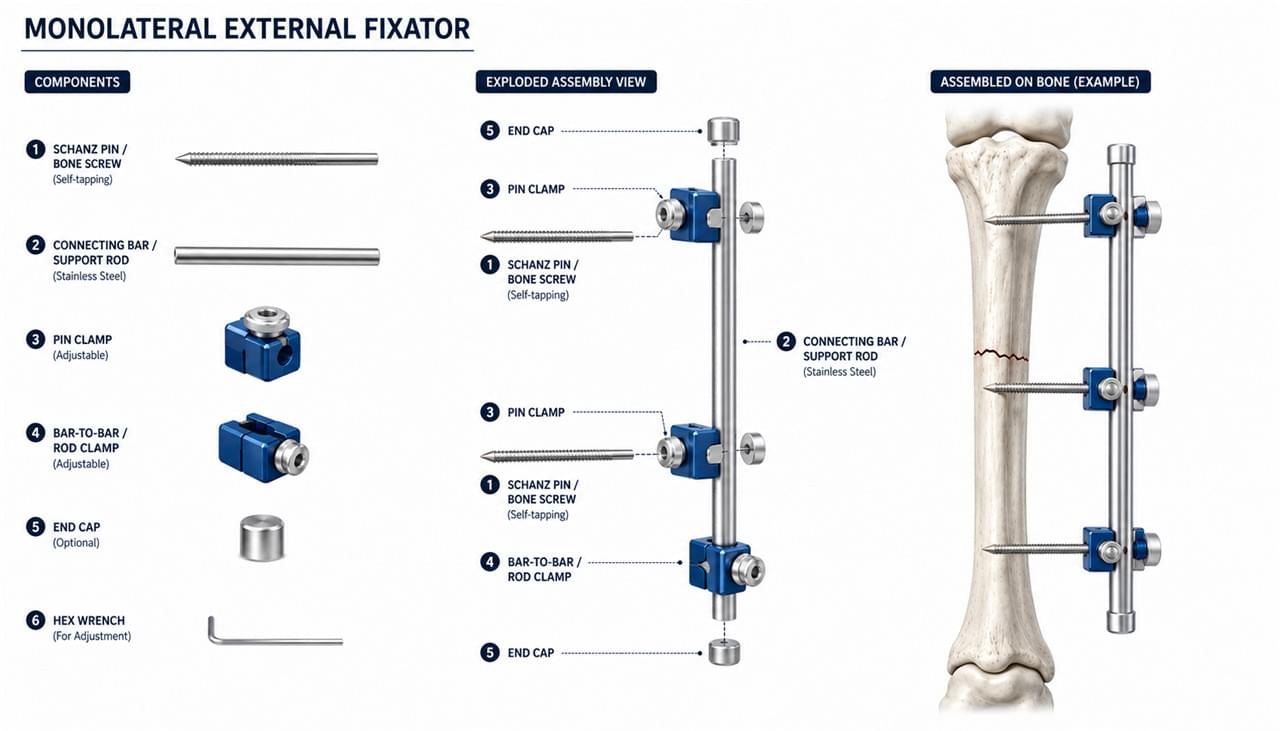
🏗️ Monolateral External Fixators: Structure and Strengths
A monolateral external fixator uses 2–4 Schanz half-pins driven in from one side of the limb, linked by a single bar — or a double-bar configuration when extra stability matters.
Design Characteristics of the Monolateral External Fixator
- Single-plane pin insertion: all pins enter from one side only
- Connecting bar: carbon fiber, aluminum, or stainless steel
- Clamp mechanism: universal or fixed-angle pin clamps
- Optional extras: telescoping rod for dynamization, ball joint for multiplanar tweaks, articulated components
Want the engineering details behind pin diameter and bar stiffness? The external fixation principles overview on NCBI’s StatPearls explains exactly how construct stiffness scales with pin size and rod material — well worth a bookmark for procurement teams comparing systems.
Key Advantages of the Monolateral External Fixator
- Speed: an experienced surgeon can have one on in 15–30 minutes
- Comfort: lighter and less bulky — patients genuinely notice the difference
- Cost: simpler components mean a friendlier price tag
- Availability: standard training in every orthopedic residency program
- Acute trauma versatility: the go-to for damage control and open fracture bridging
Where the Monolateral External Fixator Falls Short
Let’s be honest about the downsides. Stability is predominantly one-plane, multiplanar deformity correction is limited, and half-pins concentrate more stress at the pin-bone interface than tensioned K-wires ever will.
Best Clinical Applications for the Monolateral External Fixator
- Femoral shaft fractures — bridging fixation in polytrauma
- Tibial shaft fractures, definitive or bridging
- Open fractures across all long bones
- Periarticular fractures: distal radius, calcaneus (temporary)
- Pelvic ring injuries via pelvic external fixation
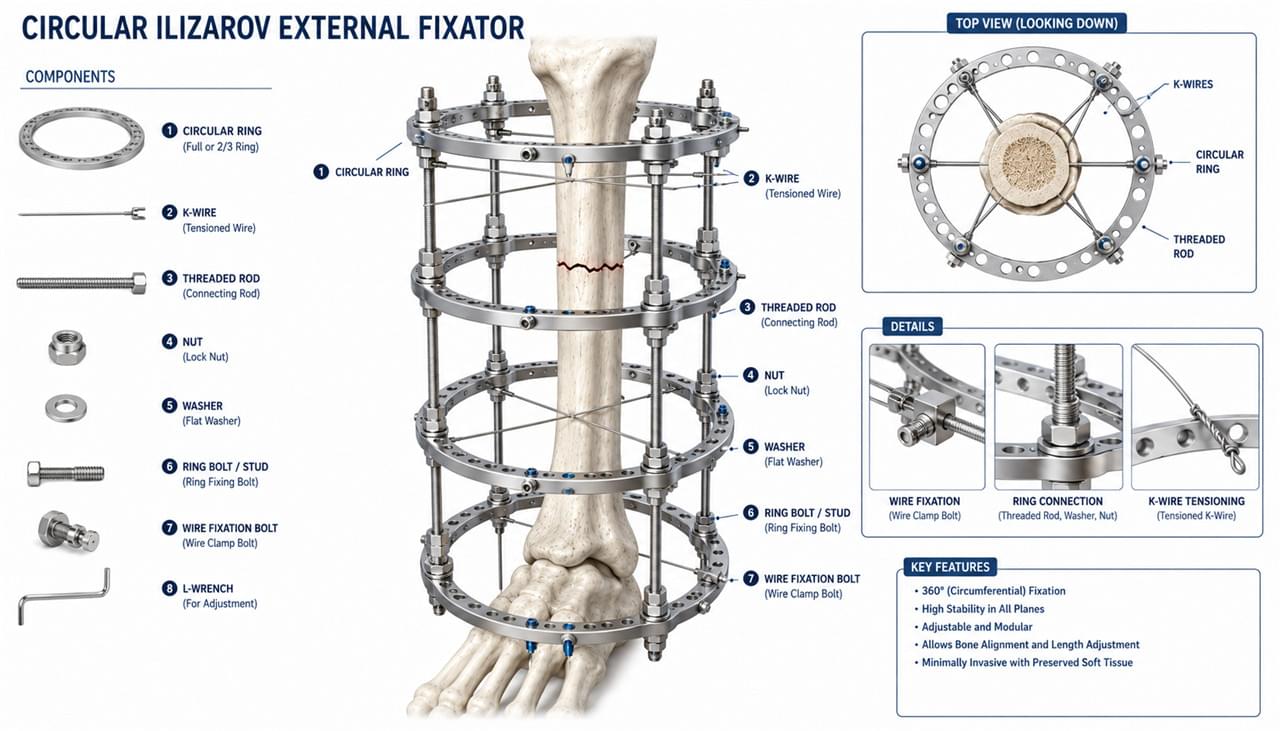
🔵 Circular (Ilizarov-Type) External Fixators: Structure and Strengths
The circular external fixator wraps the limb in rings connected by threaded rods, with thin K-wires tensioned through bone at each level. It’s a direct descendant of the classic Ilizarov external fixator concept — refined over decades, now more capable than ever.
Circular External Fixator: Design Characteristics
- Circumferential rings: typically 4–5 for the lower extremity
- Tensioned K-wires: 1.5–2.0 mm, tensioned to 90–130 kg per ring
- Threaded rods: enable distraction, compression, or angular adjustment
- Advanced variant: the hexapod Taylor Spatial Frame with six computer-controlled struts
Curious about the surgical side? The AO Surgery Reference walks through full ring (Ilizarov) fixation step by step — from safe wire corridors to frame assembly and pin-site aftercare.
Circular External Fixator: Key Advantages
- True 3D control: all six degrees of freedom are adjustable
- Distributed loading: tensioned wires spread forces across the bone — noticeably kinder to osteoporotic bone
- Progressive correction: limb lengthening, deformity correction, bone transport
- Stability in every plane: clearly superior to monolateral in multiplanar scenarios
Circular External Fixator: Limitations
- Complexity: 60–120+ minutes to apply, with a steep learning curve
- Bulkiness: heavy frames take a real toll on daily life
- Compliance: some protocols require patients to perform daily adjustments themselves
- Cost: more components, more complex clamps and ring systems
- Acute trauma: generally reserved for elective reconstruction
Best Clinical Applications for Circular Fixators
- Limb lengthening — congenital short limb, post-traumatic shortening
- Multiplanar deformity correction — malunions, developmental dysplasias
- Complex tibial plateau and pilon fractures
- Tibial non-union with deformity
- Infected non-union via bone transport across the defect
📊 Head-to-Head: Monolateral vs Circular External Fixator
When you put the monolateral external fixator next to its circular cousin, the differences snap into focus. Here’s the comparison table surgeons actually use:
| Parameter | Monolateral | Circular (Ilizarov) | Hexapod (TSF) |
|---|---|---|---|
| Pin type | Half-pins (Schanz) | K-wires + optional half-pins | K-wires + half-pins |
| Plane of stability | 1–2 planes | All planes | All planes |
| Application time | 15–30 min | 60–120 min | 90–180 min |
| Deformity correction | Limited | Excellent | Computer-guided |
| Limb lengthening | Not ideal | Gold standard | Gold standard |
| Patient comfort | Good | Challenging | Challenging |
| Average product cost | Low-moderate | Moderate-high | High |
| Learning curve | Shallow | Steep | Very steep |
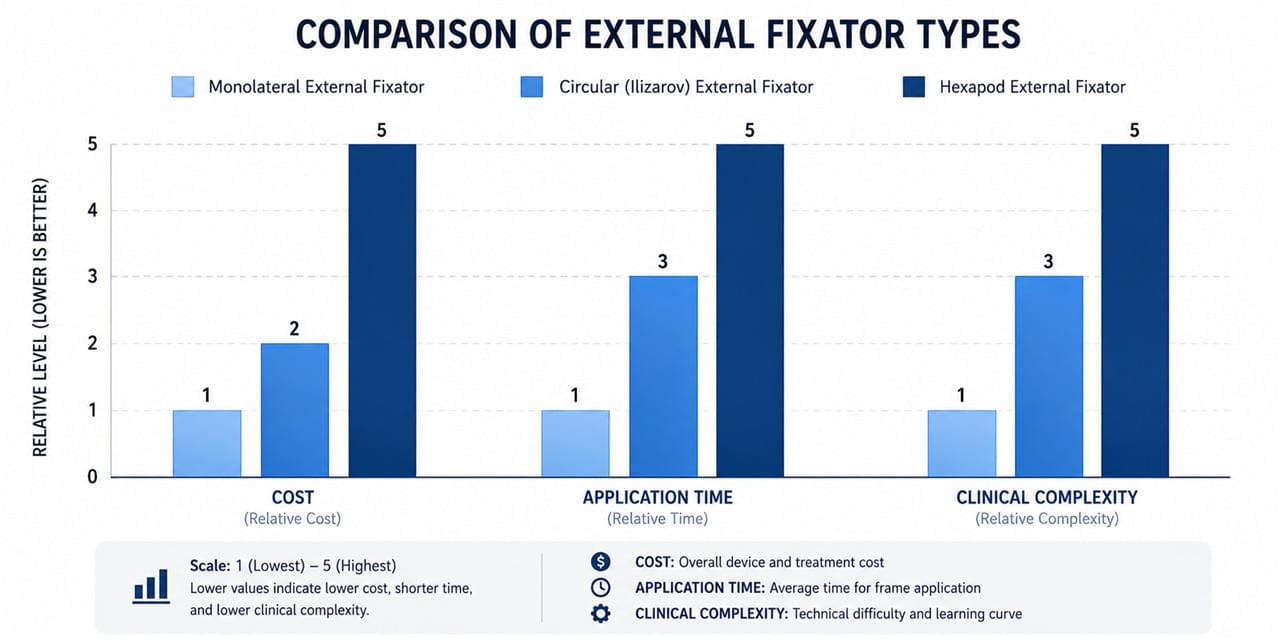
💰 Cost and Complexity Considerations
For hospital procurement teams and distributors, the monolateral external fixator remains the best balance of cost, versatility, and adoption speed. Here’s what per-case price points look like at OEM supply level:
- Monolateral kits (frame + pins + accessories): USD 200–800, depending on region and quality tier
- Circular Ilizarov sets: USD 500–2,000+
- Hexapod/TSF systems: USD 3,000–8,000+
In cost-sensitive emerging markets, monolateral dominates by pure volume. Circular systems live in specialized deformity correction and limb reconstruction centers.
For OEM manufacturers, monolateral wins on practicalities too: higher volume from broader clinical indications, simpler manufacturing with fewer precision components, and a standard 510(k) regulatory pathway for most systems.
❓ FAQ: Monolateral vs Circular External Fixator
Q1: Can a monolateral fixator correct limb shortening?
Not effectively. Some controlled dynamization is possible, but distraction osteogenesis demands the multiplanar control and adjustment capability of circular or hexapod systems.
Q2: Which is better for a tibial shaft fracture?
For acute tibial shaft fractures — especially open ones — the monolateral external fixator is standard and highly effective. Circular fixation steps in for complex metaphyseal-diaphyseal fractures or when multiplanar correction is required.
Q3: Is the Taylor Spatial Frame a type of Ilizarov external fixator?
Yes — the TSF is a hexapod variant of the circular principle, swapping threaded rods for six adjustable struts and adding computer-guided correction capability beyond traditional Ilizarov systems.
Q4: What training do circular external fixators require?
More than standard residency provides. Fellowship training or dedicated limb reconstruction courses are the norm, and manufacturers typically offer application training as part of commercial support.
Q5: Which type is more cost-effective for an emerging market hospital?
The monolateral external fixator, hands down. One well-designed modular system covers the majority of acute trauma indications at a fraction of the per-case cost of circular systems.
🏁 Conclusion
The monolateral external fixator and circular fixator serve different clinical roles — and that’s exactly the point. Monolateral dominates acute trauma and damage control. Circular systems rule deformity correction, limb lengthening, and complex reconstruction. For most trauma departments, especially in emerging markets, a high-quality modular monolateral system is the priority investment.
Return to the full guide: External Fixators: Design, Types and Clinical Applications.
Looking for monolateral or circular external fixation system supply partnerships? Contact our team to discuss product specifications.
⚠️ Medical Disclaimer
This article is for informational purposes only. Clinical device selection requires qualified orthopedic surgeon assessment.
 English
 Arabic
 French
 German
 Italian
 Japanese
 Korean
 Portuguese
 Turkish
 Russian
 Spanish