


Orthopedic implant materials form the silent foundation of orthopedic device performance. Selecting the right material is the defining factor between an implant that performs flawlessly for decades and one that fails catastrophically within years. For device manufacturers, materials engineers, and hospital procurement teams, mastering the mechanical properties, biological compatibility, and cost dynamics of these materials is crucial for ensuring clinical success.
This guide is part of our extensive master class: 整形外科用インプラント:種類、材料、製造技術.
🛠️ Critical Criteria for Sourcing Implant Materials
Surgical implants must withstand a brutal biological environment while enduring millions of high-stress loading cycles without cracking. The criteria for picking these components include:
- Biocompatibility & Safety: Zero toxic, inflammatory, or adverse immune reactions in human tissues per the rigorous ISO 10993 series standards.
- Mechanical Integrity & Fatigue Resistance: Excellent structural resilience to bear weight over long life cycles.
- Corrosion Resistance: The ability to withstand continuous exposure to highly corrosive bodily fluids.
- Osseointegration Capacity: Promoting natural bone growth onto the surface for permanent structural fixation.
- Advanced Diagnostics Compatibility: Minimizing distortion or risks during post-operative MRI and CT scans.
🔬 Deep-Dive: 5 Vital Orthopedic Implant Materials
1. Titanium Alloys: The Structural Powerhouse
Titanium alloys remain the unquestioned industry gold standard for load-bearing skeletal applications. Among them, Ti-6Al-4V (Grade 5) and its premium counterpart Ti-6Al-4V ELI (Extra-Low Interstitial) dominate production lines.
🌟 Key Benefits of Titanium Orthopedic Implants
- Biocompatibility: Features a natural titanium dioxide passive layer that resists corrosion and naturally encourages rapid osseointegration.
- Optimized Elasticity: Offers a modulus of elasticity (~110 GPa) that sits closer to human bone than stainless steel, significantly decreasing stress shielding.
- Diagnostic Ease: Provides excellent MRI-conditional safety profiles with minimal image artifacts.
Common Clinical Applications: Femoral stems, tibial trays, hip acetabular shells, trauma bone plates, and high-strength pedicle screws.
2. Cobalt-Chrome Alloys: The Ultimate Bearing Surface
When joint replacements require extreme hardness and fluid, frictionless movement, cobalt chrome orthopedic solutions are the premium choice. Comprising cobalt, chromium, and molybdenum (per ASTM F75 and F1537), these alloys are built for articulating surfaces.
🌟 High-Performance Wear Resistance
- Extreme Hardness: Reaches roughly 35 HRC, protecting critical joint surfaces against abrasive scratches.
- High Modulus: Its stiff structure (~230 GPa) provides massive structural strength but requires careful engineering to manage stress shielding risks.
Common Clinical Applications: Total knee replacement femoral components, sliding hip joints, and specialized high-stiffness spinal rods.
3. PEEK: The Flexible Polymer Revolution
ポリエーテルエーテルケトン(PEEK)は、現代の脊椎手術の様相を劇的に変えました。この高性能ポリマーは、独自の解剖学的特性を一致させることで、金属代替品と肩を並べます。.
🌟 Clinical Advantages of PEEK Spinal Implants
- 放射線透過性: X線およびCTスキャンで完全に透明であり、外科医が視覚的な障害なしに骨癒合の進行を容易に追跡できるようにします。.
- 骨模倣弾性率: 曲げ弾性率が約3.6 GPaであり、人間の皮質骨に近く、インプラント部位周辺の骨の劣化を防ぎます。.
💡 プロのヒント:PEEKは本質的に疎水性であるため、プレミアムバリエーションには、骨結合を促進するためにチタンプラズマ溶射またはハイドロキシアパタイト(HA)コーティングが施されています。.
Common Clinical Applications: 脊椎後弯固定ケージ(TLIF、PLIF、ALIFデザインを含む)および特殊な椎体置換術。.
4. Stainless Steel 316L: The Rugged Trauma Workhorse
チタンとの厳しい競争に直面していますが、316L医療グレードオーステナイト系ステンレス鋼は、一時的な構造的固定の定番であり続けています。厳格なISO 5832-1規格によって世界的に管理されており、優れた機械的靭性を提供します。.
🌟 Cost-Effective Mechanical Power
- 高い経済性: チタンやコバルトクロムよりも調達および加工が大幅に安価です。.
- 高い降伏強度: 170~690 MPaの範囲で、優れた一時的な安定性を提供します。ただし、ニッケル含有量が高いため、患者のアレルギー検査が必要です。.
Common Clinical Applications: 内部外傷固定プレート、一時的な骨ネジ、Kワイヤー、および構造用シュタインマンピン。.
5. Ultra-High Molecular Weight Polyethylene & Bio-ceramics
これらの特殊素材は、現代の関節再建アセンブリを完成させます。高架橋ポリエチレン(XLPE)およびビタミンE安定化バリエーションは、関節部品の超低摩擦ライナーとして機能し、摩耗粒子を90%以上削減します。.
一方、ジルコニア強化アルミナ(ZTA)セラミックスは、その極度の硬度と不活性な生物学的プロファイルにより、プレミアムセラミック大腿骨頭に広く使用されています。さらに、プラズマ溶射ハイドロキシアパタイト(HA)コーティングは、構造用金属表面上の直接的な生体活性結合剤として機能します。.
📊 Comprehensive Comparison Matrix
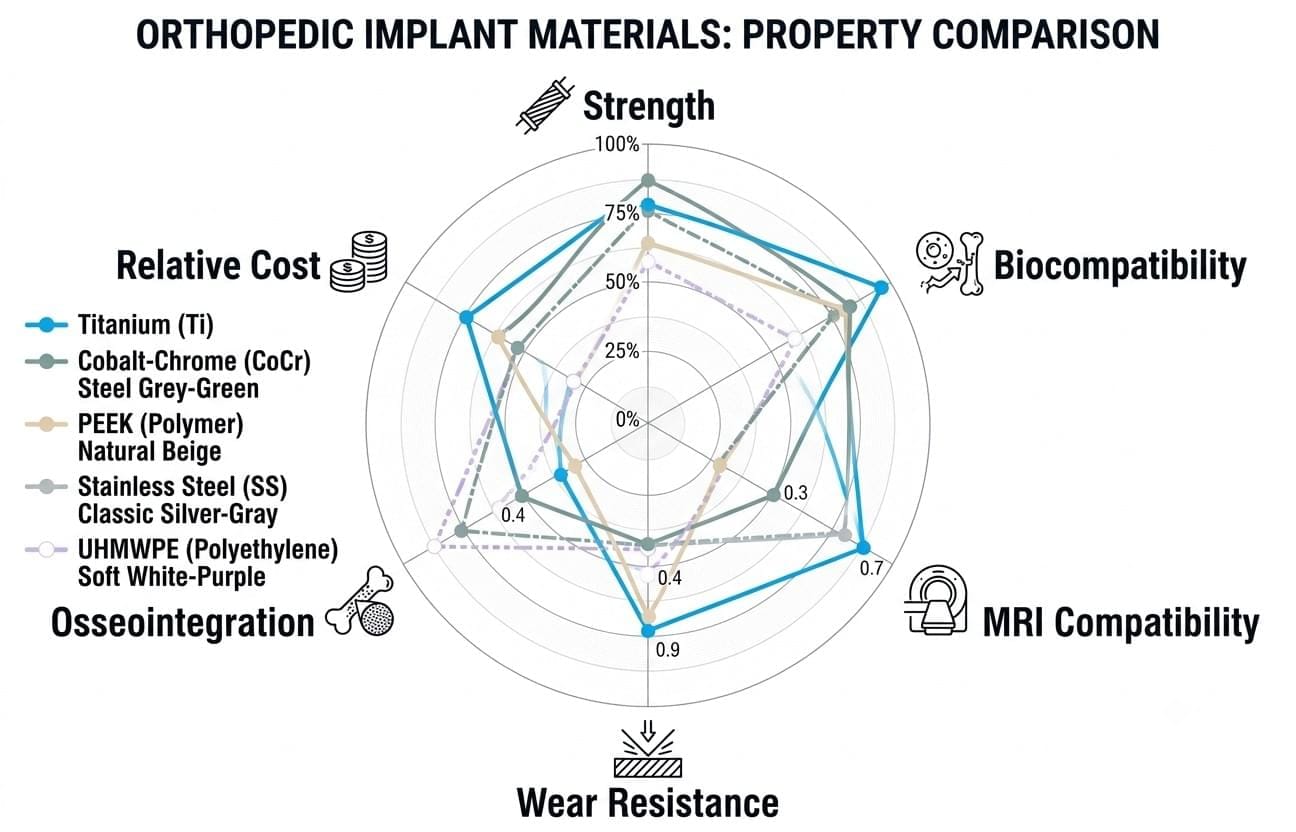
| 材料カテゴリ | 降伏強度 | 弾性率 | 生体適合性プロファイル | 診断(MRI)適合性 | 相対的な製造コスト |
|---|---|---|---|---|---|
| Ti-6Al-4V合金 | 880~1100 MPa | 110 GPa | ⭐ 優れた | 条件付き(低歪み) | 💰 高い |
| CoCrMo合金 | 500~1000 MPa | 230 GPa | 👍 良好 | 条件付き(高アーチファクト) | 💰 高い |
| PEEKポリマー | 100 MPa | 6 GPa | ⭐ 優れた | ✅ 高い適合性 | 💎 中程度 |
| 316Lステンレス鋼 | 170~690 MPa | 200 GPa | 👍 良好 | 条件付き(高アーチファクト) | 📉 低い |
| UHMWPEライナー | 約20 MPa | 7〜1 GPa | ⭐ 優れた | ✅ 高い適合性 | 📉 低〜中程度 |
| アルミナセラミック | 500 MPa以上 | 380 GPa | ⭐ 優れた | ✅ 高い適合性 | 💎 中程度 |
💬 Frequently Asked Questions
Q: Why is titanium favored over stainless steel for permanent implants?
チタンは、より低い弾性率による、より優れた生体適合性、優れた耐食性、および応力遮蔽の低減を提供します。ステンレス鋼は、低コストのため、一時的な外傷用ハードウェアに好まれます。.
Q: How does PEEK solve imaging issues after a spinal procedure?
放射線を遮断する金属とは異なり、PEEKは放射線透過性があります。これにより、医療チームは標準的なX線を使用して、デバイスを介して直接、内部の治癒と骨の成長を監視できます。.
Q: Are there biodegradable implant material options?
はい。マグネシウム合金や生体吸収性ポリマー(PLAやPGAなど)は、小児外傷や軟部組織固定にますます利用されており、治癒とともに体内で徐々に溶解します。.
🎯 Conclusion
利用可能なものから選択する 整形外科用インプラント材料 は、現代のヘルスケア製造における最も重要なエンジニアリング上の決定の1つです。構造強度、耐摩耗性、画像診断適合性、コストのバランスをとることで、デバイスが優れた、人生を変えるパフォーマンスを提供することを保証します。.
これらの原材料が高度な製造方法によってどのように成形されるかについては、当社の包括的なガイドをお読みください。 整形外科用インプラント:種類、材料、製造技術.
認定エンジニアリングサポート、機械的検証、または準拠した材料調達が必要ですか? 専門家によるコンサルテーションについては、今すぐエンジニアリングチームにお問い合わせください。 免責事項:この技術リソースは、医療機器の製造および調達担当者向けに調整されています。材料の性能は、正確な設計、表面処理、および臨床実装によって異なります。.
現代の整形外科手術に革命をもたらす5つの究極の整形外科インプラント材料 1.
 English
 Arabic
 French
 German
 Italian
 Japanese
 Korean
 Portuguese
 Turkish
 Russian
 Spanish