


Trauma implants play a vital role in modern fracture treatment, helping surgeons restore bone stability while natural healing takes place. Whether managing a simple shaft fracture or a complex periarticular injury, choosing the right implant directly affects mechanical stability, surgical efficiency, and long-term patient outcomes.
Unlike joint replacement devices that are typically designed for lifelong use, many trauma implants provide temporary support until the bone heals. In many patients they remain safely in place, while others may undergo implant removal after recovery based on clinical needs.
📌 This article is part of our comprehensive guide: Orthopedic Implants: Types, Materials & Manufacturing Technologies.
Understanding the Biomechanics Behind Trauma Implants
Successful trauma implants for fracture fixation are built around one objective: creating an environment where bone can heal safely while restoring normal anatomy.
✅ Maintaining Fracture Stability
The first responsibility of any implant is preventing excessive movement at the fracture site. Too much motion may lead to delayed union or nonunion, while carefully controlled micromotion can stimulate healthy callus formation in selected fracture patterns.
✅ Preserving Alignment
Throughout the healing process, implants must maintain correct bone length, rotational alignment, and anatomical positioning. Without adequate fixation, even small shifts can negatively affect joint function and long-term mobility.
✅ Balancing Load Sharing and Load Bearing
Different fixation systems manage mechanical loads differently.
- Load-sharing implants, such as intramedullary nails, allow bone and implant to carry forces together.
- Load-bearing constructs, including compression plates and lag screws, provide rigid fixation by absorbing most mechanical stress until healing progresses.
⚙️ Manufacturers validate these devices through rigorous mechanical testing based on international standards published by the FDA guidance on orthopedic trauma implants and ASTM International.
Orthopedic Plates in Trauma Implants
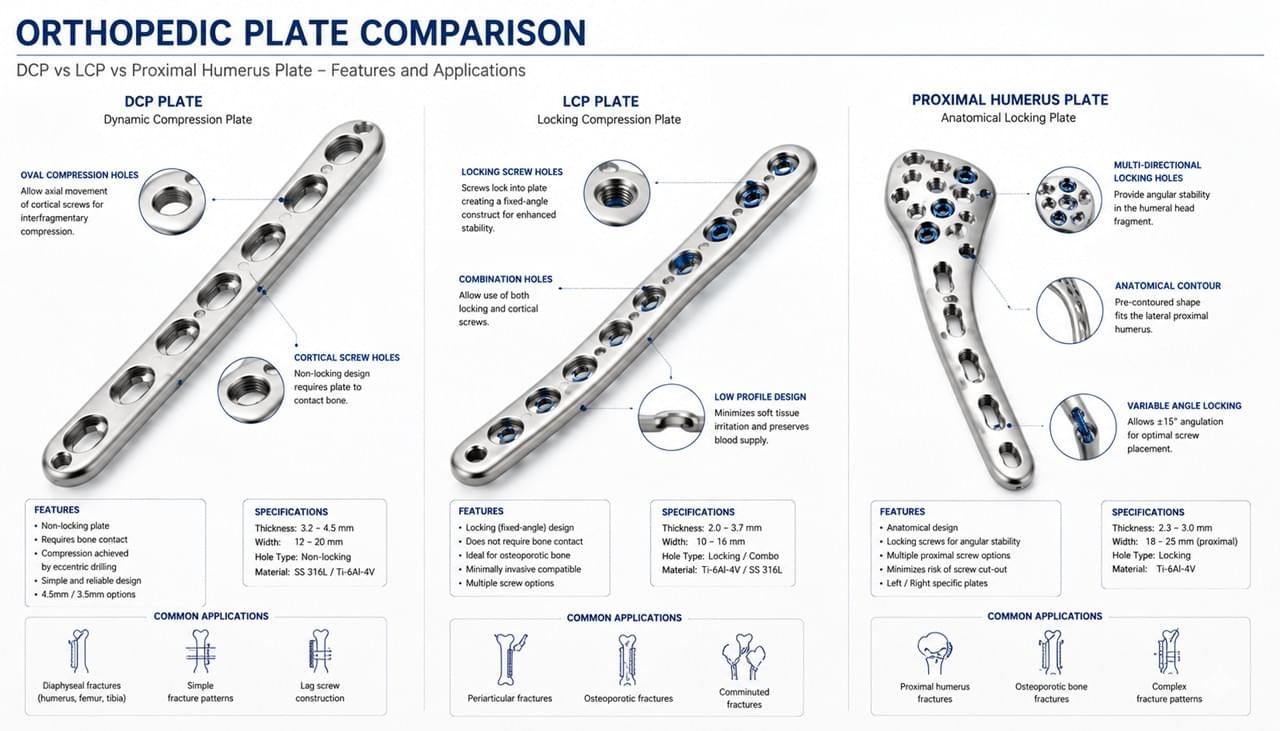
Among all trauma implants, orthopedic plates remain one of the most versatile solutions for fracture fixation. Modern plate systems combine improved biomechanics with minimally invasive surgical techniques to address a wide variety of fracture patterns.
Dynamic Compression Plates (DCP)
Dynamic Compression Plates remain a reliable option for simple diaphyseal fractures where absolute stability is required.
Key characteristics include:
- Stainless steel or titanium alloy construction
- Oval screw holes that generate interfragmentary compression
- Excellent for transverse and short oblique fractures
- Often combined with lag screws for enhanced fixation
💡 Because DCP systems rely on direct bone contact, accurate contouring is essential during surgery.
Locking Compression Plates (LCP)
Locking Compression Plates have become the preferred choice for many modern fracture procedures.
Instead of relying solely on friction between the plate and bone, locking screws thread directly into the plate, creating a fixed-angle construct with greater mechanical stability.
Major advantages include:
- ✅ Better fixation in osteoporotic bone
- ✅ Reduced risk of screw loosening
- ✅ Improved support for comminuted fractures
- ✅ Compatibility with minimally invasive plate osteosynthesis (MIPO)
This design also minimizes disruption to periosteal blood supply, helping preserve the biological environment necessary for healing.
Anatomical Pre-contoured Plates
Advances in implant design have produced pre-shaped plates that closely match human anatomy, reducing intraoperative bending while improving implant fit.
Common examples include:
- Proximal humerus plates
- Distal femur plates
- Proximal tibia plates
- Calcaneal plates
These specialized systems shorten surgical time and help achieve more predictable reduction in anatomically complex regions.
Materials Used in Trauma Implants
Material selection influences strength, fatigue resistance, imaging compatibility, and cost.
| Material | Advantages | Typical Applications |
|---|---|---|
| Titanium Alloy (Ti-6Al-4V) | Lightweight, highly biocompatible, MRI compatible | Definitive fixation and periarticular fractures |
| Stainless Steel 316L | Strong, economical, widely available | General trauma procedures and cost-sensitive markets |
| Cobalt-Chromium | Excellent fatigue strength | Selected high-load applications |
🔍 Titanium has become increasingly popular because its lower elastic modulus more closely matches natural bone, helping reduce stress shielding.
Orthopedic Plates and Screws: The Foundation of Internal Fixation
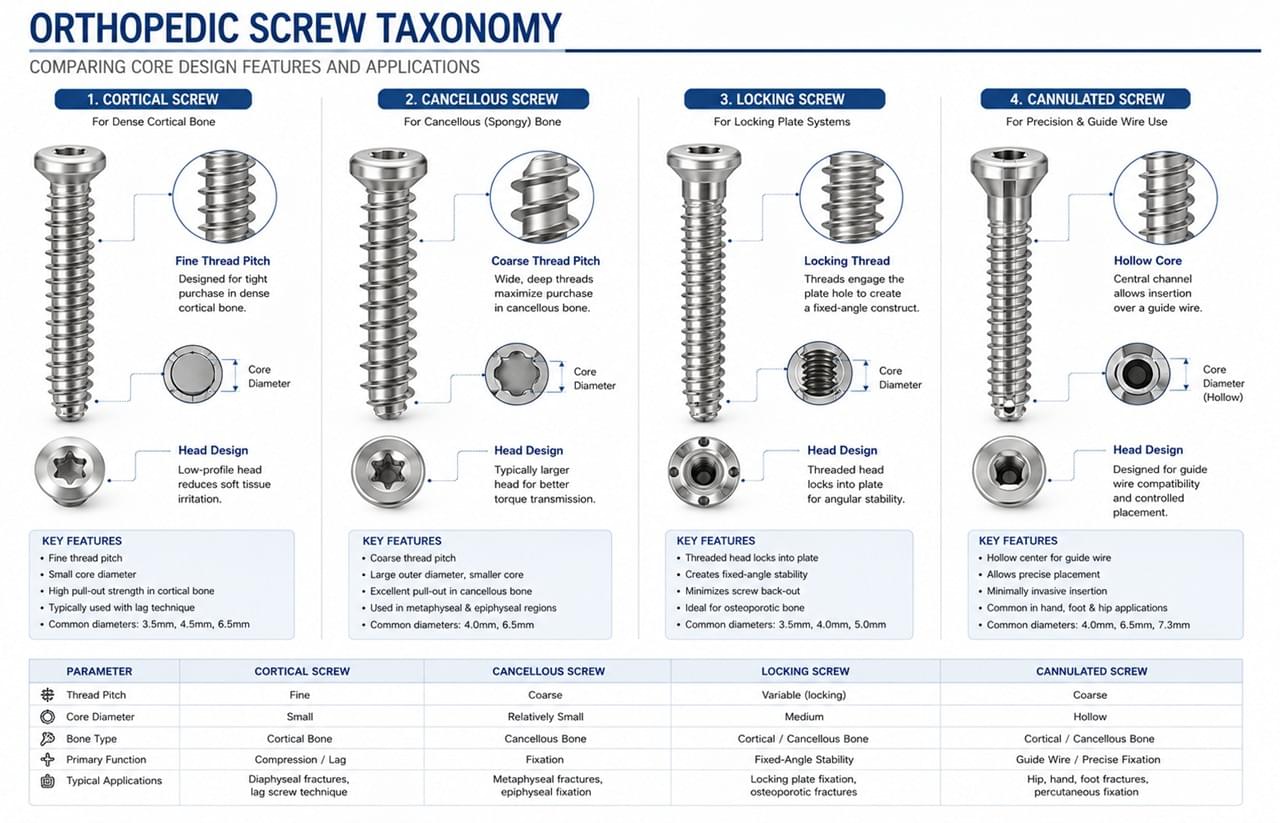
No discussion of orthopedic plates and screws would be complete without understanding screw selection. Although plates often receive more attention, screws ultimately determine fixation quality and construct stability.
Cortical Screws
Designed for dense cortical bone, cortical screws feature fine threads that maximize grip in the diaphysis of long bones.
Typical diameters include:
- 3.5 mm
- 4.5 mm
- 6.5 mm
These screws are commonly inserted through both cortices to achieve maximum holding strength.
Cancellous Screws
Cancellous screws have wider, deeper threads that provide stronger purchase in metaphyseal and epiphyseal bone.
They are frequently used in:
- Femoral condyle fractures
- Tibial plateau fractures
- Pelvic reconstruction
- Articular fixation
Partially threaded versions can also generate compression across fracture fragments.
Locking Screws
Unlike conventional screws, locking screws engage both the bone and the plate.
Benefits include:
- Reduced screw pull-out
- Improved fixation in poor-quality bone
- Stable fixed-angle constructs
- Better performance under cyclic loading
This technology has significantly expanded treatment options for elderly patients with osteoporosis.
Cannulated Screws
Cannulated screws contain a hollow central channel that allows placement over a guidewire.
Their advantages include:
- Greater placement accuracy
- Less invasive insertion
- Reduced fluoroscopy adjustments
- Excellent for femoral neck and scaphoid fractures
📌 Precision placement is especially valuable in anatomically demanding procedures where even slight positioning errors may affect healing.
Intramedullary Nail Systems in Trauma Implants
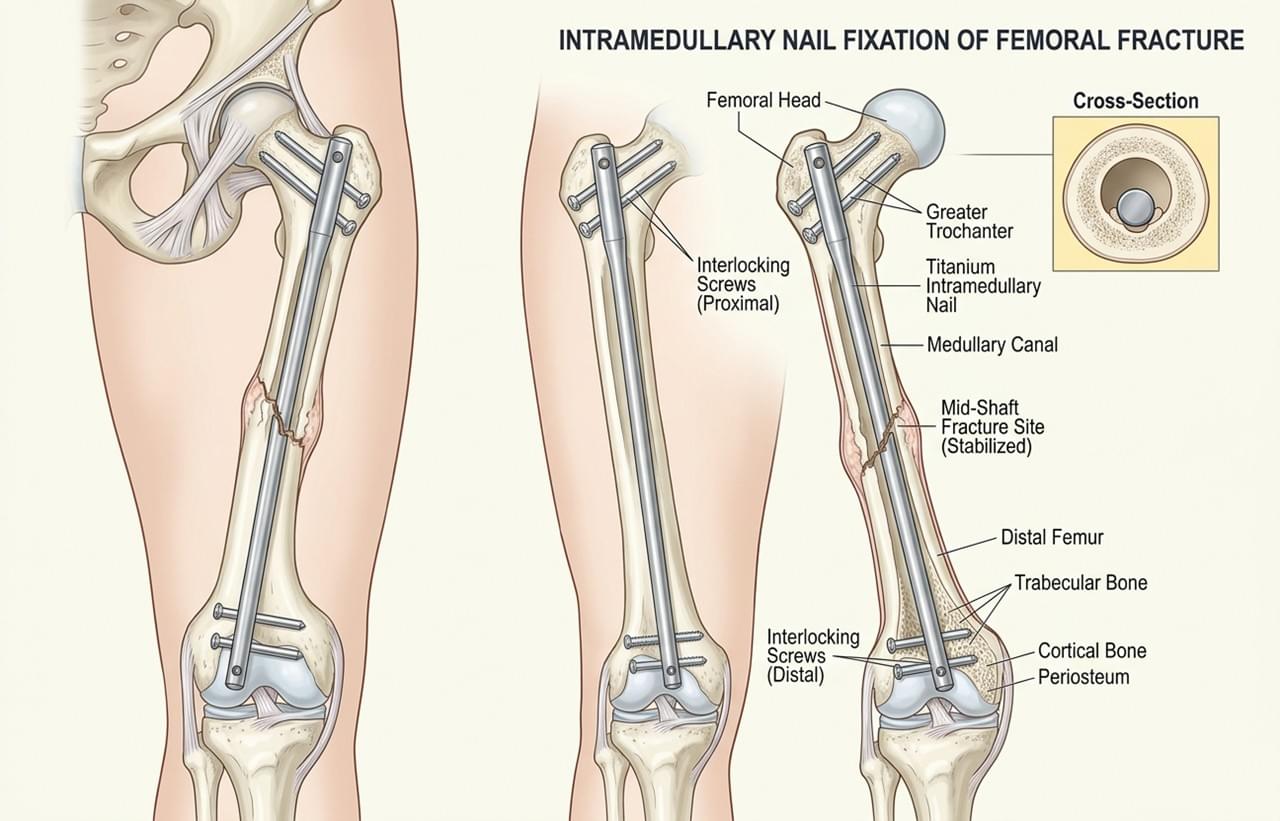
Among modern trauma implants, intramedullary (IM) nail systems are widely recognized as the preferred solution for many long-bone fractures. Positioned inside the bone’s medullary canal, they provide stable fixation while preserving surrounding soft tissue and blood supply.
Compared with traditional plating techniques, IM nails generally require smaller incisions and allow earlier rehabilitation, making them a standard choice for femoral and tibial shaft fractures.
Why Intramedullary Nails Perform So Well
The design of intramedullary nail systems offers several important biomechanical advantages:
- ✅ Central load sharing reduces bending stress by aligning the implant with the bone’s mechanical axis.
- ✅ Preserved blood supply through minimally invasive insertion supports faster biological healing.
- ✅ Improved early mobility, allowing many patients to begin weight-bearing sooner when clinically appropriate.
- ✅ Lower soft-tissue disruption, reducing surgical trauma compared with extensive open plating.
💡 These benefits make IM nails particularly valuable for high-energy trauma and fractures involving the femur or tibia.
Femoral Intramedullary Nails
Femoral IM nails are considered the gold standard for many shaft fractures because they combine excellent mechanical strength with minimally invasive fixation.
Typical design features include:
- Diameter ranging from 9–13 mm
- Multiple length options for different patient anatomies
- Static and dynamic interlocking screw configurations
- Antegrade or retrograde insertion techniques
Proper implant sizing and accurate locking screw placement are essential to maintaining alignment and rotational stability throughout healing.
Cephalomedullary Nails
Cephalomedullary nails extend fixation into the femoral head and are commonly used for intertrochanteric and subtrochanteric hip fractures.
Their advantages include:
- Better control of unstable proximal femur fractures
- Enhanced rotational stability
- Strong fixation in osteoporotic bone
- Early postoperative mobilization
📌 Successful outcomes depend heavily on precise screw placement, particularly maintaining an appropriate Tip-Apex Distance (TAD) to minimize fixation failure.
Tibial and Humeral IM Nails
Intramedullary nails are also widely used in the tibia and humerus.
For tibial fractures, multiple proximal and distal locking options improve stability across a wide range of fracture patterns.
Humeral nails are designed with smaller diameters and shorter lengths to match upper-limb anatomy while minimizing soft-tissue irritation around the shoulder.
Choosing the Right Trauma Implant
Selecting the most appropriate trauma implants for fracture fixation requires balancing fracture characteristics, patient factors, and surgical objectives. No single implant is ideal for every situation.
Surgeons typically evaluate several key considerations:
📍 Fracture Location
- Long-bone shaft fractures often favor intramedullary nails.
- Periarticular fractures generally benefit from anatomical locking plates.
📍 Fracture Pattern
Simple fractures may achieve excellent results with compression plating, while comminuted injuries often require bridge plating or load-sharing nail constructs.
📍 Bone Quality
Patients with osteoporosis frequently benefit from locking plate technology because fixed-angle screws provide stronger fixation in weakened bone.
📍 Surgical Resources
Available imaging equipment, operating room capabilities, and surgeon experience all influence implant selection. In many healthcare systems, balancing clinical performance with overall treatment cost is also an important consideration.
Frequently Asked Questions
What are trauma implants used for?
Trauma implants stabilize fractured bones, maintain anatomical alignment, and create the mechanical conditions necessary for successful bone healing. Common devices include plates, screws, and intramedullary nails.
Are titanium plates better than stainless steel plates?
Titanium alloys offer excellent biocompatibility, corrosion resistance, and MRI compatibility, making them the preferred option for many modern procedures. Stainless steel remains a reliable and cost-effective alternative, particularly in budget-sensitive healthcare markets.
When are intramedullary nails preferred over plates?
Intramedullary nails are generally preferred for femoral and tibial shaft fractures because they provide load-sharing fixation, preserve soft tissues, and often support earlier functional recovery.
Do trauma implants need to be removed?
Not always. Many implants remain in the body permanently without causing problems. Removal is usually considered only when implants produce pain, irritation, infection, or interfere with future treatment.
What standards regulate trauma implants?
Manufacturers typically design and validate trauma implant systems according to internationally recognized standards, including ASTM and ISO specifications, while meeting the regulatory requirements of target markets.
✅ Trauma implants remain one of the most important product categories in orthopedic surgery, providing reliable solutions for fracture fixation across patients of all ages.
From conventional compression plates to advanced locking systems and intramedullary nail systems, each implant is designed to address specific clinical challenges while promoting stable healing and restoring function. Understanding their biomechanics, materials, and applications helps manufacturers, distributors, and procurement professionals make informed decisions in an increasingly competitive orthopedic market.
Whether evaluating new product lines or selecting manufacturing partners, a thorough understanding of trauma implant technology is essential for delivering safe, high-quality fracture fixation solutions.
📌 Continue exploring our complete orthopedic series:
Orthopedic Implants: Types, Materials & Manufacturing Technologies
Looking for a trusted trauma implant manufacturer or OEM partner? Contact our team to discuss your sourcing requirements, quality certifications, and customized manufacturing capabilities.
Medical Disclaimer
Medical Disclaimer
This article is intended for informational purposes only and is written for medical device manufacturers, distributors, procurement specialists, and healthcare industry professionals. It should not be interpreted as medical advice or surgical guidance. Diagnosis, implant selection, and fracture treatment should always be performed by qualified orthopedic surgeons based on individual patient conditions and current clinical guidelines.
 English
 Arabic
 French
 German
 Italian
 Japanese
 Korean
 Portuguese
 Turkish
 Russian
 Spanish