


Orthopedic joint replacement technology has transformed modern medicine 🏥. Yet while many people group all joint prostheses into one category, a hip implant, knee implant, and shoulder implant are engineered for very different biomechanical demands.
For manufacturers, hospital procurement teams, distributors, and OEM partners, understanding these distinctions is essential when evaluating product performance, regulatory compliance, and long-term clinical value.
This article explores how modern orthopedic implant systems differ in design, materials, fixation methods, and clinical applications — while highlighting the engineering challenges behind each solution.
For a broader overview, visit: Orthopedic Implants: Types, Materials & Manufacturing Technologies.
🔍 Why Joint Replacement Implants Are Not the Same
Although all joint reconstruction devices share similar goals, each system must function within a completely different anatomical environment.
Every implant must achieve:
- ✅ Long-term biocompatibility
- ✅ Mechanical durability under repetitive stress
- ✅ Stable fixation to bone
- ✅ Minimal wear debris generation
- ✅ Accurate restoration of joint movement
Organizations such as the FDA and the American Academy of Orthopaedic Surgeons (AAOS) provide important regulatory and clinical guidance for orthopedic implant systems worldwide.
However, the real complexity begins when comparing how each joint actually moves and bears load.
🦴 Hip Implant Systems: Built for Heavy Load Transfer
Why Hip Implant Design Is So Demanding
The hip is one of the body’s most heavily loaded joints. During walking, stair climbing, or standing up, forces can reach several times body weight. Because of this, a hip implant must deliver exceptional fatigue resistance and long-term structural stability.
Modern total hip arthroplasty systems generally include four major components:
- Femoral stem
- Femoral head
- Acetabular shell
- Acetabular liner
Titanium alloy remains one of the most common materials because of its excellent strength-to-weight ratio and osseointegration performance.
Hip Implant Materials and Applications
One of the biggest factors influencing implant longevity is the bearing surface combination.
Common pairings include:
🔹 Ceramic-on-polyethylene
🔹 Ceramic-on-ceramic
🔹 Metal-on-polyethylene
Each option offers different advantages in wear resistance, cost, and fracture risk. Today, ceramic bearings are increasingly preferred for younger and more active patients because of their reduced wear profile.
Cemented vs Cementless Hip Implant Fixation
A major distinction in hip implant systems is fixation strategy.
Cemented Fixation
- Immediate stability
- Often preferred for elderly patients
- Useful in poor bone quality cases
Cementless Fixation
- Encourages biological bone ingrowth
- Frequently selected for younger patients
- Requires highly engineered porous surfaces
This difference significantly impacts implant manufacturing and surface treatment technologies.
⚙️ Knee Implant Systems: Managing Complex Motion
Why Knee Implant Mechanics Are More Complex
Unlike the hip joint, the knee does not simply rotate like a ball-and-socket system. It combines rolling, sliding, rotation, and translation simultaneously.
Because of this complexity, knee implants require highly precise geometries to recreate natural movement patterns.
A typical total knee arthroplasty system includes:
- Femoral component
- Tibial tray
- Polyethylene insert
- Patellar component
Knee and Shoulder Implant Comparison: Motion vs Stability
When comparing a knee system to a shoulder replacement, the knee prioritizes controlled stability under high repetitive load.
Important design considerations include:
- Multi-radius curvature
- Ligament balancing
- Polyethylene wear resistance
- Flexion stability
Highly cross-linked polyethylene has become increasingly popular due to its improved wear characteristics.
Clinical Applications for Knee Replacement
A knee implant is commonly used for:
- Severe osteoarthritis
- Rheumatoid arthritis
- Post-traumatic degeneration
- Advanced cartilage loss
Globally, total knee arthroplasty remains one of the most frequently performed orthopedic procedures.
💡 Shoulder Implant Systems: Maximizing Mobility
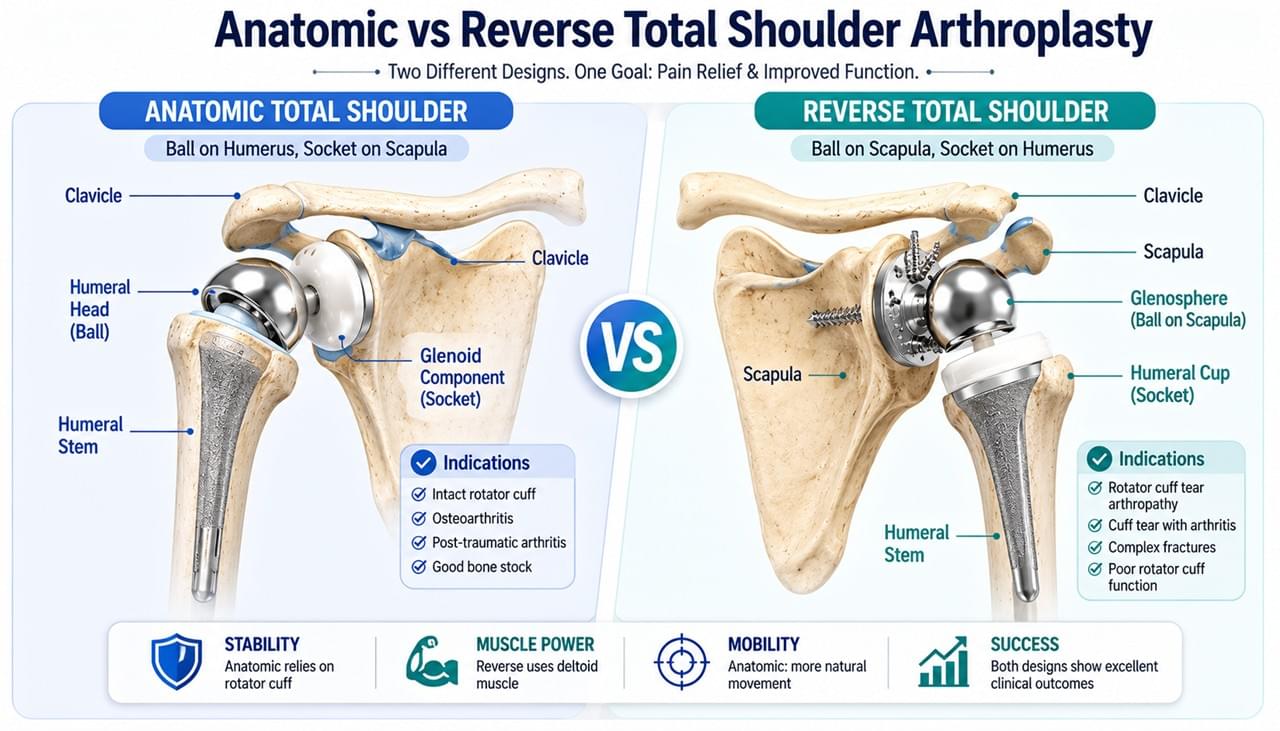
Shoulder Implant Design Focuses on Range of Motion
The shoulder provides the greatest range of motion of any major joint in the human body. However, this flexibility comes with reduced natural stability.
As a result, shoulder arthroplasty systems rely heavily on soft tissue balance.
Two major categories dominate the market:
Anatomic Shoulder Replacement
This configuration mimics natural anatomy and is typically used when the rotator cuff remains functional.
Reverse Shoulder Replacement
This innovative approach reverses the ball-and-socket orientation, allowing the deltoid muscle to compensate for rotator cuff deficiency.
Reverse systems have dramatically expanded treatment possibilities for elderly patients with severe cuff arthropathy.
Orthopedic Joint Replacement Systems Require Different Engineering
Compared with hip or knee systems, shoulder implants face unique challenges:
⚡ Glenoid fixation durability
⚡ Soft tissue balancing
⚡ Instability prevention
⚡ Limited bone stock
These factors make shoulder implant design especially demanding from both surgical and manufacturing perspectives.
🏭 Manufacturing Differences Across Implant Categories
The engineering processes behind orthopedic implants vary considerably depending on the joint being treated.
Hip Implant Manufacturing
Hip stems often require:
- 5-axis CNC machining
- Porous coating technology
- Advanced fatigue testing
Knee Implant Manufacturing
Knee components demand:
- Ultra-precise polishing
- Multi-radius machining
- Tight dimensional tolerances
Shoulder Implant Manufacturing
Shoulder systems emphasize:
- Sphericity precision
- Glenoid fixation technology
- Modular component compatibility
For OEM manufacturers, specialization in one implant category often requires entirely different tooling, polishing, and validation capabilities.
📈 Why Implant Selection Matters for Buyers and Distributors
Understanding implant differences is not only important for surgeons. It also directly affects:
- Product sourcing decisions
- Regulatory approvals
- Inventory planning
- Hospital procurement strategies
- Long-term partnership selection
Distributors and purchasing teams that understand implant biomechanics are often better positioned to evaluate product quality and supplier reliability.
✅ Conclusion
A hip implant, knee implant, and shoulder implant may all belong to the orthopedic reconstruction sector, but their engineering principles differ dramatically.
Hip systems prioritize heavy load transfer and wear resistance. Knee implants focus on complex motion control and long-term polyethylene performance. Shoulder replacements emphasize mobility and soft tissue balance.
As orthopedic technologies continue evolving, manufacturers and procurement professionals who understand these distinctions will be better equipped to make informed sourcing, development, and investment decisions.
Interested in sourcing certified orthopedic implant systems or discussing OEM cooperation opportunities? 👉 Contact our team for technical specifications and partnership support.
📌 Medical Disclaimer
This article is intended for informational and industrial reference purposes only. It does not replace professional medical advice, diagnosis, or surgical consultation. Implant selection decisions should always be made by qualified orthopedic specialists.

 English
 Arabic
 French
 German
 Italian
 Japanese
 Korean
 Portuguese
 Turkish
 Russian
 Spanish