


The orthopedic industry drivers powering global market growth are well-documented. But for manufacturers and distributors, understanding the counterbalancing challenges is equally critical. Success in this market requires not just capitalizing on tailwinds — it requires navigating the headwinds with precision.
This article explores both sides of the equation, building on the strategic overview in our main guide: Global Orthopedic Devices Market: Trends, Size & Opportunities.
The Demand Side: What Is Driving Orthopedic Market Growth
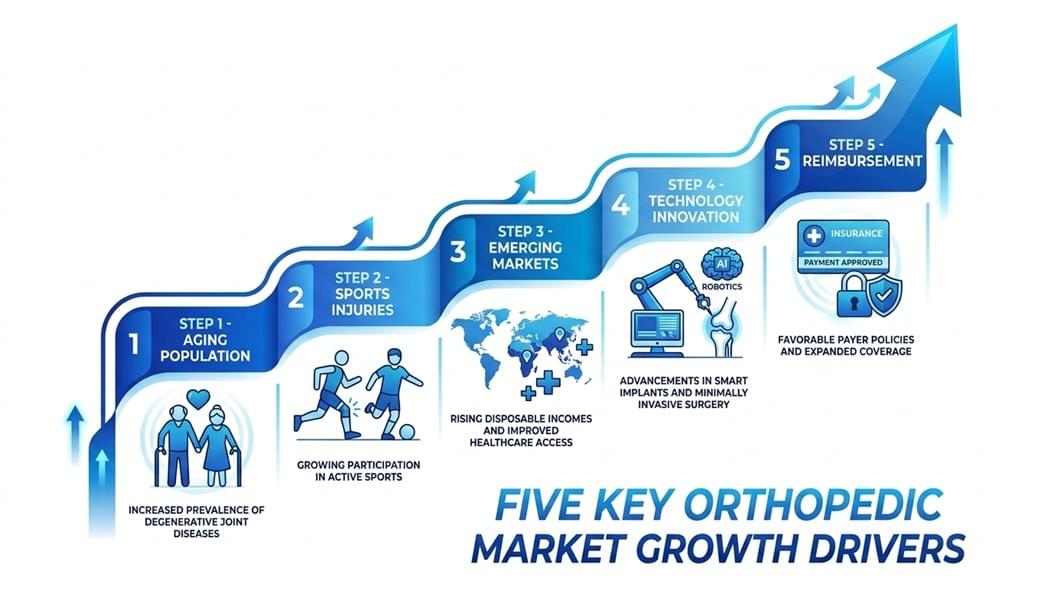
Driver 1: The Aging Population Megatrend
The single most powerful orthopedic industry driver is demographics. The global population aged 60 and above is projected to reach 2.1 billion by 2050, according to the World Health Organization. With age comes an exponential rise in:
- Osteoporotic fractures (hip, vertebral, wrist)
- Knee and hip osteoarthritis requiring joint replacement
- Degenerative disc disease requiring spinal intervention
- Rotator cuff tears and shoulder pathology
This demographic reality creates a structural, multi-decade demand floor beneath the orthopedic devices market that no cyclical downturn can fully undercut.
Driver 2: Sports Injuries and Active Lifestyle Trends
A parallel demand stream comes from younger, physically active populations. Rising participation in high-impact recreational sports — trail running, cycling, team sports, gym-based fitness — is driving increased incidence of:
- ACL and ligament tears requiring reconstruction
- Acute fractures and dislocations (trauma implant demand)
- Overuse injuries and stress fractures
This cohort increasingly expects rapid recovery, fueling demand for advanced minimally invasive techniques and high-performance implant systems.
Driver 3: Healthcare Infrastructure Expansion in Emerging Markets
Government healthcare investment programs in India, Brazil, Indonesia, Vietnam, Egypt, and Sub-Saharan Africa are expanding hospital infrastructure at scale. New surgical facilities require full orthopedic equipment ecosystems — implants, instruments, power tools, rehabilitation devices. This represents multi-billion-dollar greenfield opportunity for manufacturers who can supply certified, cost-effective products.
Driver 4: Technological Innovation Driving New Procedures
Technology is both expanding the eligible patient population and creating premium pricing opportunities:
- Robotic-assisted joint replacement (Mako, ROSA, Velys) is improving outcomes and expanding joint replacement to younger patients
- 3D-printed implants are enabling complex reconstructions previously impossible with standard implants
- Navigation and augmented reality systems are reducing surgical error rates
- Biodegradable fixation is eliminating implant removal procedures in select trauma cases
These innovations create new product categories and extend the total addressable market.
Driver 5: Reimbursement Expansion and Universal Health Coverage
Universal health coverage (UHC) programs in the WHO Global Action Plan framework are gradually bringing orthopedic procedures within reach of populations previously excluded from surgical care. Even partial reimbursement in middle-income countries significantly expands procedure volumes.
The Supply Side: Orthopedic Market Challenges Every Manufacturer Faces
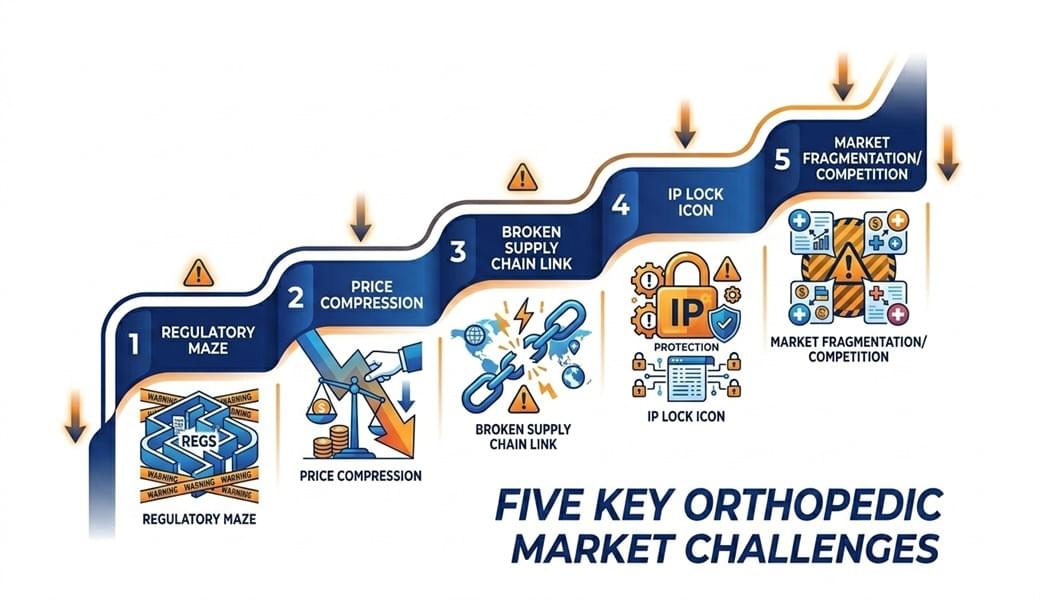
Challenge 1: Regulatory Complexity and Increasing Scrutiny
Regulatory burden is the most frequently cited orthopedic market challenge by manufacturers. The landscape has fundamentally shifted:
- The EU MDR (Regulation 2017/745) eliminated the self-certification route for many legacy devices, requiring notified body review with robust clinical evidence — a process costing hundreds of thousands of euros per product
- The FDA’s 510(k) pathway is seeing increased scrutiny, with growing requirements for randomized clinical data even for substantially equivalent devices
- Multiple emerging markets (China NMPA, India CDSCO, Brazil ANVISA) have implemented domestic registration requirements that go beyond simply mirroring FDA or CE approval
For manufacturers, the compliance burden directly impacts time-to-market and product launch economics.
Challenge 2: Price Compression from Institutional Procurement
Hospital group purchasing organizations (GPOs), national tendering agencies, and government volume-based procurement programs are systematically driving down implant prices:
- China’s National Centralized Procurement (NPRC) program reduced joint implant prices by 80–90% in centrally procured categories
- European hospital tenders increasingly reward price over product differentiation for standard implant categories
- US GPO contracts limit vendor diversification and compress margins
This trend rewards scale, lean manufacturing, and supply chain efficiency — areas where well-structured OEM/ODM partnerships have a natural advantage.
Challenge 3: Supply Chain Vulnerabilities
The COVID-19 pandemic exposed the fragility of global orthopedic supply chains. Key vulnerabilities include:
- Concentration of titanium bar stock and PEEK raw material supply in limited geographies
- Single-source component dependencies (specialized screws, bone cement polymers)
- Sterilization facility capacity constraints (EtO sterilization limitations in the US)
- Logistics bottlenecks affecting just-in-time implant consignment models
Manufacturers who diversified their supply chains and built strategic raw material buffers during 2020–2022 consistently outperformed peers on delivery reliability. For supply chain strategies, see: 7 Proven Secrets to Simplify Your 2025 Procurement.
Challenge 4: Talent Scarcity in Specialized Engineering
Orthopedic device development requires a rare combination of mechanical engineering, biomaterials science, biomedical engineering, and regulatory affairs expertise. Recruiting and retaining qualified engineers, clinical specialists, and RA/QA professionals remains a significant challenge — particularly for mid-size manufacturers competing against the compensation packages of large medtech companies.
Challenge 5: Intellectual Property and Technology Transfer Risk
Manufacturers operating in OEM/ODM partnership models face ongoing IP challenges:
- Design replication by contract manufacturers or former employees
- Insufficient IP protection in certain manufacturing geographies
- Reverse engineering of proprietary surface treatments and implant geometries
Robust contractual frameworks, IP registration strategies, and technology compartmentalization are essential safeguards.
Balancing Drivers and Challenges: Strategic Implications
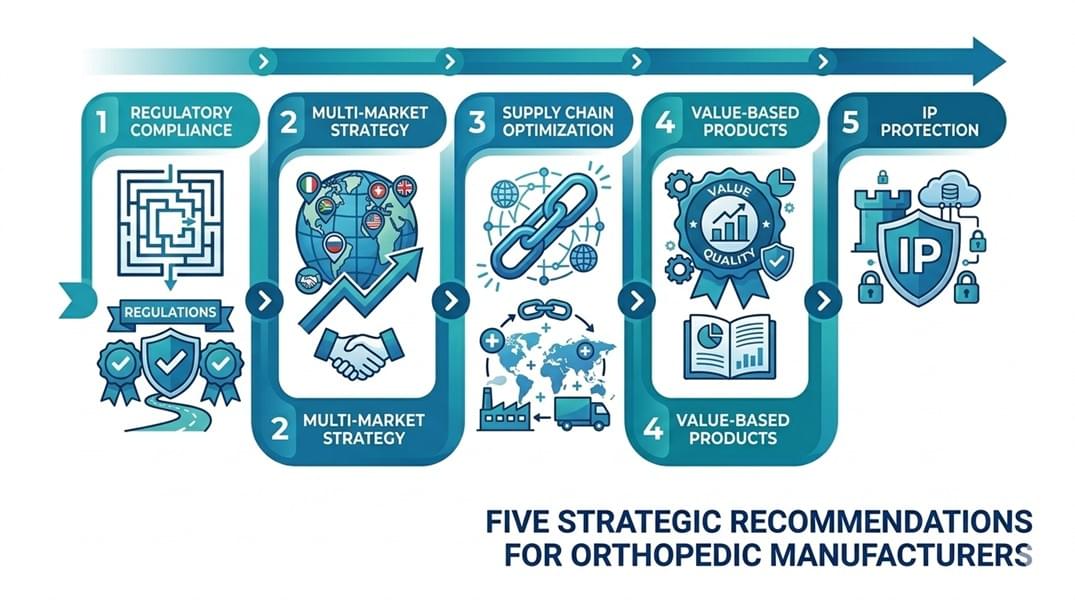
For manufacturers and OEM/ODM suppliers, the key strategic question is how to maximize exposure to orthopedic industry drivers while minimizing exposure to the major challenges. Practical approaches include:
- Regulatory-first product development: Build regulatory compliance into product design from day one, not as an afterthought
- Multi-market certification strategy: Pursue FDA, CE, and at least one major emerging market registration in parallel to spread sunk costs
- Supply chain diversification: Dual-source critical components and maintain 90-day raw material buffer stocks
- Value-tier product lines for emerging markets: Design cost-optimized products that meet clinical requirements without premium features that do not affect outcomes
- Partnership-based IP protection: Establish clear ownership agreements and trade secret protocols before any technology transfer
FAQ: Orthopedic Industry Drivers and Challenges
Q1: What is the most important driver of orthopedic market growth? Population aging is the dominant structural driver, creating sustained, multi-decade demand for joint replacement, spine surgery, and fracture fixation across all major markets.
Q2: How serious is the regulatory challenge for orthopedic manufacturers? Extremely serious. The EU MDR, US FDA increased scrutiny, and emerging market domestic registration requirements collectively demand significant investment in regulatory affairs capabilities — often USD 100K–500K+ per market per product.
Q3: Is price compression a permanent challenge? Yes, in commodity implant categories. But innovation-based differentiation — via robotics integration, advanced materials, and digital connectivity — creates defensible premium positioning.
Q4: How can OEM manufacturers address IP protection concerns? Through robust NDA/NNN agreements, patent registration in key markets, technology compartmentalization, and careful partner due diligence.
Q5: What is the impact of China’s VBP program on global orthopedic pricing? China’s VBP program has dramatically reduced implant prices in China’s public hospital sector (80–90% reductions in joint implants). While this primarily affects domestic China pricing, it signals a global trend toward institutional price power that will likely spread to other emerging markets over time.
The orthopedic industry drivers — aging demographics, emerging market expansion, and technological innovation — are powerful and durable. But the orthopedic market challenges — regulatory complexity, price compression, and supply chain fragility — require sophisticated, proactive management. Manufacturers and OEM/ODM suppliers who build compliance, operational resilience, and innovation capabilities alongside commercial expansion will be best positioned for sustained growth.
Return to our main guide for the complete market picture: Global Orthopedic Devices Market: Trends, Size & Opportunities.
Looking to overcome entry barriers and accelerate growth in the orthopedic devices market? Contact our team to explore compliant manufacturing partnerships and market entry strategies.
Medical Disclaimer
This content is for informational purposes only, directed at medical device industry professionals. Nothing in this article constitutes regulatory, legal, or financial advice. All market data should be independently verified. Regulatory requirements vary by jurisdiction; consult qualified regulatory affairs professionals for country-specific guidance.

 English
 Arabic
 French
 German
 Italian
 Japanese
 Korean
 Portuguese
 Turkish
 Russian
 Spanish