


Here’s a number that changed everything: May 2021. That’s when Regulation (EU) 2017/745 — the MDR — replaced the old Medical Device Directive and turned European market access from a paperwork exercise into a genuine test of clinical evidence. The full regulatory text lives on EUR-Lex, and it runs to hundreds of pages.
For orthopedic device manufacturers eyeing the EU’s 27 member states plus EFTA countries, EU MDR CE marking is the price of admission. This guide walks through the six requirements that decide whether your joint prosthesis ships to Berlin or sits in a warehouse. It’s part of our complete framework: Orthopedic Device Regulatory Compliance.
🇪🇺 What Changed Under the MDR
The MDD-to-MDR Shift That Reshapes EU MDR CE Marking
The old directive let manufacturers largely self-certify mid-risk devices with literature-based clinical claims. The MDR ended that era. Four changes hit hardest:
- Expanded scope — devices without a medical purpose, reprocessed single-use devices, certain aesthetic products, and software are now in
- Stricter clinical evidence — mandatory clinical evaluation for all classes, tightened equivalence criteria, and PMCF that actually has to produce data
- Transparency — UDI labeling, EUDAMED registration, and a public Summary of Safety and Clinical Performance for implants
- Tougher oversight — Notified Bodies face redesignation, unannounced audits are fair game, and MDCG guidance keeps raising the bar
In short: the era of paper-thin clinical justification is over.
Economic Operators: Who Owes What
The MDR assigns legal roles with no ambiguity. Manufacturers own compliance end to end — technical documentation, quality systems, post-market surveillance, UDI assignment. Authorized Representatives are mandatory for non-EU manufacturers and share real legal liability. Importers must verify CE marking and documentation before products enter the supply chain. Distributors check labeling, handle storage properly, and report incidents upstream.
Pick your AR carefully — they’re not a mailbox, they’re a co-defendant.
🗂️ Device Classification Under the MDR
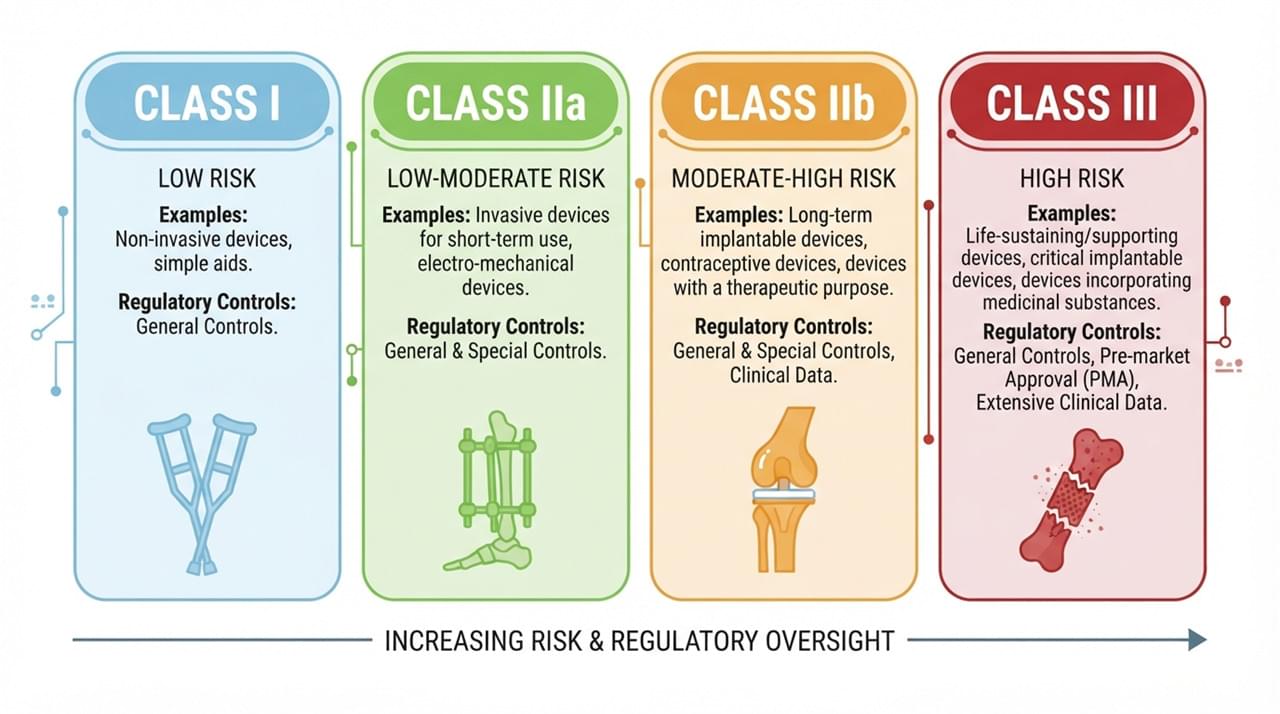
Classification is the fork in the road, because your class dictates everything downstream — including how much Notified Body involvement your EU MDR CE marking effort will need.
| Class | Risk Level | Typical Orthopedic Examples |
|---|---|---|
| I | Low | Crutches, wheelchairs, external braces, reusable surgical instruments (Is/Im/Ir sub-classes) |
| IIa | Medium | External fixators, short-term invasive devices, CPM machines, wound care |
| IIb | Higher-medium | Joint prostheses, spinal implants, bone screws and plates, bone cements, powered instruments |
| III | High | Absorbable implants, devices with medicinal products, active implantables |
The rules that matter most for orthopedics: Rule 8 (implantable and long-term invasive devices) pushes joint replacements to IIb or III, while Rule 9 places powered surgical instruments at IIa/IIb and Rule 12 slots navigation systems into IIa. Get this wrong and your entire conformity strategy is built on sand.
⚙️ Conformity Assessment: The Engine of EU MDR CE Marking
Class I: Self-Certification (With Caveats)
Standard Class I devices — non-sterile, non-measuring — need only a declaration of conformity and solid technical documentation. No Notified Body required. But the sub-classes change the math: Is (sterile) needs sterilization validation, Im (measuring) needs metrological review, and Ir (reusable instruments) needs reprocessing validation — all requiring Notified Body involvement.
Class IIa and IIb: Full Notified Body Engagement
Most orthopedic manufacturers live here. Under Annex IX (the QMS route), the Notified Body audits your quality system and samples your technical documentation; Annex XI Part A offers a product-verification alternative. For IIb devices — think knee prostheses and spinal implants — expect design dossier review, clinical evaluation assessment, and manufacturing site audits.
Class III: The Deep End of EU MDR CE Marking
Absorbable implants and other Class III devices face the most rigorous path: full QMS plus design dossier examination, likely expert panel consultation, and a clinical investigation in most cases. Annual surveillance follows. Notably, implantable devices now require an SSCP — a public summary of safety and clinical performance — reviewed alongside MDCG-endorsed guidance.
📋 Technical Documentation: Where EU MDR CE Marking Lives or Dies
Your technical file is the case the Notified Body will judge. It must contain:
- Device description — intended purpose, indications, patient population, classification rationale
- Design and manufacturing data — drawings, materials, processes, subcontractors
- Risk management per ISO 14971 — hazards, controls, residual risk, risk-benefit analysis. For the standard behind this, see our guide to ISO Standards and Quality Management
- Clinical evaluation — the heavyweight section, covered next
None of this is optional, and gaps here are the single most common cause of delayed certificates.
Clinical Evaluation: The Toughest Test for EU MDR CE Marking
The Clinical Evaluation Report demands a systematic literature review, a state-of-the-art analysis, and a defensible risk-benefit conclusion. Equivalence claims now require the same intended use and similar technical characteristics — vague “similar enough” arguments don’t survive scrutiny anymore.
For novel devices, high-risk implantables, or significant design changes, a clinical investigation is likely unavoidable. And for implantable and Class III devices, a PMCF plan isn’t a nice-to-have — it’s a legal obligation to keep collecting data after launch.
Post-Market Surveillance Obligations
CE marking doesn’t end your paperwork; it schedules it. PSURs are due every two years for Class IIa and annually for IIb/III. PMCF data must feed back into clinical evaluation updates. Trend reporting and risk reassessment run continuously. Manufacturers who treat PMS as an afterthought usually meet it again as a vigilance problem.

🏛️ Notified Body: Your Gatekeeper to EU MDR CE Marking
Notified Body Selection for Orthopedic Devices
Not every Notified Body can certify every device. Designation happens under MDR Article 42, and each body’s scope is listed in the NANDO database — always verify it directly. For orthopedics, look for relevant codes: MDN 1101 (bone and joint prostheses), MDN 1102 (orthopedic implants), MDN 1201 (orthopedic accessories).
Established players include BSI, DEKRA, TÜV SÜD, SGS, and Bureau Veritas — but capacity, not brand, is usually the deciding factor. Lead times stretch to a year or more, so engage early.
The Audit Process, Stage by Stage
Stage 1 reviews your quality manual and flags gaps before anyone boards a plane. Stage 2 is the on-site assessment: QMS implementation, technical documentation review, facility inspection, and personnel interviews. After certification, annual surveillance audits continue — and unannounced inspections are now explicitly on the menu.
A practical tip: walk your own facility a week before Stage 2. Whatever you find, they’ll find.
💾 EUDAMED and UDI: Registration and Traceability
EUDAMED UDI Registration Requirements
EUDAMED is the EU’s central database — six modules covering actor registration, UDI/device registration, certificates, clinical investigations, vigilance, and market surveillance. Actor registration is already mandatory; UDI registration is phasing in by risk class. Until all modules are fully mandatory, the legacy national systems run in parallel — which means double bookkeeping for now.
UDI Labeling Basics
Every UDI has two parts: a Device Identifier (static model information) and a Production Identifier (lot, serial number, expiration). The carrier must be machine-readable — barcode or RFID — with human-readable text, placed on the device and packaging. Class III obligations are already live, with implantable IIa/IIb following the phased timeline.
For comparison, the U.S. system runs on its own UDI rules — our FDA 510(k) approval process guide covers how the American pathway differs.
🔄 Transitioning from MDD to MDR
Legacy Device Provisions
MDD certificates remain valid until expiration — extended to December 2027 for Class III and IIb implantables, and December 2028 for other IIb, IIa, and Class I sterile/measuring devices. Conditions apply: no significant design changes, continued vigilance reporting, and a signed MDR application contract with a Notified Body. Miss the conditions and the extension evaporates.
Migration Strategy for EU MDR CE Marking That Actually Works
Start with a gap analysis — map MDD compliance against MDR requirements and prioritize the holes. Update technical documentation (enhanced CER, PMCF plan, labeling revisions) while your legacy certificate still protects revenue. Then book your Notified Body slot early; capacity is the bottleneck everyone underestimated.
The honest math: total first-year MDR compliance costs run from €200,000 to over €1,000,000 for complex devices. Budget for it — or watch the transition deadline approach with no certificate in hand.
❓ Frequently Asked Questions
Q1: How long does it take to get EU MDR CE marking?
Initial conformity assessment typically takes 12–18 months, including quality system audit and technical documentation review. Complex Class III devices requiring clinical investigations can exceed 24 months. Early Notified Body engagement is the single best accelerant.
Q2: What are the main clinical evidence differences from MDD?
Clinical evaluation is now mandatory for all classes, equivalence criteria are stricter, PMCF is obligatory for implantables and Class III, and SSCPs must be published. Many devices that leaned on equivalence now need fresh clinical data.
Q3: Can FDA clearance substitute for EU MDR CE marking?
No. FDA data may support your submission, but the MDR requires its own quality system certification, MDR-format technical documentation, and clinical evaluation meeting European standards. Some data is reusable — the processes are not interchangeable.
Q4: What happens if my MDD certificate expires before MDR certification?
You cannot legally place devices on the EU market. The extensions to 2027/2028 require signed Notified Body contracts and other conditions — plan years, not months, ahead.
Q5: Do I need a European Authorized Representative?
Yes, if you’re outside the EU. The AR is your legal liaison, holds documentation for inspection, and shares compliance responsibility. Their name goes on your labeling.
Q6: How much does MDR compliance cost compared to MDD?
Substantially more: Notified Body fees (€50,000–€200,000+), clinical evaluation updates (€20,000–€100,000+), PMCF studies (€100,000–€500,000+ for major studies), plus QMS enhancements and annual surveillance. First-year totals range from €200,000 to €1,000,000+ for complex devices.
🏁 The Bottom Line
EU MDR CE marking is no longer a formality — it’s a demonstration that your orthopedic device is safe, performs as claimed, and stays under surveillance for its entire life. The six pillars — classification, conformity assessment, technical documentation, clinical evaluation, Notified Body engagement, and EUDAMED/UDI registration — form one interconnected system, and weakness in any one of them stalls the whole application.
Start with classification, build the file around the clinical evidence standard, and engage your Notified Body earlier than feels comfortable. For the full regulatory landscape, return to our Orthopedic Device Regulatory Compliance guide.
Medical Disclaimer
The information provided is for educational purposes only and does not constitute legal or regulatory advice. MDR requirements continue to evolve, and professional consultation with regulatory affairs specialists is essential for specific compliance strategies.


 English
 Arabic
 French
 German
 Italian
 Japanese
 Korean
 Portuguese
 Turkish
 Russian
 Spanish