


The global orthopedic industry is evolving rapidly, and orthopedic mergers acquisitions are becoming one of the strongest forces shaping the future of medical technology. From robotic surgery systems to AI-powered diagnostics and advanced biomaterials, consolidation is transforming how orthopedic companies compete, innovate, and expand internationally.
For manufacturers, distributors, OEM suppliers, and investors, understanding these market shifts is no longer optional. Industry consolidation affects pricing power, supply chains, product portfolios, and long-term strategic positioning. At the same time, innovation remains a critical driver of competitive advantage in the orthopedic devices market. 🏥
This article is part of our Global Orthopedic Devices Market content hub.
Why Orthopedic Mergers Acquisitions Continue to Accelerate 📈
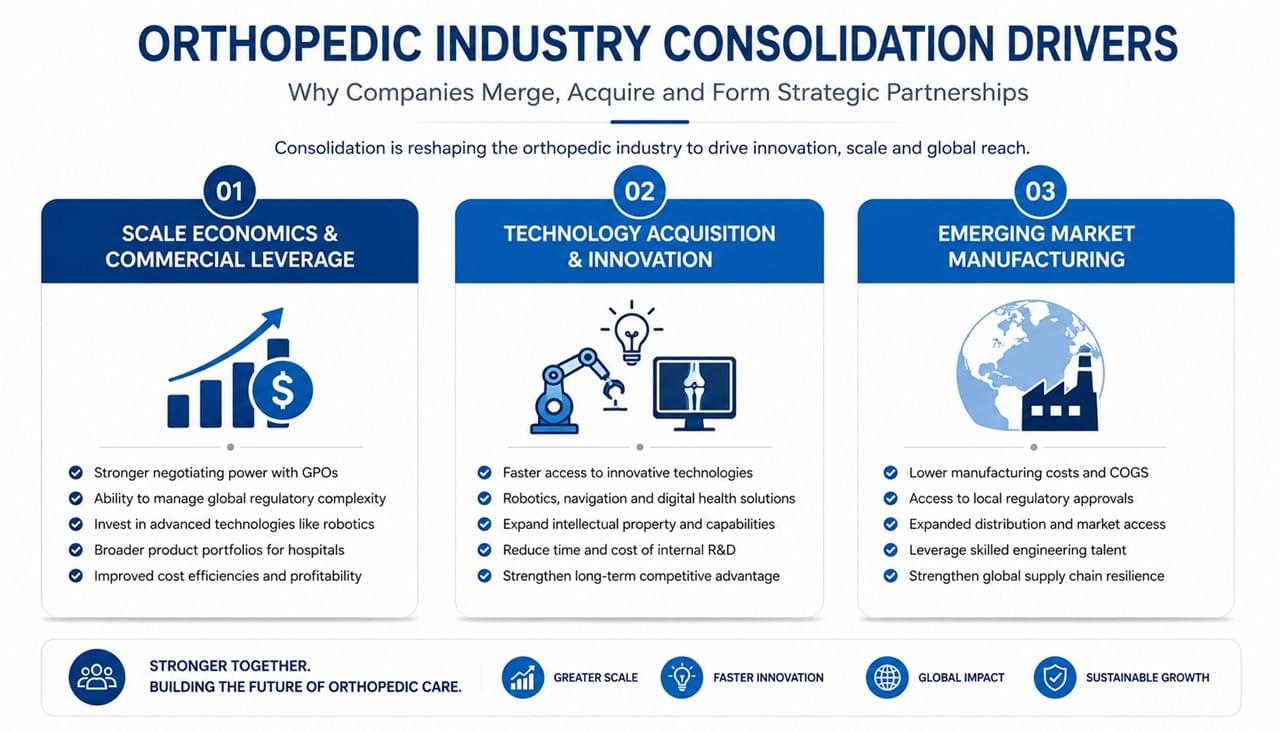
The rise of orthopedic mergers acquisitions is driven by several strategic pressures across the healthcare sector. Large orthopedic companies are seeking stronger market control, broader product ecosystems, and faster innovation cycles.
Orthopedic Mergers Acquisitions and Scale Economics
One of the main reasons behind consolidation is scale. Larger orthopedic companies gain important commercial advantages, including:
- Stronger bargaining power with hospital purchasing groups
- Greater ability to manage global regulatory compliance
- More resources for robotic surgery development
- Expanded implant and instrumentation portfolios
According to the Orthopedic Devices Market Overview by Grand View Research, the orthopedic market continues to grow steadily due to aging populations and rising musculoskeletal disorders worldwide.
Today, major players such as Stryker, Zimmer Biomet, Smith+Nephew, and Globus Medical collectively dominate a significant portion of the global orthopedic market.
Orthopedic Mergers Acquisitions vs Internal R&D
For many companies, acquiring innovation is faster than building it internally. Instead of spending years developing new technologies, corporations often purchase startups with proven intellectual property or clinical validation.
Well-known examples include:
- Stryker’s acquisition of MAKO Surgical for robotic-assisted orthopedic surgery
- Multiple navigation software acquisitions across spine and joint reconstruction sectors
- Growing investments in AI-driven rehabilitation platforms
This trend reflects a broader orthopedic innovation strategy for manufacturers seeking faster market entry and stronger competitive positioning.
For additional healthcare M&A insights, the PwC Global Healthcare Deals Insights Report offers valuable market analysis.
Orthopedic Mergers Acquisitions in Robotics and Digital Health 🤖
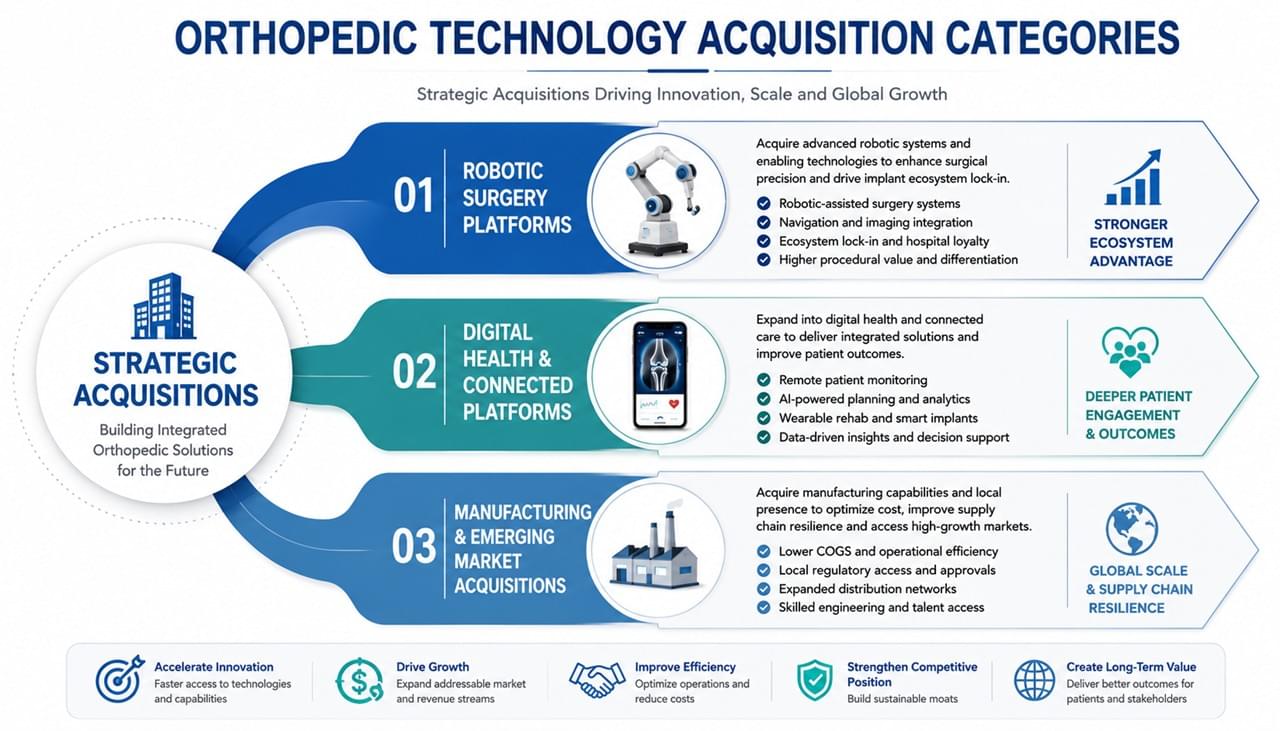
Technology-focused acquisitions are now among the most influential trends in orthopedic healthcare.
Robotic Surgery Platforms
Robotic orthopedic systems require enormous investment in engineering, software development, clinical trials, and surgeon training. Because of these high barriers, acquisitions have become the preferred growth strategy.
Benefits of robotic acquisitions include:
- Faster commercialization
- Stronger implant ecosystem integration
- Improved hospital loyalty
- Reduced implant price competition
Hospitals that adopt robotic systems often continue purchasing compatible implants and instruments from the same manufacturer. This creates powerful long-term customer retention.
The U.S. FDA Medical Devices Database also shows the increasing number of digitally integrated orthopedic technologies entering regulatory pathways.
Digital Health and Connected Orthopedic Devices
Another major area of orthopedic mergers acquisitions involves digital healthcare platforms.
Large orthopedic companies are increasingly acquiring:
- Remote rehabilitation monitoring platforms
- Wearable recovery devices
- AI surgical planning systems
- Data analytics software
- Smart implant technologies
These connected systems help hospitals improve patient outcomes while generating valuable clinical data. They also strengthen long-term relationships between device manufacturers and healthcare providers.
Orthopedic Industry Consolidation Trends Impacting OEM Suppliers 🏭
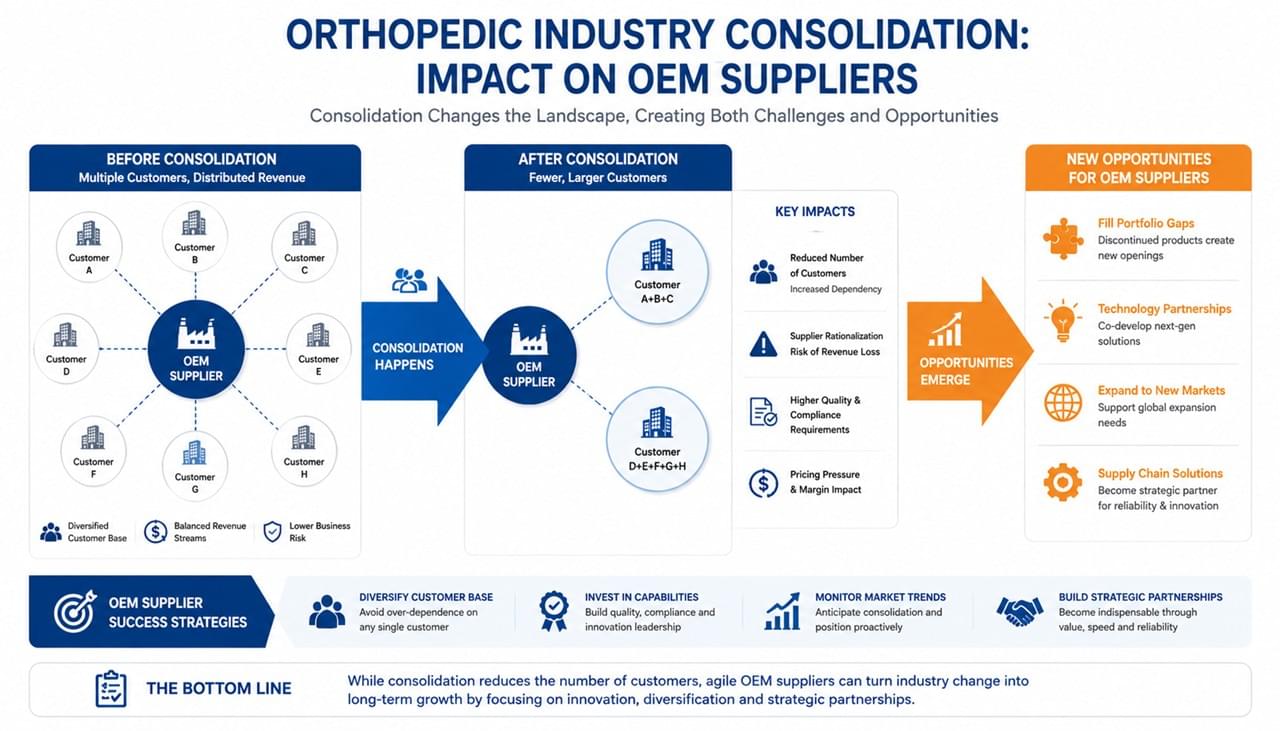
The ongoing wave of orthopedic industry consolidation trends creates both risks and opportunities for OEM and ODM manufacturers.
Fewer Customers, Larger Buyers
As orthopedic companies merge, supplier concentration increases. This means manufacturers may depend heavily on fewer customers.
Potential risks include:
- Reduced pricing leverage
- Supplier rationalization after mergers
- Higher compliance expectations
- Greater dependence on large contracts
OEM manufacturers should avoid excessive reliance on a single customer. Diversified partnerships remain essential for long-term stability.
For more manufacturing insights, visit our guide on OEM & ODM Orthopedic Manufacturing.
New Growth Opportunities After Consolidation
Despite the challenges, consolidation also opens new market gaps.
Merged companies often discontinue overlapping product lines or shift strategic priorities. Smaller manufacturers can capitalize on these gaps by offering:
- Alternative implant systems
- Cost-effective surgical instruments
- Regional distribution partnerships
- Faster manufacturing flexibility
This creates opportunities for agile companies with strong quality systems and efficient production capabilities.
Orthopedic Innovation Strategy for Manufacturers 🔬
Not all innovation comes through acquisitions. Organic R&D remains a powerful competitive strategy in the orthopedic industry.
Orthopedic Mergers Acquisitions and Advanced Biomaterials
Biomaterial innovation continues to reshape orthopedic product development.
Important material trends include:
- Biodegradable magnesium implants
- Enhanced PEEK materials
- Antimicrobial implant coatings
- Bioactive ceramic technologies
- Advanced porous titanium surfaces
These innovations improve osseointegration, reduce infection risks, and enhance imaging compatibility.
For technical material analysis, explore Orthopedic Implant Materials: Titanium, PEEK and More.
Minimally Invasive Orthopedic Systems
Hospitals increasingly prefer minimally invasive procedures that reduce recovery time and surgical trauma.
As a result, manufacturers are developing:
- Lower-profile implants
- Compact surgical instrumentation
- MIS-compatible fixation systems
- Faster rehabilitation solutions
Companies capable of combining minimally invasive design with manufacturing precision will maintain strong market relevance.
Orthopedic Company Acquisitions and Global Manufacturing 🌍
International expansion remains another major driver behind orthopedic company acquisitions and robotics investments.
Large companies frequently acquire manufacturers in emerging regions to achieve:
- Lower production costs
- Local regulatory access
- Regional distribution channels
- Engineering talent expansion
China, India, and Eastern Europe continue attracting attention as strategic manufacturing hubs for orthopedic production.
The International Trade Administration Medical Device Market Reports provides additional insight into global medical device manufacturing and export trends.
How Distributors Are Adapting to Orthopedic Industry Consolidation 📦
Distributor relationships are also evolving due to consolidation.
Large post-merger companies sometimes shift toward direct sales models, reducing reliance on independent distributors. However, smaller regional markets may receive less attention during integration phases.
This creates openings for:
- Independent orthopedic distributors
- Specialized regional suppliers
- Emerging implant brands
- Flexible logistics partners
Distributors with strong hospital relationships and technical expertise remain highly valuable in competitive markets.
For more purchasing insights, see Orthopedic Device Purchasing Behavior.
FAQ About Orthopedic Mergers Acquisitions ❓
What are the biggest orthopedic mergers acquisitions in recent years?
Some major transactions include Stryker acquiring MAKO Surgical, the Zimmer-Biomet merger, and the Globus Medical-NuVasive merger.
Why are robotics important in orthopedic acquisitions?
Robotics platforms create long-term implant ecosystem integration and improve surgical precision, making them highly valuable strategic assets.
How does orthopedic industry consolidation affect OEM manufacturers?
Consolidation often reduces the number of large customers while increasing quality and pricing pressure on suppliers.
Can smaller orthopedic manufacturers still compete?
Yes. Companies with specialized technologies, advanced manufacturing capabilities, and regulatory expertise can still grow successfully.
What innovation areas are growing fastest?
Robotics, smart implants, AI-driven surgical planning, digital rehabilitation, and biomaterial science are among the fastest-growing orthopedic innovation sectors.
The future of the orthopedic market will continue to be shaped by orthopedic mergers acquisitions, advanced medical technologies, and global industry consolidation. Large corporations are pursuing robotics, digital health integration, and international manufacturing expansion to strengthen their market positions.
At the same time, OEM manufacturers, distributors, and mid-sized innovators still have substantial opportunities. Companies that invest in advanced manufacturing, regulatory compliance, and differentiated product development will remain valuable partners in a rapidly consolidating market.
Return to the full market overview here: Global Orthopedic Devices Market: Trends, Size & Opportunities.
Looking to strengthen your orthopedic manufacturing strategy or innovation positioning? Visit the Orthopedic device industry resources at MedTech Europe for additional market and regulatory insights.
 English
 Arabic
 French
 German
 Italian
 Japanese
 Korean
 Portuguese
 Turkish
 Russian
 Spanish